
Two frontier-class models reached the public on the same Thursday this month. GPT-5.6 shipped in three priced trims after twelve days behind a government gate. A few hours later Grok 4.5 arrived claiming the same tier at a quarter of the price. If your codebase treats a change of model as a migration, you lost that day before it began. The most valuable thing a team building on AI can own in 2026 is not the right model. It is the ability to fire the one it has by Friday and run a better one by Monday.
The model you picked is already wrong
Pick a favorite model today and the market will embarrass you by the end of the quarter. That says nothing about your judgment and everything about the tempo. Capable models now leapfrog on a monthly cadence and cut prices on a quarterly one, and the week this was written made the point without any help.
Grok 4.5 launched at two dollars per million input tokens and six per million out, against the five and twenty-five that Anthropic charges for Claude Opus 4.7, and claimed to sit in the same class. The cheapest trim of GPT-5.6, Luna, came in at one and six. Six weeks ago the model you would have named best was a different one at a different price. Six weeks from now it changes again. Anyone who standardized a whole stack on a single model in the spring is now paying a premium to a vendor the market has already routed around.
The mistake is not choosing wrong. It is choosing once. Teams treat model selection as a quasi-religious act, Team Claude against Team GPT, then wire that model's SDK, its prompt quirks, its output format, and its refusal habits through every layer of the product. Now the model is load-bearing, and a load-bearing model is one you cannot afford to replace the week a cheaper, better one lands, which is to say most weeks.
I run this publication's pipeline across four different models on purpose. The news scorer, the writer's desk, the image generator, and the voice each sit on a different vendor, and the voice has a second vendor wired behind it that takes over automatically when the first one fails. The reason is economic. Each job has its own cheapest-capable model, and when one gets materially better or cheaper overnight, moving to it should take an afternoon.
Rent the capability, don't marry the vendor
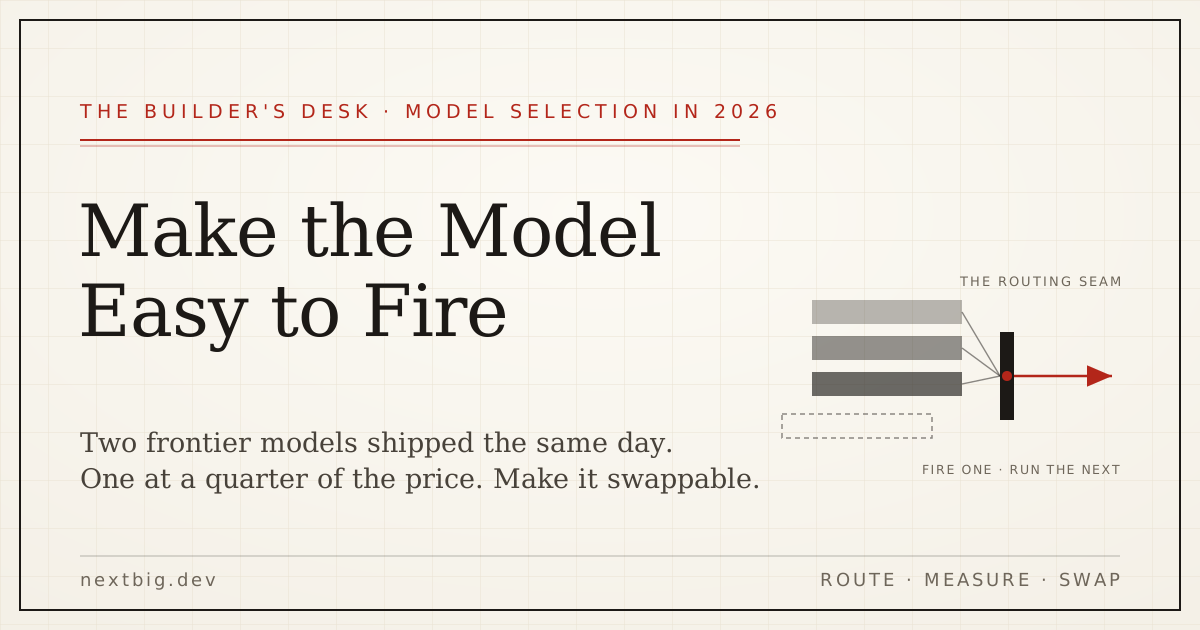
What you actually build to last is the seam around the model. One interface every call passes through, one eval set that decides whether a model is good enough, one meter that logs what each call cost and how long it took, and one fallback for when the primary is down. Get those four right and the model becomes what it always should have been: a dependency you can swap, priced by the task at hand.
Treat the model like a contractor you can swap for a better one next quarter. Build the interview once, and every rehire is a config change.
Grant the counter-case, because portability is not free and anyone who says otherwise is selling a framework. Prompts do not transfer cleanly between models. Each one has its own tool-calling dialect, its own long-context behavior, its own list of things it will and will not refuse. And the very top of the market holds real, sticky capability gaps you cannot cheap your way around. The reason a government office asked to gate the strongest trim of GPT-5.6 was that its hardest capabilities are genuinely difficult to reproduce. If your product is that top-end reasoning task, you may be tied to one model for good reasons.
Here is the distinction that makes the whole thing work. Most production calls are not the hardest task. The bulk of the tokens a real product burns go to classification, extraction, routing, summarizing, reformatting, and first drafts, and those run fine on a mid-tier or even a local model at a fraction of frontier prices. The skill in 2026 is knowing which of your calls actually need the smartest model, and routing the rest somewhere cheaper.
Route by task, not by loyalty
Stop asking which model is best and start asking which model is enough for this specific call. Here is how the traffic sorts, cheapest tier that clears the bar for each job.
| The call | Route to | Why |
|---|---|---|
| Classify, extract, route, tag | Cheapest capable | High volume, low ambiguity, correctness you can measure. Frontier prices here are pure waste. A cheap or local model clears it. |
| Summarize, first-draft, reformat | Mid-tier + verify | Quality matters but is checkable. A cheap model plus a cheap validation step beats a frontier one-shot on cost-per-resolved-task. |
| Hard reasoning, agents, code | Frontier | Real capability gaps, and a wrong answer is expensive. Pay up here, then measure whether the gap is worth it call by call. |
| Untrusted input plus real credentials | Best model, tightest scope | A smarter model does not stop a prompt injection. Scope the token and gate the action, whatever model you pick. |
| Private, regulated, latency-fixed | Local / open | When data cannot leave the building or cost and latency must be pinned, run an open model yourself. |
Two rules make the table work in practice.
First, measure cost-per-resolved-task, not cost-per-token. A model at a dollar per million tokens that kicks thirty percent of its work back to a human can cost more, once you add the cleanup, than one at five dollars that kicks back three. Count the retries, the escalations, and the cleanup, then divide by the tasks that actually came out right. The token price is the sticker. The resolution cost is what you pay.
The cheapest model is the one that clears the task on the first try. Sticker price rarely tells you which one that is.
Second, you cannot swap what you cannot measure, so build the eval set before you optimize anything. Fifty to two hundred real cases pulled from your own traffic, each with a known-good answer and an automatic scorer, is the single artifact that turns model choice from a leap of faith into a config change. It is why I can move the model behind this publication's briefing in an afternoon. Every generated piece is scored against a rubric before it ships, so a new model either clears the bar or it does not, and I never have to trust a launch-day chart to find out.
Which points at the last discipline: never price a model in its first month. Launch prices are introductory and launch benchmarks are chosen to flatter. Run the new release against your golden set, in your product, on your traffic, and move production only when your own numbers say so.
The tax I'm paying to keep it swappable
Fair is fair. Making the model easy to fire has a cost, and the cost is abstraction. A perfectly generic interface that speaks only the lowest common denominator throws away the best parts of the best models. Native tool use, prompt caching that cuts the cost of repeated context, structured outputs, computer use: the model-specific features are often the whole reason to pay for the model in the first place. Over-abstract and you hand back in lost capability everything you saved in portability, and you have built a worse product that happens to be easy to swap between.
The answer is a thin seam rather than a heavy framework. Normalize the eighty percent that every model shares: messages in, text or JSON out, a cost and a latency number logged on the way through. Then leave a clean escape hatch for the twenty percent where a specific model's specific feature earns its keep. The goal is the smallest interface that lets you change your mind, and nothing heavier. The failure mode on the far side, a giant orchestration layer bolted on before you own a second model to justify it, is its own lock-in, just to a framework instead of a vendor.
And the honest concession holds: if your product is the hardest reasoning task in the market, the top model's lead is real, and single-vendor may be the right answer. Just make that a decision you took on the evidence, with the seam still in place, rather than a default you backed into because switching felt like work.
The seven-line version
The thesis, made into a checklist you can start on Monday.
- Put every model call behind one interface. Messages in, text or JSON out, cost and latency logged on every call.
- Build a golden eval set before you tune anything. Fifty to two hundred real cases, known-good outputs, an automatic scorer.
- Price the finished task. Count retries, escalations, and human fixes, then divide by the tasks that came out right.
- Tier your traffic. Cheapest capable model for the high-volume easy calls, frontier reserved for the ones where a wrong answer is expensive.
- Wire a fallback behind the same interface. A second vendor or a local model, tripped automatically on error, timeout, or rate limit.
- Re-bench monthly, re-price quarterly. Run the golden set against every notable release, and move production only after your numbers move first.
- Lock down the credentials. Any call that reads untrusted input runs with least privilege, because a better model does not stop a prompt injection. We walked through exactly how that goes wrong the day before this ran.
Our Call
By July 9, 2027, at least two broadly available models that benchmark within roughly ten percent of the frontier on public evaluations will sell output tokens at or below five dollars per million. The steep frontier price, the twenty-five to thirty dollars that Opus 4.7 and GPT-5.6 Sol charge today, survives only at the very top trim, and Opus-class capability becomes something you rent for the price of a mid-tier model. The consequence for anyone building: model choice collapses into a routing-and-cost decision for all but the hardest work, and a team hard-wired to one vendor is simply overpaying.
The case: capability is converging and compute is deflating at the same time. Two labs shipped comparable models on one afternoon this month, one of them priced explicitly to reset the market. Every hyperscaler is now making its own good-enough silicon, which pulls the cost of inference down underneath all of them, and open models handed out for free set a floor that keeps dropping. When capability stops being scarce and compute keeps getting cheaper, price is the only axis left to compete on, and it moves one way.
What proves us wrong: if by July 2027 frontier-tier output still clusters at fifteen to thirty dollars per million tokens and no broadly available Opus-class model sells output below five, then capability stayed scarce enough to hold its price. The convergence this month was a head-fake, and single-vendor lock-in was the correct call after all. The live counter-signal is the government gate itself. If the strongest models keep getting held back by clearance, scarcity at the top could hold the price line longer than market pressure erodes it.
Settles: July 9, 2027, against published API price sheets.
Frequently asked questions
Which AI model should I use in 2026?
Not a single one. Route by task. Send the high-volume, low-ambiguity work (classification, extraction, routing, first drafts) to the cheapest model that clears your quality bar, and reserve a frontier model for the calls where a wrong answer is expensive: hard reasoning, agentic tool use, and code. The models leapfrog monthly and cut prices quarterly, so the durable move is to build one interface, one eval set, and one fallback, and swap whichever model you chose in an afternoon.
Is Grok 4.5 as good as Claude Opus?
xAI describes Grok 4.5 as "Opus-class, but faster, more token-efficient" and "roughly comparable to Opus 4.7," priced at $2 per million input tokens and $6 output against Opus 4.7's $5 and $25, while conceding it trails the very top models on benchmarks. The honest read: close enough that the price difference wins for most production work, and short enough of the top that you should not trust it blind on your hardest reasoning. Test it on your own golden set of real cases before you route production traffic to it, because a launch-day benchmark is marketing, and your own workload is the only test that counts.
How do I reduce LLM API costs without losing quality?
Measure cost-per-resolved-task instead of cost-per-token, then tier your traffic. Most of the tokens a real product burns go to easy, checkable work that runs fine on a mid-tier or local model at a fraction of frontier prices; send only the genuinely hard calls to the expensive model. Add a cheap verification step instead of a frontier one-shot, cache repeated context, and re-price quarterly as the market drops. A model at $1 per million tokens that escalates 30 percent of its work to a human can cost more, once you add the cleanup, than one at $5 that escalates 3 percent.
Should I fine-tune a model or route between models?
Default to routing. Fine-tuning locks you to one base model and a portability tax right as the frontier leapfrogs it, and a swap becomes a retrain. It earns its place only for a narrow, stable, high-volume task where a small tuned model genuinely beats a big general one on cost-per-resolved-task, and you should prove that on evals before you commit. For everything else, a good prompt behind a swappable interface keeps your options open and your costs falling with the market.
GPT-5.6 vs Grok 4.5 vs Claude: which is cheapest?
On published output-token prices as of July 2026: GPT-5.6 Luna and Grok 4.5 are $6 per million, GPT-5.6 Terra is $15, Claude Opus 4.7 is $25, and GPT-5.6 Sol is $30. But the cheapest token rarely makes the cheapest finished task. A model that needs retries or human cleanup on your specific workload can cost more all-in than a pricier model that gets it right the first time. The number that decides it is cost-per-resolved-task, measured on your own evaluation set with your real traffic.
References and research base
This piece draws on the model launches of the week of July 6, 2026, on published API pricing as of that week, and on the systems this publication runs in production. Prices move fast and are dated to when they were read. The routing framework and Our Call are this desk's thesis rather than reported fact.
- Model launches and pricing. OpenAI's GPT-5.6 (Sol, Terra, Luna) general availability and the twelve-day government-gated preview, July 9, 2026, reported by The Verge and VentureBeat and corroborated by OpenAI's own pages; trim pricing at $5/$30, $2.50/$15, and $1/$6 per million input and output tokens. Grok 4.5 from xAI, released July 8 and public July 9, 2026, at $2/$6 against Claude Opus 4.7's $5/$25, with Musk's "Opus-class, but faster, more token-efficient" claim and its own concession that it trails the top benchmarks, per TechCrunch. We covered the launches in our July 9 briefing.
- Compute deflation, memory inflation. TechCrunch, "Nvidia is a victim of the compute marketplace it created," July 9, 2026: H100 spot rates off a spring peak near $3.20 an hour, Nvidia's stock down about 15 percent since May, DRAM up roughly tenfold in a year. The reason inference keeps getting cheaper as custom silicon spreads.
- The open and local floor. Ollama's $65 million raise and roughly 9 million users, TechCrunch, July 9, 2026: a free, self-hosted tier setting a price floor under the paid market.
- Firsthand systems and prior reporting. This publication's own multi-model pipeline, which scores, writes, illustrates, and voices across four vendors with an automatic speech fallback, and our prior essay The Best AI Investment Doesn't Care Which Model Wins (July 5, 2026) on capability commoditizing while the scarcity moves off the model. The "never price a model in its first month" rule is house practice.
Source-quality note
The hard numbers here are API list prices and launch details from the week of July 6, 2026, and they will age faster than anything else on this page; re-check them against current price sheets before you act on them. The routing tiers, the cost-per-resolved-task method, and Our Call are this desk's framework and thesis, offered as judgment rather than reported fact. One input is deliberately soft: "within ten percent of the frontier" is a moving, contestable line, because public evals disagree and labs grade their own homework. Read the call as a claim about the direction and rough magnitude of price convergence, settled against the published price sheets on the date named.