Washington pulls two Anthropic models offline by federal order
US Commerce orders Anthropic to disable Fable 5 and Mythos 5 for all customers by federal letter, the first frontier model pulled offline by directive.
At 5:21 Friday evening, the federal government ordered Anthropic to disable two deployed models, and the only way to comply was to pull Fable 5 and Mythos 5 for every customer on Earth.
It's Saturday, June 13, 2026. Here's the rundown. After the shutdown we've got phones turned into compute, fifteen hundred poisoned Arch packages, GLM 5.2 landing right on cue, and the tape.
The order came from Commerce Secretary Lutnick under national security export authorities. It bars export, re-export, or domestic transfer of either model to any foreign national — including Anthropic's own foreign-national employees, inside the US.
Which is the whole trick. If you can't even let your own engineers touch it, there's no partial compliance — you flip the switch off for everyone. That's why a paying US customer woke up to a dark endpoint.
Mythos 5 is the high-capability cyber model. Fable 5 was last week's general-use, safeguarded build of the same capability. The trigger, per Anthropic, was a jailbreak that routes around Fable 5's guardrails.
And here's where our briefing gets spicy — Anthropic isn't contesting the order, but it's flatly contesting the facts. It says the demo surfaced a few previously known, minor vulnerabilities, and that other public models find the exact same ones.
The evidence so far is verbal. Essentially: ask the model to read a codebase and patch flaws. And the WSJ reports Amazon's CEO talked to officials before the crackdown.
That detail wrecks the clean national-security story. Amazon is Anthropic's biggest backer and its Bedrock channel. So the company that distributes the model may have helped get it shut off. That's not security policy, that's something murkier.
For builders the takeaway is concrete: if you served either model through the API or Bedrock, you have a production outage with no migration window. The desk's call is route to Claude's remaining models today, or to an open weight you run yourself.
The deeper lesson — closed-API capability now carries regulatory tail risk that no SLA covers. A model can be legal at lunch and dark by dinner, by letter, with no appeal before the switch flips. If you can't lose a capability for a week, you need a documented second provider. Not someday. This week.
And the structural shift in our briefing: export control used to hit chips and weights crossing borders. This hit a running endpoint serving US customers. Expect more directives naming specific deployed models.
Expect labs to pre-segment the dangerous cyber models behind license walls instead of shipping general-use builds that get jailbroken back into them. Which, conveniently, is exactly what that anonymous open-source manifesto trending the same day is screaming about.
On infrastructure — Google Research wants to turn retired smartphones into a distributed compute cluster, salvaging working SoCs and batteries that would otherwise be e-waste.
It's carbon arbitrage. Silicon that's already manufactured beats new datacenter capacity when embodied carbon dominates. Not an accelerator replacement — but for latency-tolerant batch jobs at the edge, idle phones are free emissions you already paid for.
And the number that matters this week: an RTX 5080 paired with a 3090 runs Qwen 3.6 27B at Q8 and over 80 tokens a second. Roughly two thousand dollars of mixed-generation hardware.
That's production-grade single-user throughput on your own desk. The day a federal letter can dark your provider, keeping a capable local model warm stops being a hobby and starts being a continuity plan.
Security desk: the Atomic Arch campaign poisoned AUR packages — started Thursday at 400, climbed past fifteen hundred, one list puts it at 1,579 before Arch addressed the affected commits.
Attackers adopted orphaned packages and modified PKGBUILDs that yay and paru run at install — dropping a rootkit and an infostealer hunting tokens and SSH keys. Official repos were never touched. But if your CI runs on Arch images that pull the AUR, you may have shipped poisoned artifacts downstream.
Separately, a research dump details twenty-one zero-days in FFmpeg — the codec library buried under most media pipelines and a quiet dependency in AI ingestion stacks.
If you decode untrusted video or audio through FFmpeg, that's a sandbox-and-patch weekend, not a Monday item. The decode layer is the part nobody audits and everybody runs.
On models — GLM 5.2 shipped from Zhipu, the latest open-weight frontier-class build from a Chinese lab.
Right on schedule. With controls now reaching deployed endpoints, the GLM and Qwen line is where self-hostable capability increasingly lives. Benchmark it against your closed default now — before you're forced to, on a Friday night.
On the dev bench — Andrew Ng's aisuite gives one OpenAI-style interface across many providers, so swapping a backend is a config change, not a rewrite.
Provider abstraction stopped being a nice-to-have the moment a letter could disable your model overnight. That layer is what turns a forced migration into a one-line edit. Wire it this week.
Also landing: a pair of writeups on running a local coding agent on macOS cheaply, and Paca — a stripped-down Jira alternative where coding agents are first-class participants, not bolt-ons.
Same direction every time: keep the inference loop on hardware you control for the bulk of the work, reserve paid frontier calls for the hard parts. Chatwoot's also climbing again as the open-source Intercom — your conversations stay out of a vendor's database.
One for the capital desk: the TensorZero repo went read-only on June 12 — about eleven thousand stars, Apache-2.0.
The headline frames it as a flameout after a 7.3 million seed — but that round was announced last August, there's no shutdown post, and the docs are still live. Acquisition, rename, relicense, wind-down — treat the why as open. The owner archive leaves it forkable, which is the only reassuring part.
The tape. Long Alphabet, medium conviction — the federal kill switch converts single-provider risk into a procurement story, and Gemini Enterprise is compounding near 40 percent quarter on quarter on a multi-model Vertex marketplace.
Watch Amazon, medium — its CEO reportedly triggered the action against its largest investee weeks before Anthropic's targeted October listing. Q1 booked 16.8 billion pre-tax from that position, including a 12.3 billion non-cash revaluation. And watch Anthropic itself into that IPO window.
Highest conviction is the Alphabet long. The falsifier: Google Cloud growth decelerating below 30 percent year on year in the Q2 print, or no Gemini Enterprise acceleration cited. That settles by August 31.
We're also watching Alibaba at low conviction — over half of open-weight download share, but mindshare isn't revenue, and a US export mood makes Chinese weights a poor fit for the regulated workloads driving diversification.
The tape is the desk's scorecard, not advice.
Quick hits. A Trump order bars the Census Bureau and BEA from using statistical noise — experts say 2030 redistricting data plans must be completely redesigned.
The EFF warns H.R. 6028 would rush a disastrous overhaul of the US Copyright Office.
Apple migrated its TrueType hinting interpreter to Swift, and Renault detailed an electric motor that uses no rare earths.
A pancreatic tumour treatment may have revealed a cancer master switch, and areweguiyet surveys the state of building user interfaces in Rust.
And IEEE Spectrum argues the computer science degree isn't dead — file under skeptical, alongside one read on the shutdown titled simply, there is a shadow hanging over this Fable thing.
Our call: Fable 5, the safeguarded build, comes back online for customers within 60 days, while Mythos 5 stays dark under license — because Anthropic isn't fighting the order, it's building a record to fight the facts.
Proves us wrong if Fable 5 is still fully disabled for all customers on August 13, 2026 — that's when it settles.
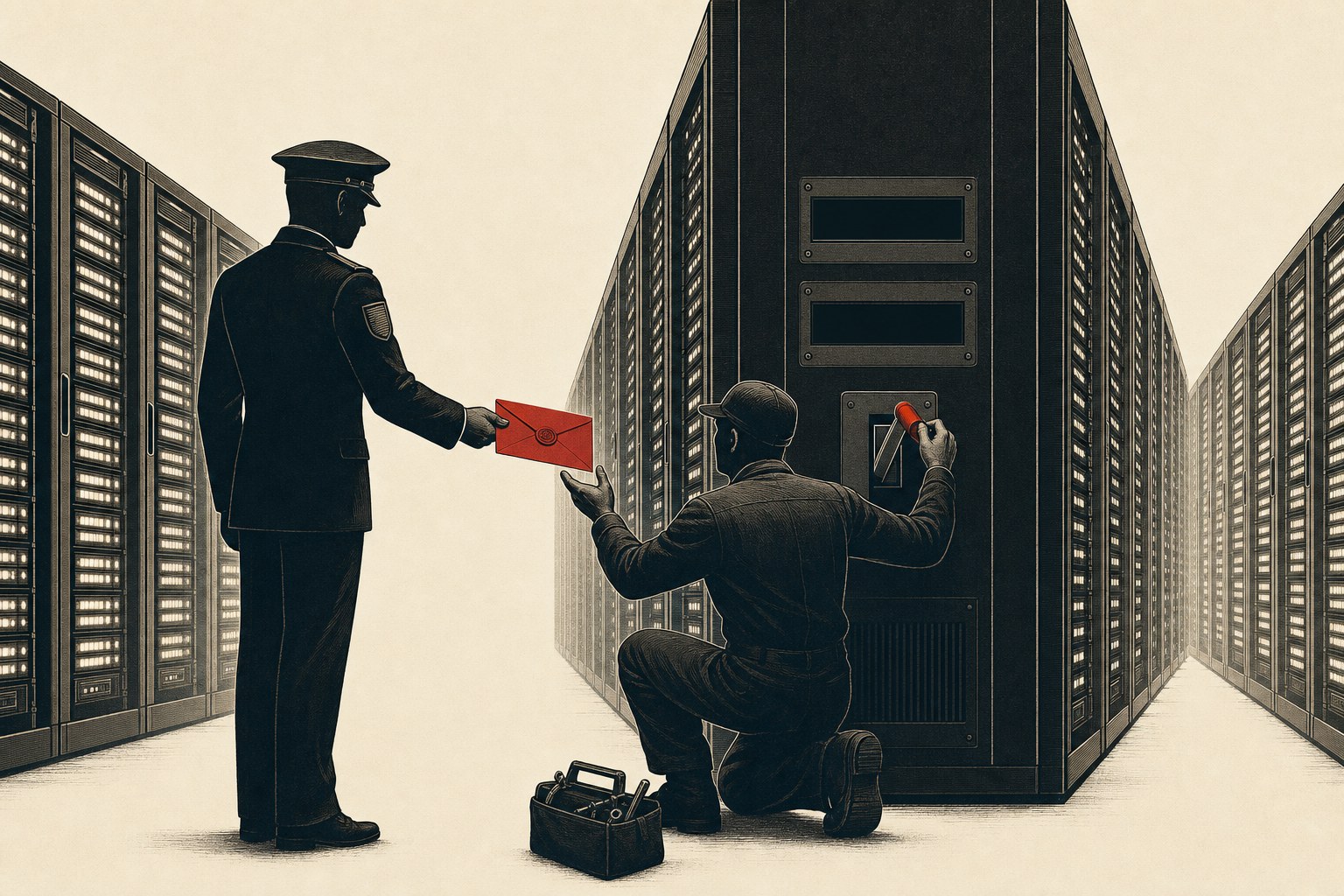
At 5:21pm ET on Friday, Anthropic received an export-control directive from Commerce Secretary Howard Lutnick suspending all access to Fable 5 and Mythos 5. The order, issued under national security authorities, bars export, re-export, or domestic transfer of the two models to any foreign national — inside or outside the US, including Anthropic's own foreign-national employees. The only way to comply was to disable both models for every customer. All other Anthropic models stay online.
This is the first time a leading lab has yanked a publicly deployed model under direct federal order. Mythos 5 is the high-capability cyber model; Fable 5 was last week's general-use, safeguarded build of the same capability. The trigger, per Anthropic, was government awareness of a jailbreak that routes around Fable 5's guardrails. Anthropic disputes the severity in plain terms: it reviewed a demonstration of the technique, found it surfaced a small number of previously known, minor vulnerabilities, and confirmed other publicly available models find the same ones. To date the evidence has been verbal — essentially asking the model to read a codebase and patch flaws. The WSJ reports Amazon CEO talks with US officials helped trigger the crackdown, which complicates the clean national-security framing.
If you built on either model, you have a production outage with no migration window. Anyone serving Mythos 5 or Fable 5 through Anthropic's API or Bedrock needs a fallback today: route to Claude's remaining models, or to an open-weight option you can run yourself. The lesson for anyone with a frontier model in the critical path is that closed-API capability now carries regulatory tail risk that no SLA covers — a model can be legal Friday afternoon and dark Friday evening, by letter, with no appeal before the switch flips. Build a documented second provider for any capability you cannot afford to lose for a week.
The signal for the next 6-12 months: capability and export control have collided at the deployment layer, not the training layer. Until now the controls hit chips and weights crossing borders. This hits a running endpoint serving paying US customers. Expect more directives naming specific deployed models, and expect labs to pre-segment high-capability cyber models behind license walls rather than ship general-use versions that can be jailbroken back into them. That is precisely the dynamic the anonymous "Open source AI must win" manifesto trending the same day is reacting to: when a few closed APIs hold the capability, a government letter is a single point of failure.
Watch what Anthropic does next. It is not contesting the order, but it is openly contesting the facts behind it — which suggests the company expects to argue Fable 5 back into service once the evidence is examined.
Google turns retired phones into a low-carbon compute cluster
Google Research proposes reusing decommissioned smartphones as a distributed computing platform, salvaging working SoCs and batteries that would otherwise be e-waste. The pitch is carbon arbitrage: idle silicon already manufactured beats new datacenter capacity for latency-tolerant, low-intensity workloads. Not a replacement for accelerators, but a real angle for edge and batch jobs where embodied carbon dominates the footprint.
Two consumer GPUs hit 80 tok/s on a 27B model at Q8
An RTX 5080 paired with an RTX 3090 runs Qwen 3.6 27B at Q8 and 80+ tokens/sec. That is production-grade single-user throughput on roughly $2k of mixed-generation hardware, no datacenter card required. With Anthropic models getting pulled by federal letter the same week, the case for keeping a capable local model warm on your own silicon just got more concrete.
Arch AUR malware contained at 1,579 packages — official repos untouched
The "Atomic Arch" campaign started Thursday at 400 compromised AUR packages and climbed past 1,500 before Arch believed all affected commits were addressed; one cited list puts it at 1,579. Attackers adopted orphaned packages and modified PKGBUILDs that yay and paru execute at install, dropping a rootkit and infostealer hunting credentials, tokens, and SSH keys. Official [core], [extra], and [multilib] were never touched — but CI runners on Arch images that pull from the AUR may have shipped poisoned artifacts downstream.
21 zero-days disclosed in FFmpeg
A research dump details twenty-one zero-day vulnerabilities in FFmpeg, the codec library buried under most media pipelines and a quiet dependency in countless AI ingestion stacks that decode video and audio. If you process untrusted media through FFmpeg, this is a sandbox-and-patch weekend, not a Monday item.
Amazon CEO's talks with officials helped trigger the Anthropic crackdown
The WSJ reports Amazon CEO discussions with US officials preceded the export-control directive that shut down Fable 5 and Mythos 5. Amazon is Anthropic's largest backer and its Bedrock distribution channel, which makes the reporting awkward and the national-security framing murkier. Read alongside Anthropic's own statement disputing the jailbreak evidence.
"Open source AI must win" manifesto rides the shutdown to the front page
An unsigned single-page position statement argues AI is civilizational infrastructure and access must not depend on closed APIs, shifting terms, or prices set by a handful of companies — warning against "a subscription economy for cognition." No author, no signatories, no data; it is an argument, not a release. Its timing on the same day as the Anthropic shutdown is the whole point: a federal letter just demonstrated the failure mode it describes.
GLM 5.2 ships
Zhipu's GLM 5.2 is out, the latest open-weight frontier-class model from a Chinese lab. With US export controls now reaching deployed endpoints, open-weight models you can self-host are the obvious hedge — and the GLM/Qwen line is where that capability increasingly lives. Benchmark it against your current closed default before you need to.
Andrew Ng's aisuite gives one interface to many model providers
aisuite offers a unified, OpenAI-style interface across multiple generative AI providers, so swapping backends is a config change rather than a rewrite. Provider abstraction stopped being a nice-to-have the moment a government letter could disable your model overnight — this is the kind of layer that turns a forced migration into a one-line edit.
Running a local coding agent on macOS, and doing it cheaply
Two practical writeups landed together: a step-by-step for setting up a local coding agent on macOS, and a guide to AI coding at home without burning cash on API bills. Both point the same direction — keeping the inference loop on your own hardware for the bulk of agentic work and reserving paid frontier calls for the hard parts.
Paca: a lightweight Jira alternative built for human-AI collaboration
Paca pitches itself as a stripped-down issue tracker designed for teams where coding agents are first-class participants, not bolt-ons. Worth a look if you are wiring agents into your workflow and find heavyweight project tools fight the loop more than they help.
Chatwoot keeps climbing as the open-source Intercom alternative
Chatwoot — open-source live chat, email, and omni-channel support desk positioned against Intercom, Zendesk, and Salesforce Service Cloud — is trending again on GitHub. The self-hosted support stack is a steady win for teams that don't want customer conversations living in a vendor's database.
TensorZero archives its repo — cause unconfirmed
The TensorZero GitHub repo (~11,285 stars, Apache-2.0) went read-only on June 12. The headline frames it as a flameout after a $7.3M seed, but that round was announced in August 2025 and no shutdown post exists — the blog, docs, and CEO's site are still pitching the product. The LLMOps gateway claimed sub-1ms p99 and ~1% of global LLM API spend; an owner archive leaves it forkable. Treat the why — acquisition, rename, relicense, or wind-down — as open.
Closed-API capability now carries regulatory tail risk: a model legal at lunch can be dark by dinner, with no appeal. If you have a frontier model in your critical path, wire a provider-abstraction layer like aisuite this week, benchmark an open-weight fallback (GLM 5.2 or Qwen) you can self-host, and confirm it runs on hardware you control — two consumer GPUs already do 80 tok/s on a 27B model.
Fable 5 — the safeguarded general-use model — comes back online for customers within 60 days, while Mythos 5 stays dark under license.
Anthropic is not contesting the order but is openly contesting the facts, saying the jailbreak surfaces only minor, already-known vulnerabilities that other public models also find. That is a company building a record to argue the safeguarded build back into service. The consensus read treats a federal shutdown as permanent; it is missing that the evidence so far is verbal and narrow.
Fable 5 remains fully disabled for all customers on August 13, 2026.
Fable 5 returned globally on July 1, nineteen days into the sixty-day window, after US export controls lifted and Anthropic shipped a new cybersecurity classifier. Mythos 5 stayed restricted to vetted institutions.
The federal kill switch on Fable 5 and Mythos 5 converts Anthropic's launch trust wobble into demonstrated regulatory tail risk for single-provider closed APIs, and Gemini Enterprise — compounding near 40% QoQ on a multi-model Vertex marketplace — is the procurement beneficiary. Updated from the 06-12 long: what changed is the failure mode went from silent fallback to a government de-deployment wi
Anthropic disabled both models for every customer Friday at 5:21pm ET after an export-control directive; Friday's close predated it and Saturday's Amazon disclosure, so Monday is the first repricing. The consensus reads this as Anthropic-specific, but the operational lesson enterprises take is provider abstraction, which favors hyperscaler model marketplaces that sit many models behind one API. Alphabet also holds roughly 14% of Anthropic, so it shares the mark exposure while owning the cleaner distribution upside.
Amazon's CEO reportedly triggered the federal action against Anthropic — its largest investee — weeks before Anthropic's targeted October NASDAQ listing, putting a regulatory haircut on the very asset that flattered Amazon's earnings. Q1 2026 booked $16.8B pre-tax from the Anthropic position, including a $12.3B non-cash revaluation; that quality-of-earnings line now carries fresh IPO-mark risk.
WSJ, The Information and Reuters report Jassy flagged Fable 5 cyber risk to Trump officials, setting the export controls in motion. Amazon's stake is marked in the mid-to-high teens of a $965B valuation, implying roughly $135-160B on paper against an $8B cost base. The market reads Amazon's beats as operational; a disputed, competitor-driven directive that dents Anthropic's IPO price would reverse part of that paper gain and invite governance scrutiny.
The first federal de-deployment of a live frontier model lands six weeks before a targeted October NASDAQ IPO at a $965B mark and $47B run rate. Updated from the 06-12 watch: the trust problem escalated from a 2x-Opus pricing-and-silent-fallback issue to demonstrated, no-appeal regulatory risk that any underwriter must now price into the float.
Anthropic disputes the severity — minor, previously known vulnerabilities other public models surface too — but compliance forced a global shutdown of its best-coding models, and a co-investor's lobbying appears to have driven it. That combination, capability leadership plus single-directive fragility, is precisely the overhang public-market AI buyers underwrite. The capability still wins benchmarks; the deployment durability does not.
The wire's one-way read — open source must win, self-host a Qwen fallback — points at Alibaba, which holds over 50% of open-weight download share. The fade: the tailwind is mindshare, not revenue, and a US export-control and copyright-overhaul mood makes Chinese weights a poor fit for the exact regulated, security-sensitive workloads driving the diversification.
The briefing names Qwen as the self-host fallback, and GLM 5.2 shipped the same day, so open-weight mindshare is real. But Alibaba has already closed its flagship Max tier and monetizes through DashScope and Alibaba Cloud, not the open weights, and US enterprises de-risking from a federal kill switch will not standardize critical paths on a Chinese provider. The crowded long here is an instrument mismatch, not a thesis.