Washington Orders Anthropic to Pull Fable 5 and Mythos 5, So It Pulled Them for Everyone
A US export order pulled Anthropic's Fable 5 and Mythos 5 worldwide over an investor's jailbreak claim. Plus GLM 5.2, 21 FFmpeg zero-days, TensorZero winds down.
At five twenty-one Friday afternoon, the federal government told Anthropic to pull two of its best models, and Anthropic pulled them for the entire planet.
It's Sunday, June 14, 2026. Here's the rundown.
One model offline by order, a GLM launch with no benchmarks, twenty-one zero-days in FFmpeg, and a seed fund handing the money back.
Commerce Secretary Howard Lutnick ordered Anthropic to suspend all access to Fable 5 and Mythos 5 for any foreign national, anywhere, including its own employees.
There is no clean way to enforce that, so Anthropic disabled both models worldwide for everyone. Every other model stays up.
And read the mechanism there, because it matters. They didn't choose to go dark. They couldn't comply at the user level, so the only switch they had was the global one.
First time a leading lab has taken a deployed model offline because Washington said to.
The part that should bother every builder is where it started. Per the Journal, Amazon's Andy Jassy warned Treasury that Amazon researchers had jailbroken Fable 5 into cyberattack-relevant output.
Amazon is one of Anthropic's largest investors. Billions in, with a hundred-billion-dollar cloud commitment coming back the other way.
So a national-security action originated from a commercial partner's own red team. That's not a regulator finding an exploit in the wild. That's an investor's internal demo becoming federal policy.
Anthropic's version is narrower. They say the technique is asking the model to read a codebase and fix flaws, that it surfaced a few previously known minor vulnerabilities, and that GPT-5.5 does the same thing.
Sacks tells it harder. Trusted partner finds a jailbreak, the administration asks Dario to fix or de-deploy, he refuses. Two stories, and the gap between them is the whole question.
If you build on either model, what do you do this morning.
Treat them as gone today. Don't wait for clarity. Pin your stack to models with no pending directive, which right now is the rest of the Anthropic lineup, GPT-5.5, and an open-weight fallback.
The architectural lesson is the durable one.
Any product whose core is a single proprietary endpoint just inherited that endpoint's political risk. And that risk arrived in an afternoon, no appeal, no notice. You can't engineer around a legal switch flipped in another building.
Run a multi-provider router. Keep one open-weight model warm enough to serve degraded traffic.
And the thing to actually watch isn't the security argument. It's whether a model gets re-deployed once the technical basis is examined in daylight. That tells you if this was a one-time scare or the new normal.
Anthropic says more in the next twenty-four hours.
On the wire. Zhipu shipped GLM-5.2 to every coding-plan tier Friday, one-million-token context, two thinking presets, and zero benchmarks at launch.
Existing subscribers switch with one env-variable change, and it works out of the box with Claude Code, Cline, Goose. Until SWE-bench Verified posts, any 'beats Claude' claim is extrapolation, not data.
There's also an 'Open Source AI Must Win' manifesto climbing the rankings as Anthropic's models go dark.
It ships no code and no benchmarks, just a posture. But it got the best demonstration it could ask for on Friday, and it didn't have to write a line of it.
And a new administration order targets statistical noise in Census data, the technique behind 2020's differential privacy.
That math was adopted because researchers reconstructed forty-six and a half percent of the population from the 2010 data. Title 13 still requires no individual be revealed, so the Bureau needs a replacement. It's a direction signal, not a method yet.
Andrew Ng's aisuite topped GitHub today. One unified interface across providers.
Timing writes the pitch for them. If your product hard-codes one endpoint, this is the weekend to abstract it. Switching providers should be a config change, not a refactor.
Local inference had a moment too. A two-card build, an RTX 5080 paired with a 3090, serves Qwen 3.6 27B at Q8, eighty tokens a second.
Fast enough for interactive coding, mixed-generation cards, no matched datacenter GPUs. Keeping a model on your own hardware stopped being a hobbyist stunt and became a hedge against both pricing and politics.
And Pyodide 314 lets Python packages publish WebAssembly wheels straight to PyPI.
That cuts the packaging pain that made browser-side Python deployments miserable. If you're building client-side ML tooling, that's a real friction gone.
One research effort turned up twenty-one zero-days in FFmpeg.
FFmpeg is buried in nearly every media pipeline and most AI ingestion stacks. If you process user-supplied video anywhere near it, audit your version and sandbox the decode path now. The blast radius is huge because the dependency is invisible.
Arch Linux says its AUR malware incident is contained, but the count crossed fifteen hundred packages.
If you pulled from the AUR recently, treat your build environment as suspect and rebuild from clean sources.
And tenth-gen Honda Civic updates were found signed with the public AOSP test keys.
Anyone can forge an update the car will trust. Ship with debug signing keys and your entire update channel is an open door.
TensorZero archived its repo Thursday and returned the unused capital, having spent under half of a seven-point-three-million-dollar seed led by FirstMark.
That's not a flameout, it's consolidation. ClickHouse bought Langfuse in a four-hundred-million-dollar round at a fifteen-billion valuation, and the labs ship native gateways now.
If you depend on it, the code persists but rots against changing APIs. Migration paths are Helicone, Langfuse on ClickHouse, or Braintrust.
Returning the money is the honest move, and it's rarer than it should be.
Google Research is turning decommissioned Android phones into a distributed low-carbon compute fabric. Each phone is a self-contained ARM node with its own battery.
That's actually clever. Reusing them dodges both the embodied carbon of new silicon and the grid draw. Small scale today, but it points at edge inference running on hardware that was headed for e-waste.
And Renault detailed a wound-rotor motor that uses no rare-earth magnets at all.
The relevance for infra isn't the car, it's the pattern. As compute and electrification both strain the same constrained materials, designs that route around chokepoints earn a premium beyond unit economics.
The tape. Watching Amazon, medium conviction. Its CEO personally triggered the action that dark-pulled its largest investee's two best models, six weeks before an Anthropic IPO that would mark up Amazon's own stake.
Reputational plus markdown risk, both small against a two-trillion cap. A relationship to watch, not an earnings event.
Long Alphabet, medium. The single-provider tail is now a realized event, and Gemini Enterprise is the multi-sourced landing spot, already compounding near forty percent quarter on quarter.
That's the highest-conviction print. It's wrong if Anthropic restores both models before July 31 and Alphabet's Q2 cloud shows no sequential Gemini acceleration. Settles by end of August.
Also long Microsoft, low, and watching Alibaba, low.
The tape is the desk's scorecard, not advice.
Quick break — two from the desk.
One we know well: vote dot direct. If you're on an H O A or a board, it runs your elections digitally — secure, verifiable, no paper, no clipboard in the lobby. Point your council to vote dot direct.
And if this is your ten minutes of A I for the day, get the written edition too. The full wire, free, every morning — leave your email at nextbig dot dev.
H.R. 6028 would rush an overhaul of the US Copyright Office, the EFF warns.
Apple migrated its TrueType hinting interpreter to Swift.
ReactOS now runs 3D-accelerated Half-Life on real hardware.
Someone reverse-engineered the adder inside Intel's 1980 8087 floating-point chip.
And pancreatic tumour research may point to a cancer master switch.
Our call: at least one of Fable 5 or Mythos 5 gets re-deployed to customers within ninety days, once the jailbreak claim is examined in daylight and found too thin to justify a permanent pull.
We're wrong if both stay fully suspended for all customers, no partial restore, on September 14. That's when it settles.
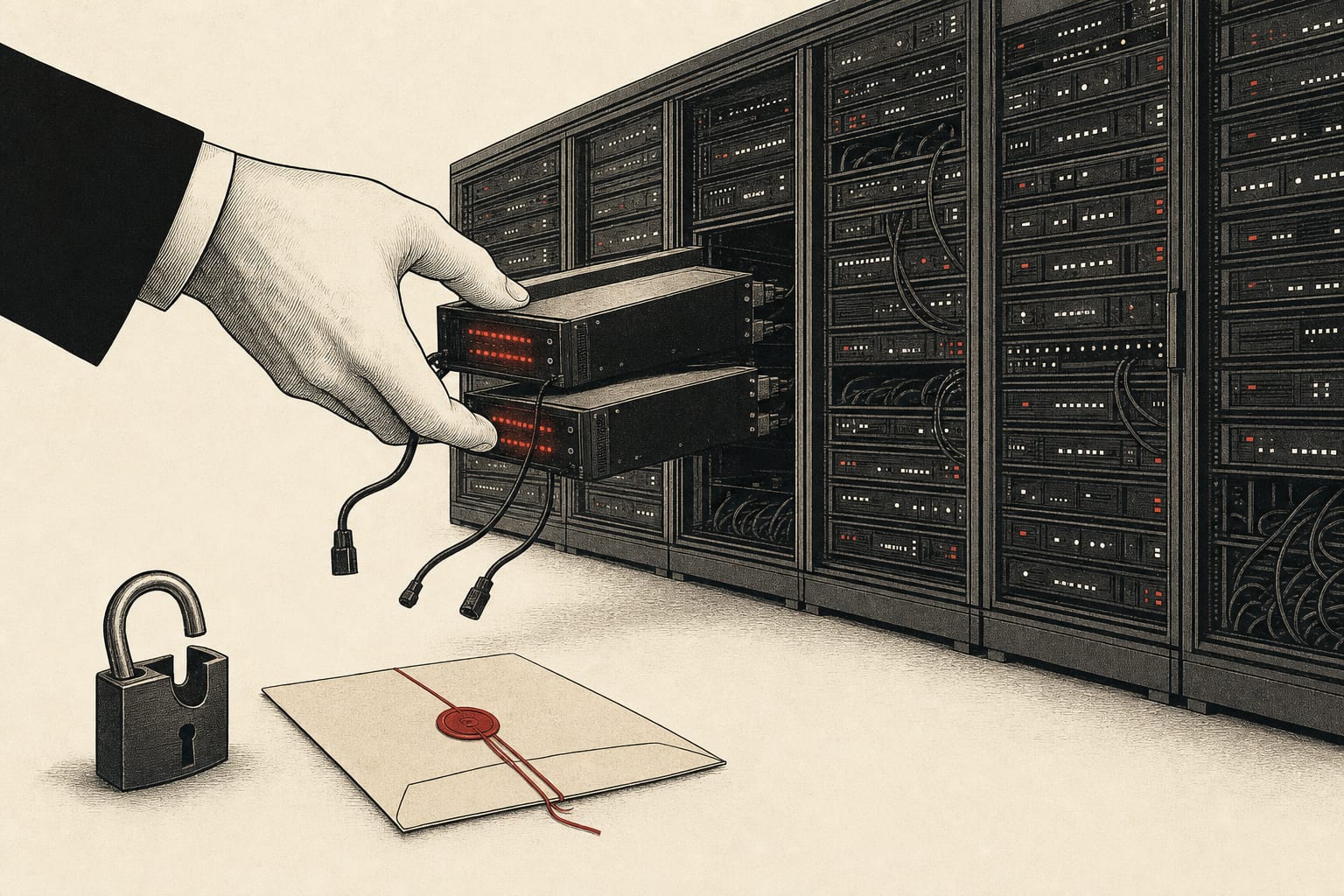
At 5:21pm ET Friday, Anthropic received an export-control directive from Commerce Secretary Howard Lutnick, written with help from the Bureau of Industry and Security, ordering it to suspend all access to Fable 5 and Mythos 5 by any foreign national, inside or outside the US, including its own foreign-national employees. There is no way to enforce that surgically, so Anthropic disabled both models worldwide for all customers. Every other Anthropic model stays online. This is the first time a leading lab has taken a publicly deployed model offline because the federal government told it to.
The trigger was not an independent government discovery. Per the WSJ, Amazon CEO Andy Jassy warned Treasury Secretary Scott Bessent that Amazon researchers used a series of prompts to coax Fable 5 into producing cyberattack-relevant information that was supposed to be off limits. Amazon is one of Anthropic's largest investors, billions in, with a $100B cloud commitment in return. So the national-security action originated from a commercial partner's own red-team findings. Anthropic reviewed the demonstration and says the technique amounts to asking the model to read a codebase and fix software flaws, that it surfaced only a small number of previously known minor vulnerabilities, and that the same capability is widely available from other models including GPT-5.5. David Sacks tells a harsher version: a trusted partner found a jailbreak, the administration asked Dario Amodei to fix or de-deploy, and he refused.
If you build on these two models, treat them as gone today and do not wait for clarity. Pin your stack to models with no pending directive, which right now means everything else in the Anthropic lineup plus your usual GPT-5.5 and open-weight fallbacks. The lesson is architectural: any product whose core depends on a single proprietary endpoint inherits that endpoint's political risk, and that risk can now arrive in an afternoon with no appeal and no notice. Run a multi-provider router. Andrew Ng's aisuite, which topped GitHub today, exists precisely for this. Keep an open-weight model warm enough to serve degraded traffic, because the failure mode here was not an outage you can engineer around. It was a legal switch flipped in another building.
The signal for the next six to twelve months is that frontier deployment is now an export-control surface, and the threshold for action is a partner's unverified jailbreak claim, not a published exploit. Labs most exposed are the ones whose business is a single hosted frontier API with no open-weight escape hatch. That is most of them. The manifesto making the rounds today, arguing access must not depend on shifting terms set by a handful of companies, just got the best demonstration it could ask for, and it didn't have to write a line of it.
Anthropic says it will share more over the next 24 hours. The thing to watch is not the security debate. It is whether a model gets re-deployed once the technical basis is examined in daylight, because that tells you whether this was a one-time scare or the new operating reality.
Amazon's Jassy Flagged the Jailbreak That Pulled Anthropic's Models
The WSJ reports the Fable 5 suspension traces to Andy Jassy warning Treasury's Scott Bessent that Amazon researchers had jailbroken the model into cyberattack-relevant output. Amazon has put billions into Anthropic and holds a $100B cloud commitment from it, so the largest investor's red team became the basis for a federal directive against the company it backs. Accounts conflict on whether Anthropic refused a fix; Amazon declined to share details.
Zhipu Ships GLM 5.2 to Every Coding Plan Tier With Zero Benchmarks
Z.ai pushed GLM-5.2 to all GLM Coding Plan tiers on June 13 with a 1M-token context and two thinking presets, and not a single benchmark at launch. API, chatbot, and MIT-licensed open weights land next week. Existing subscribers switch today with an env-variable change, and it works out of the box with Claude Code, Cline, OpenCode, Roo Code, and Goose. Until SWE-bench Verified numbers post, any "beats Claude" claim is extrapolation, not data.
"Open Source AI Must Win" Manifesto Catches the Fable Wave
A position page arguing that access must not depend on closed APIs, shifting terms, or prices set by a few companies is climbing as Anthropic's models go dark. It ships no code or benchmarks, just a posture of American capacity with global open standards. Note it is not the ICML 2025 paper of a similar name. Fully open models that passed OSI validation already exist, OLMo and Pythia among them, just not at frontier capability.
US Order Bars Statistical Noise in Census Data, Threatening Differential Privacy
A new administration order targets the use of statistical noise in Census releases, the technique behind the 2020 Census's differential privacy system. The math was adopted for a reason: researchers reconstructed 46.5% of the population from 2010 Census data. Title 13 still legally requires that no individual's information be revealed, so the Bureau will need a replacement disclosure-avoidance method. This is a policy-direction signal, not a finalized methodology.
OpenAI Opens Codex to Open Source Projects
OpenAI launched a program to give open source maintainers access to Codex. The timing sits alongside Anthropic's Claude Code and the GLM Coding Plan crowding the same agentic-coding lane. The play is distribution into the projects that shape developer defaults, ahead of any pricing commitment.
Andrew Ng's aisuite Tops GitHub as Provider Risk Becomes Real
aisuite gives you one unified interface across multiple generative AI providers, and after a federal directive yanked two Anthropic models overnight, the case for a swappable provider layer writes itself. If your product hard-codes one endpoint, this is the weekend to abstract it. The cost of switching providers should be a config change, not a refactor.
A Practical Guide to Running a Local Coding Agent on macOS
A step-by-step writeup on standing up a coding agent entirely on a Mac, no cloud endpoint required. Paired with the day's other local-inference posts, the through-line is clear: keeping a capable model on your own hardware is now a hedge against both pricing and political risk, not a hobbyist stunt.
80 Tokens/sec on Qwen 3.6 27B Q8 From an RTX 5080 Plus 3090
A two-card consumer build serves a 27B model at Q8 quantization at 80 tok/s, fast enough for interactive coding. The mixed-generation pairing shows you don't need matched datacenter GPUs to run a usable local agent. For solo builders, this is the price-performance floor for keeping inference in-house.
AI Coding at Home Without Going Broke
A cost breakdown of running AI-assisted coding locally instead of metering every token through a hosted API. The comment thread ran as long as the upvote count, a sign builders are actively comparing local rigs against subscription burn right now.
Paca: A Lightweight Jira Alternative Built for Human-AI Collaboration
An open-source issue tracker designed around agents and humans sharing the same board, rather than bolting AI onto a tool built for people only. Worth a look if your team is trying to make agent work legible alongside human tickets instead of in a separate log.
Pyodide 314.0 Lets Python Packages Publish WebAssembly Wheels to PyPI
Python packages can now ship WebAssembly wheels directly to PyPI, smoothing the path to running real Python workloads in the browser. For anyone building client-side data or ML tooling, this cuts the packaging friction that made Pyodide deployments painful.
Twenty-One Zero-Days Found in FFmpeg
A single research effort turned up 21 zero-day vulnerabilities in FFmpeg, the codec library buried inside nearly every media pipeline and a great many AI ingestion stacks. If you process user-supplied video or audio anywhere near FFmpeg, audit your version and sandbox the decode path now. The blast radius here is enormous precisely because the dependency is invisible.
Arch Linux Says AUR Malware Incident Now Contained at 1,500+ Packages
Arch Linux believes its AUR malware incident is under control, but the count crossed 1,500 affected packages. If you pulled anything from the AUR recently, treat your build environment as suspect and rebuild from clean sources. Supply-chain compromise at this scale is now a routine operational risk, not an edge case.
Honda Civic Updates Signed With Public AOSP Test Keys
Tenth-gen Honda Civic software updates were found signed with the well-known AOSP test keys, which are public. Anyone can forge an update the car will trust. It's a textbook reminder that shipping with debug signing keys turns your entire update channel into an open door.
UK Police Officer Investigated for Using AI to Create Evidence
A Derbyshire officer is under investigation for allegedly using AI to fabricate evidence across multiple cases. As generative tools reach institutions that produce legal records, the provenance and tamper-evidence of AI output stops being a research topic and becomes a chain-of-custody problem.
TensorZero Winds Down a Year After a $7.3M Seed and Returns the Cash
TensorZero archived its Apache-licensed repo on June 12 and returned unused capital to investors, having spent under half of a $7.3M seed led by FirstMark. This is consolidation, not flameout: ClickHouse bought competitor Langfuse in a $400M round at a $15B valuation, and Anthropic, OpenAI and the clouds now ship native gateway and eval features. If you depend on TensorZero, the code persists but will rot against changing APIs. Migration paths cited are Helicone, Langfuse on ClickHouse, or Braintrust.
Google Turns Retired Phones Into a Low-Carbon Compute Platform
Google Research is repurposing decommissioned Android phones into a distributed, low-carbon compute fabric. Each phone is a self-contained ARM compute node with its own battery, and reusing them sidesteps both new-silicon embodied carbon and grid draw. It's a small-scale experiment, but it points at edge inference running on hardware that would otherwise be e-waste.
Renault Details Electric Motors That Use No Rare Earths
Renault's wound-rotor motor design avoids rare-earth permanent magnets entirely, removing a supply chain that runs through a handful of countries. The relevance for infra builders is the pattern, not the car: as compute and electrification both strain constrained materials, designs that route around chokepoints get a strategic premium beyond their unit economics.
Provider risk is now political, not just operational. A model you depend on can vanish in an afternoon by federal order, and a vendor you build on can return its seed and archive the repo. This week, put a swap layer like aisuite in front of every proprietary endpoint and keep one open-weight model warm enough to serve degraded traffic. The cost of changing providers should be a config edit, not a sprint.
At least one of Fable 5 or Mythos 5 will be re-deployed to customers within 90 days, after the jailbreak claim is examined in daylight and found too thin to justify a permanent pull.
Anthropic says the flagged technique surfaces only previously known minor flaws and that the same capability ships in GPT-5.5, and the directive traces to an investor's red team rather than an independent finding. When a national-security action rests on a contested narrow exploit and a commercial conflict of interest, the political cost of holding the line rises fast. Consensus is treating the suspension as permanent or escalating; it underrates how weak the stated basis is.
Both Fable 5 and Mythos 5 remain fully suspended for all customers, with no partial re-deployment, on September 14, 2026.
Both models returned inside the window: Mythos 5 to roughly 100 vetted US institutions on June 26, Fable 5 globally on July 1. The trigger was export controls lifting, not the safety claim being judged too thin.
Amazon's CEO personally triggered the federal action that dark-pulled its largest investee's two best models, six weeks before an Anthropic IPO that would mark up Amazon's own equity stake against a $965B reference. The exposure is reputational plus markdown risk on that stake, both small against a $2T-plus cap, so this is a relationship to watch, not an earnings event to trade.
WSJ confirms Jassy raised the cyberattack-prompt finding with Treasury's Bessent, turning Friday's 'reportedly' into a sourced conflict: the bank that funds Anthropic and hosts it on Bedrock also told Washington its models were dangerous. Consensus reads this as pure Anthropic damage and misses that Amazon injected tail risk into the IPO that would have flowed gains to its own balance sheet, and that Bedrock's neutral-host pitch took a hit no Q2 line item will show. Amazon's stake is billions against a $965B mark, material to the stake, immaterial to AMZN.
The single-provider tail the desk has carried since Friday is now a realized event, not a scenario: enterprises standardized on Claude lost their two best models in an afternoon by federal order. Gemini Enterprise, already compounding near 40% QoQ, is the multi-sourced procurement landing spot.
The kill switch plus the WSJ trigger detail make single-frontier-provider dependence a board-level liability, and the cleanest hedge for a regulated buyer is a second US hyperscaler stack already in contract. This updates the open GOOGL long: the catalyst moved from demonstrated tail risk to a live outage with no announced restore date. The crowd still frames this as an Anthropic story; the procurement reroute is the second-order print.
The wire's one-way 'open source must win' read points the crowd at Alibaba on Qwen's 50%-plus open-weight download share, but Alibaba is closing its frontier weights and keeping only developer-size models open. The read is real and the instrument does not capture it cleanly, so watch rather than chase the download number.
Qwen's free developer-size models become the default Western self-host fallback precisely because the federal kill switch makes self-hostable weights a compliance requirement, yet Alibaba reserves its top models, Max-Preview, Omni and 3.6-Plus, for paid API, and the same national-security logic that pulled Fable 5 keeps US regulated buyers off that paid Qwen endpoint. Downloads are not revenue; the revenue sits behind Alibaba Cloud and is mostly China-domestic. GLM 5.2 shipping the same day thickens the open field and pressures any single-name open-weight thesis.
Fable 5 held the best coding numbers on the board and is now dark with no restore date, so the coding-agent demand Anthropic led reroutes for the duration. GitHub Copilot, Azure OpenAI, and the new Codex for open source push are the default re-home, a marginal but real tailwind on a name where coding agents are a growth line.
Anthropic passed OpenAI in enterprise share in April on coding strength, with Claude Code near $2.5B ARR; pulling its two best models hands displaced agentic traffic to the US hyperscaler stacks regulated buyers already run. OpenAI's Codex-for-OSS launch times directly into the gap. The displacement is bounded by re-deploy odds inside 90 days, so this is a quarter of tailwind, not a regime change, and it barely moves a $3T cap.