Builder.io ships an MIT-licensed framework that makes the agent a first-class user of your app
Builder.io ships an MIT-licensed agent-native framework; ClickHouse hits $250M ARR; SemiAnalysis says 99% of custom AI ASICs fail before silicon.
Builder.io shipped an open framework today that treats the agent as a real user of your app, with the same actions, the same state, and the same permissions a human gets.
It's Saturday, June 20, 2026, and here's the rundown. We've got the agent getting a seat, ASICs dying on the slide deck, RAM killing a phone, and a call about memory.
Builder.io released agent-native. It's MIT licensed, about thirty-eight hundred stars, runs on any SQL database, and deploys anywhere including serverless.
And the pitch is refreshingly blunt. You don't pick between a rich interface and an autonomous agent. Every app is both.
Walk me through the mechanism. What actually makes this different from a chat box in the corner.
One action surface, one shared SQL state. Every action works by click or by prompt, and a change from either side shows up on the other instantly.
The agent joins as a peer editor in a multiplayer document. It's not bolted to the margin. It's editing the same document you are.
And the protocols ship inside the framework. The agent SDKs, the MCP variants, the AG-UI surface, all hanging off the same actions.
That's the part I'd underline. The hard problem with agents was never the model. It was wiring one consistent set of actions a human and a model can both call with the same permissions.
So if I run a SaaS on React and Postgres, what does this actually save me.
It takes real agent support from a quarter of integration work down to a weekend. You define actions once. You stop maintaining two code paths that drift apart every release.
And the license isn't a footnote here.
No. MIT means you fork it into a regulated codebase without a procurement fight. That's the difference between a side project and something legal will let you ship.
Here's where I want the cold water. What does the demo not tell me.
Watch the compute bill. Shared state routes every agent action straight through your primary database. Each agent turn is a read-write transaction on the same store your users hit.
So capacity-plan for agents as a second class of write-heavy users. Same rate limits, same auth you give humans. And study the remote MCP OAuth piece first, because that's what keeps it safe.
Pair it with the day's other signal. Palmier exposing a local MCP server so Claude or Cursor can drive a video timeline.
Same shape. The editor itself becomes the API. And Claude Code landing in the Jira assignee dropdown is that story from the work side.
So your read on the next year.
The chat sidebar stops being a feature and starts being an architecture mistake. The teams that started with a unified action layer ship agent features faster than the incumbents can retrofit them.
SemiAnalysis says ninety-nine percent of custom AI ASICs die between the slide deck and the wafer. Simulated performance rarely survives real silicon.
Which means if a startup waves benchmark slides for its inference chip, treat them as fiction until there's hardware in a rack. Nvidia's lock holds another cycle.
And the binding cost is moving. RAM is now the most expensive part in a phone, and it just killed Nothing's CMF line because the bill of materials stopped closing.
That squeeze flows into every server you rent. Memory, not logic, is the constraint now. If you're planning a cluster this year, lock memory pricing early.
Intel's putting advanced packaging on the same tier as wafers. Accelerator output is gated by how fast you can stitch dies together.
Packaging capacity is the number that decides your 2027 GPU allocation. Most people are still watching wafer starts.
And the capacity story got a human cost. Three Amazon engineers who testified against datacenter buildouts say they were monitored and threatened, and a civil-rights complaint followed.
That friction shows up as delayed megawatts. Permitting and political risk are now line items in any region you're counting on for compute.
One more to watch, not trade on. ASML denies a US report that it shipped an EUV tool to China.
The optics chain is the single point that gates advanced nodes. A denial isn't a tool. No confirmed shipment, no change to the supply map.
John Jumper is leaving DeepMind for Anthropic. AlphaFold lead, Nobel winner, and it lands days after Noam Shazeer's reported move to OpenAI.
Two senior departures in a week is a pattern. The labs with the most aggressive product timelines are raiding DeepMind's research bench, and that decides who ships the next reasoning breakthrough.
Norway banned generative AI for kids six to thirteen. Full ban for grades one through seven, supervised use for fourteen to sixteen, starting the late-August school year.
It's an education policy, not a product rule, and the reason is sliding test scores in reading and math. If your edtech roadmap assumed classroom AI in Europe, the floor just moved.
And open weights are getting close to home. A twenty-six-billion Gemma model handling private documents on a Mac Studio.
When data can't leave the machine, local inference is a real option now, not a compromise. The open question is whether the orchestration around it is worth building.
Palmier Pro turns a Mac video editor into an MCP server agents can drive. Editor, server, and chat are open source. Only generation is paid, at twenty-nine dollars a month.
The catch is macOS Tahoe only. The lesson is the pattern. Ship a local MCP endpoint and your app becomes agent-drivable for free.
Project Valhalla landed a preview in the next JDK. Value classes, after a decade, in a pull request over a hundred ninety-seven thousand lines.
They drop object identity so the JVM can flatten them in memory. Which means equality compares by components and synchronizing on them fails. Audit any code that leaned on identity equality before you celebrate.
ClickHouse turned ten, and the load-bearing number is two hundred fifty million in run-rate revenue, more than triple year over year.
A thousand customers added in one quarter, and the join-heavy benchmark twenty-six times faster than version twenty-two. That's a vendor compounding, not coasting.
And the plumbing piece. Zero-touch OAuth landed for MCP, so agents authenticate against your identity provider without a per-app consent dance.
That's what makes the agent-native frameworks safe to deploy inside a company. It's the difference between a demo and something security signs off on. Read it before you expose an internal MCP server.
Let's Encrypt renewals threw errors today during an incident.
For anyone on short-lived certs that's a production risk, not a footnote. Check your renewal logs, confirm your automation retried, and add an independent expiry check that isn't downstream of the same provider.
And a report says Google Workspace may block Firefox access.
If your org runs Firefox by policy, test your critical Workspace flows now. A quiet access change can break logins for a whole department in a morning.
Reliance is pushing AI into calls, apps, and homes for more than five hundred million Indian subscribers through telecom distribution.
Distribution at that scale is the moat, not the model. For builders eyeing India, the question is whether you can ride a carrier's rails or get squeezed out by one.
And fusion startups have raised seven point one billion, most of it in a handful of firms.
That concentration tells you which firms hyperscalers partner with first if any of it works. A power story to track, years from a meter.
Quick break — two from the desk.
One we know well: vote dot direct. If you're on an H O A or a board, it runs your elections digitally — secure, verifiable, no paper, no clipboard in the lobby. Point your council to vote dot direct.
And if this is your ten minutes of A I for the day, get the written edition too. The full wire, free, every morning — leave your email at nextbig dot dev.
Hyundai takes full control of Boston Dynamics as SoftBank exits for three hundred twenty-five million, with Atlas headed to a vehicle plant by 2028.
MIT researchers built their own operating system just to study how chips really work.
American Express detailed a cell-based architecture for resilient payment systems.
An amateur may have cracked Linear A, a script undeciphered for a hundred twenty years.
Bobby Prince, composer for Doom, Wolfenstein 3D, and Duke Nukem 3D, has died.
And sound-wave espresso could cut coffee-brewing energy use by seventy-five percent.
Our call: memory, not GPUs, becomes the named constraint on inference economics in 2026, and at least one top-five provider publicly blames HBM or DRAM supply for a price increase or capacity limit before the end of Q3.
We're wrong if none of OpenAI, Anthropic, Google, AWS, or Azure cites memory by September thirtieth. That's when it settles.
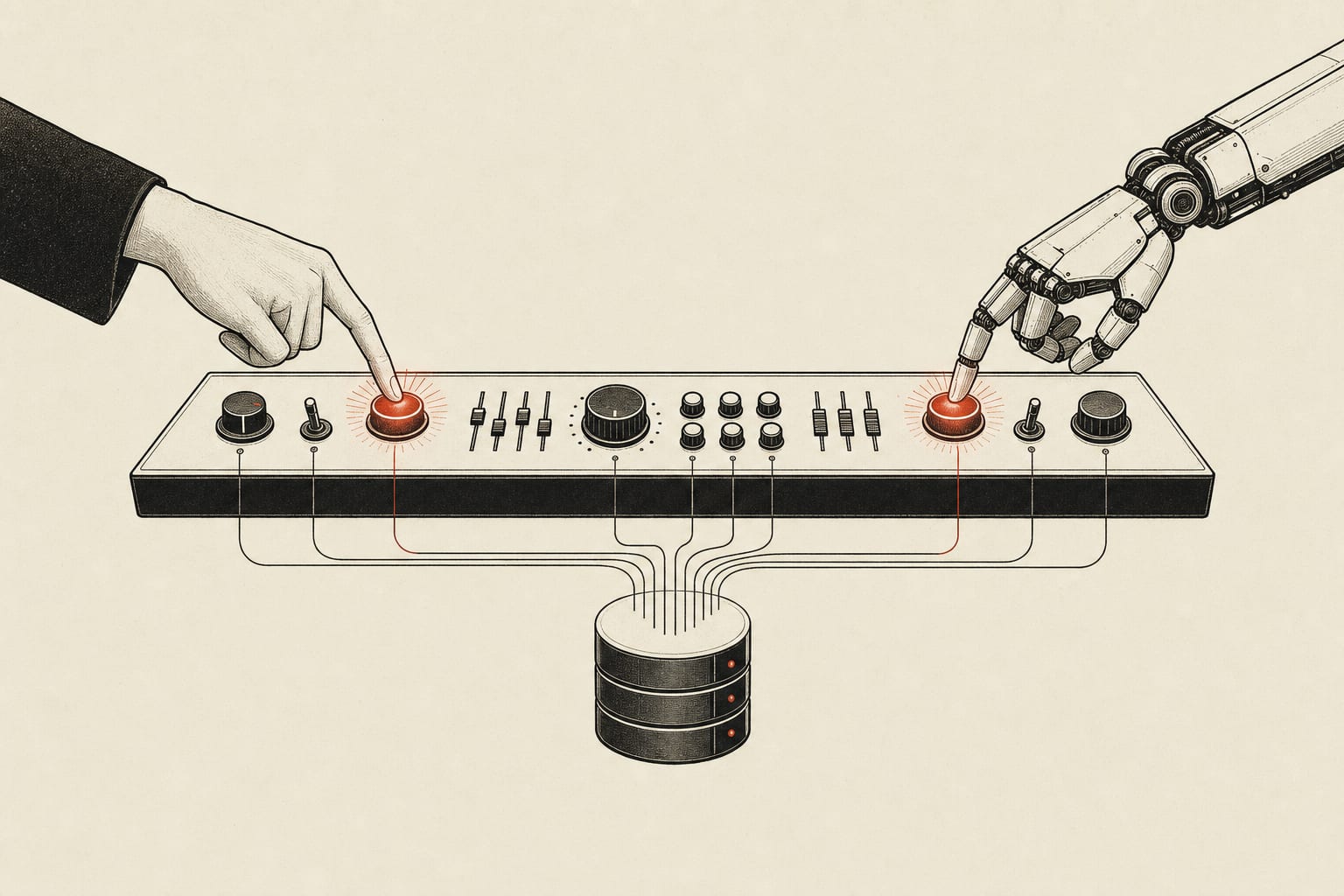
Builder.io released agent-native, an open framework where the agent and the UI are equal citizens of the same system. It is MIT licensed, sitting at roughly 3,800 stars, runs on any SQL database, and deploys anywhere including serverless. The pitch is blunt: you do not choose between a rich interface and an autonomous agent. Every app is both.
The mechanism is a single action surface backed by one shared SQL state. Every action works both ways, by click or by prompt, and a change from either side shows up on the other instantly. The agent joins as a peer editor in a CRDT multiplayer document rather than as a chat box bolted onto the margin. Protocols ship inside the framework instead of arriving as per-feature integrations: A2A, MCP, MCP Apps, remote MCP OAuth, the OpenAI and Claude Agent SDKs, AG-UI, and the Vercel AI SDK all hang off the same surface. That is the move. The hard part of adding agents to existing software was never the model. It was wiring one consistent set of actions that both a human and a model can call with the same permissions and the same state.
If you run a SaaS on React and Postgres, this lowers the floor for real agent support from a quarter of integration work to a weekend. You define actions once. The UI calls them on click, the agent calls them on request, and you stop maintaining two divergent code paths that drift apart every release. The license matters here. MIT means you can fork it into a regulated codebase without a procurement fight. Pair it with the day's other signal, Palmier Pro exposing a local MCP server at port 19789 so Claude or Cursor can drive a video timeline, and the pattern is clear: the editor itself becomes the API.
Watch the compute bill, because the shared-state design routes agent actions straight through your primary database. Each agent turn is now a read-write transaction on the same store your users hit, not a sandboxed side channel. Capacity-plan for agents as a second class of write-heavy users, and put the action surface behind the same rate limits and auth you give humans. The remote MCP OAuth support is the part to study first.
Over the next six to twelve months, the chat sidebar stops being a feature and starts being an architecture mistake. Products that treated conversation as a wrapper over a separate backend will rebuild around a unified action layer, and the ones that started there will ship agent capabilities faster than the incumbents can retrofit them. Claude Code landing in the Jira assignee dropdown is the same story from the work-management side. The agent is becoming a user with a seat, not a button.
SemiAnalysis says 99% of custom AI ASICs die between the slide deck and the wafer
The claim is a cold shower for the non-Nvidia accelerator pitch: simulated performance rarely survives real silicon, and almost all custom ASIC programs fail to ship competitive parts. If you are weighing a startup's bespoke chip for inference, treat the benchmark slides as fiction until there is hardware in a rack. Nvidia's lock-in holds for another cycle.
The EUV chokepoint is back in focus as ASML denies shipping a tool to China
The Zeiss-to-ASML optics chain is the single point that gates advanced-node supply, so any China breakthrough would reshape chip availability worldwide. For now the story resolves to a denial: ASML calls a US government report of an EUV shipment inaccurate and damaging. No confirmed tool, no change to the supply map yet. Watch this one, do not trade on it.
RAM is now the most expensive part in a phone, and it just killed a product line
Nothing's CMF Phone line is dead because memory prices spiked past the point where the BOM closed. The same squeeze that flows into a budget handset flows into every server you rent. Memory, not logic, is becoming the binding cost, and anyone planning a hardware refresh or a self-hosted cluster this year should lock memory pricing early.
Intel puts advanced packaging on the same tier as wafers
Patrick Moorhead flags packaging as a growth lever under Intel's new leadership, and he is right about where the bottleneck moved. Accelerator output is now gated by how fast you can stitch dies together, not just how fast you can print them. If you depend on GPU supply, packaging capacity is the number that decides your 2027 allocation.
Amazon investigates engineers who testified against AI data centers
Three Amazon engineers who spoke against new AI datacenter buildouts say they were monitored and threatened with termination, and a civil-rights complaint has followed. The capacity story is no longer just power and land. Local and labor friction is becoming a real drag on siting, and that friction shows up as delayed megawatts. Factor permitting and political risk into any region you are counting on for compute.
John Jumper leaves DeepMind for Anthropic as senior talent walks out the door
The AlphaFold lead and Nobel winner joining Anthropic signals a push into scientific reasoning, and it lands days after Noam Shazeer's reported move to OpenAI. Two senior departures in a week is a pattern, not a coincidence. DeepMind's research bench is being raided by the labs with the most aggressive product timelines, and that reshuffle decides which company ships the next reasoning breakthrough.
Norway bans generative AI for kids 6 to 13, supervised only for teens
This is an age-tiered education policy, not a product rule: full ban for grades one through seven, supervised use for ages 14 to 16, starting the late-August school year. The stated reason is protecting reading, writing, and math while test scores slide. If your edtech roadmap assumes classroom AI in Europe, the regulatory floor just moved, and other ministries will watch Norway's results.
Open weights at Opus level are running on a Mac Studio at home
A 26B Gemma-4 model handling private documents on consumer hardware, plus Hugging Face's cofounder touting frontier-class open models for self-hosting, point at the same shift. When data cannot leave the machine, local inference is now a real option, not a compromise. For privacy-bound workloads the question is no longer whether you can self-host, but whether the orchestration around it is worth building.
Palmier Pro turns a Mac video editor into an MCP server agents can drive
This open-source Swift editor exposes a local MCP server at port 19789 when open, so Claude, Codex, or Cursor can generate and edit clips directly in the timeline. The editor, server, and agent chat are open source; only generation is paid, with Pro at $29/mo and credits buying roughly 333 images or several minutes of video. The catch is macOS 26 Tahoe only. The real lesson is the pattern: ship a local MCP endpoint and your app becomes agent-drivable for free.
Project Valhalla lands a preview in JDK 28, disabled by default
After a decade, JEP 401 value classes are merging into OpenJDK, a pull request adding over 197,000 lines across 1,816 files. Value classes drop object identity so the JVM can flatten them in memory and skip heap allocation, which means == compares by components and synchronizing on them fails. It is a preview in a non-LTS release dated March 2027, so most teams meet a stable version only at JDK 29. Audit any code that leaned on identity equality before you celebrate.
ClickHouse turns 10, and the headline is $250M ARR
The anniversary post reads as nostalgia, but the load-bearing number is business scale: over 4,000 customers and $250M in annual run-rate revenue, more than triple year over year, with 1,000 customers added in a single quarter. Engineering kept pace too, with the join-heavy TPC-H SF100 workload now 26x faster than version 22.4. If you are picking an analytical database, this is a vendor that is compounding, not coasting.
Zero-touch OAuth lands for MCP
Enterprise-managed auth for the Model Context Protocol means agents can authenticate against your IdP without a per-app consent dance. This is the plumbing that makes agent-native frameworks safe to deploy inside a company. If you are exposing an MCP server to internal agents, read this before you ship, because it is the difference between a demo and something security will sign off on.
DuckDB internals, part one on why it is fast
A clear walk through vectorized execution, the in-process model, and the design choices that make DuckDB quick on analytical queries without a server. Worth a read if you are deciding between an embedded engine and a warehouse, or if you just want to understand where the speed actually comes from before you cite it in a design doc.
Claude Code becomes a Jira assignee
Coding agents now route work straight from the assignee dropdown or a comment, so a ticket can be handed to Claude like any teammate. Small change, large signal. The agent is getting a seat in your work-management tool, and the metric that matters next is how many of those tickets close without a human reopening them.
Let's Encrypt renewals threw errors today
A batch of certificate renewals failed during an incident, which for anyone on short-lived certs is a production risk, not a footnote. Check your renewal logs and confirm your automation retried cleanly. If your cert expiry monitoring is downstream of the same provider, this is your reminder to add an independent check.
Google Workspace is threatening to block Firefox access
A report that Workspace may restrict Firefox raises the browser-lock question for any team standardized on Google's suite. If your org runs Firefox by policy, test your critical Workspace flows now and have a fallback, because a quiet access change can break logins for a whole department in a morning.
Reliance pushes AI into calls, apps, and homes for 500M users
Ambani's plan puts AI features in front of more than 500 million Indian subscribers through telecom distribution. Distribution at that scale is the moat, not the model. For builders eyeing India, the question shifts from whether AI reaches users to whether you can ride a carrier's rails or get squeezed out by one.
Fusion startups have raised $7.1B, concentrated in a few firms
Most of the capital sits with a handful of companies, which tells you where the long-horizon power bets for datacenters are landing. Fusion is still years from a meter, but the funding concentration signals which firms hyperscalers will partner with first if any of this works. A power story to track, not a 2026 supply line.
The agent is becoming a user of your software, not a wrapper around it. Between Builder.io's shared action surface, Palmier exposing a local MCP server, Claude Code joining the Jira assignee list, and zero-touch OAuth for MCP, the pieces for treating an agent as an authenticated peer are all shipping this week. If you run a SaaS, define your actions once behind a single permissioned surface and put an MCP endpoint in front of it now, before you maintain two diverging code paths for humans and models.
Memory, not GPUs, becomes the named constraint on inference economics in 2026. At least one top-five model provider will publicly attribute a price increase or a capacity limit to HBM or DRAM supply before the end of Q3.
A RAM price spike just killed Nothing's CMF phone line because memory is now the most expensive component, and SemiAnalysis data shows semiconductor output climbing while broad manufacturing stays flat, meaning demand is concentrating in memory and advanced packaging. The consensus still frames the squeeze as a GPU and compute story and underweights memory as the binding input.
By September 30, 2026, no provider among OpenAI, Anthropic, Google, AWS, or Azure has publicly cited memory or HBM supply as a reason for a pricing change or capacity limit.
Marvell joins the S&P 500 on Monday at roughly 70x forward earnings with the index bid already front-run, up 7% Friday, while its CFO liquidated about half his stake days earlier. The passive flow is the liquidity insiders are selling into, and the custom-silicon story carrying the multiple just lost its most credible cheerleader.
SemiAnalysis [28] reminding the market that simulated ASIC slides rarely survive real silicon lands hardest on Marvell, whose two flagship programs, Microsoft Maia and AWS Trainium, are the documented stumbles, with Trainium3 reportedly lost to Alchip. The crowd reads June 22 inclusion as validation; a CFO dumping ~48% of his holdings on a 99x trailing multiple reads the other way. Marvell runs ~59% gross margin against Broadcom's ~78%, the sign of a price-taker in the programs it does win.
The same note that tempers custom silicon quietly endorses Broadcom, the one design house whose flagship program, Google's TPU, SemiAnalysis rates at ~90% utilization and 44% lower TCO than a GB200. A 99% failure rate across the field is a moat for the program that actually ships.
The market prices AVGO and MRVL as a single custom-ASIC basket; [28]'s reminder that most programs die in silicon should split them. Broadcom designs the TPU and OpenAI's chip, runs ~78% gross margins, and carries a backlog around $73B, while the cited failures cluster at Marvell's Maia and Trainium. Demand concentrating into proven programs accrues to Broadcom, not the field.
Hiring AlphaFold's John Jumper six weeks before a targeted October listing puts a Nobel-grade science story into the IPO book and lifts the comp from frontier LLM vendor toward AI for discovery, the one adjacency where safety framing is a selling point rather than a cost. At a $965B mark, the narrative that reprices the multiple matters as much as the run rate.
[29] Jumper leaving DeepMind for Anthropic is the most senior science hire in the field this year. Consensus reads it as a DeepMind talent-drain headline; the positioning read is Anthropic broadening its story into biology and chemistry ahead of the raise. DeepMind keeps the AlphaFold IP and franchise, so the desk's standing GOOGL long is unmoved by one departure.