SpaceX becomes a compute landlord, and Reflection signs a $6.3B lease
SpaceX turns its Colossus cluster into a compute landlord as Reflection commits up to $6.3B through 2029, while GB200 serving costs fall 2.5x in 70 days.
A rocket company just became a compute landlord, and Reflection AI signed a six-point-three-billion-dollar lease to rent chips it will never own.
It's Tuesday, June 23, 2026. Here's the rundown. SpaceX as a REIT, serving costs falling faster than anyone's lease, and a 200-million-parameter model claiming it punches at ten billion.
Reflection agreed to pay SpaceX a hundred and fifty million dollars a month for GB300 capacity, locked through 2029. Run it across forty-two months and that's up to six-point-three billion in rent.
And the tenant is the boring part. The story is SpaceX selling Colossus, the cluster it built for xAI, as a commercial platform. The buyer list already reads Anthropic, Google, and Cursor.
A company that lands boosters now leases frontier training capacity the way a landlord leases floors.
Because they got there first on the scarce thing. Whoever sits on the biggest GB300 reservation sets the price for everyone downstream, and they resell the slack at a markup. A hundred and fifty million a month is now what a frontier reservation clears at on the open market.
That number anchors every term sheet a lab signs for the next two years.
Here's the part that should keep Reflection's CFO up. That's one-point-eight billion a year in rent before a single token of revenue. The math only closes if the funding spigot stays open through 2029.
So the lease is really a call on their next three raises.
Exactly that. And if you're a smaller lab, it's worse. The good capacity is pre-sold to the labs with balance sheets. What hits the spot market is leftovers at worse terms.
There's also a closed loop here. SpaceX folded in Cursor this spring, and Cursor's on the buyer list.
So the landlord is billing a tenant it already owns, and the rent flows back into the same ledger that bought the GPUs. If you're running training at scale, the lesson is blunt: you don't buy chips anymore, you sign multi-year leases through whoever booked the allocation first.
SemiAnalysis says GB200 serving got two-and-a-half times cheaper in seventy days. No new hardware. Software optimization on the same NVL72 stack serving Kimi and Grok-class models.
That's the one to act on. If your inference bill is pinned to last quarter's prices, you're overpaying right now. Re-benchmark before you sign another capacity contract.
Meanwhile WIRED finds electricians starting to turn down data center jobs. No megawatt figures, but local opposition and labor unease are real.
And it lands on the slowest part of the stack, the power interconnects. The grid is the schedule risk for 2027 capacity, not the GPU. You can buy chips faster than you can wire them.
Anthropic added identity verification to Claude. Nearly seven hundred points on Hacker News, and the thread is the signal.
Developers are reading it as the front edge of KYC for high-tier access. If your product leans on Claude keys at scale, build verification friction into onboarding now instead of explaining it to users later.
Same energy on two other threads. Four hundred points arguing the downside of switching to open models is smaller than teams fear, and a GLM-versus-Opus head-to-head pulling a crowd.
That's one drumbeat, not two stories. The migration off closed frontier models is moving from blog post to budget line. Teams are seriously pricing a Chinese open model against the frontier closed one for production code.
One landmine to flag: an open issue says OpenAI's Codex can write terabytes in runaway logging.
Check disk writes on your dev machines and CI runners. It'll quietly grind through SSD endurance you pay to replace.
Greg Brockman says OpenAI's Daybreak tooling went from finding browser vulnerabilities to writing the patches for major browsers and network stacks.
If the fixes hold up under review, that changes what a security team costs to run. Remediation was always the expensive human part.
And a new eval, CyberGym, puts OpenAI ahead of Anthropic on offensive testing.
Benchmark wins are noisy, but paired with Daybreak it's a coordinated security play. For a red team picking a default model, that's the kind of result that moves the needle.
One default to go change today: Google Search now keeps images and audio you upload to train models unless you opt out.
If your team uses Circle to Search on anything sensitive, that's a leak hiding in a setting. Turn it off and tell your security lead.
OpenAI licensed Getty's library for ChatGPT image results, the same deal Getty cut with Perplexity.
The pattern's set. Answer engines are paying for image rights instead of scraping, which raises the cost floor for anyone trying to compete on visual search.
And South Africa pulled its draft AI policy seventeen days after release over fabricated sources. The latest official document caught citing references that don't exist.
If you ship anything where citations matter, treat unverified model output as a liability, not a draft. People keep skipping the one step the model can't do for them.
Google is putting seventy-five million into A24 with a DeepMind research partnership, starting with AI storyboarding. And it explicitly walls off A24's film library from training.
That fence is the template. A studio takes platform money while keeping its own data out of the model. Every rights holder talking to a frontier lab is going to copy that clause.
Meta also tapped CRED's Kunal Shah to run WhatsApp and put nine hundred million into his startup.
That's a fintech and India read on WhatsApp, with the check locking the relationship in. Watch for payments shipping to its biggest market.
A 200-million-parameter inpainting model called Moebius claims it matches ten-billion-class output.
If that holds, it's a fifty-times parameter cut on a common editing task, cheap enough to run on the edge. Big if. Test the comparison before you trust it.
Also live: Apertus, a fully open foundation model aimed at sovereign AI, pulling three hundred-plus points. And Minecraft's Java edition shipped its first build on Vulkan.
Apertus gives governments a base they can host and audit themselves, which is the whole point. And when even Minecraft drops the old OpenGL path, the legacy graphics holdouts are officially done.
Quick break — two from the desk.
One we know well: vote dot direct. If you're on an H O A or a board, it runs your elections digitally — secure, verifiable, no paper, no clipboard in the lobby. Point your council to vote dot direct.
And if this is your ten minutes of A I for the day, get the written edition too. The full wire, free, every morning — leave your email at nextbig dot dev.
Google's prepping a Pixel feature to log your daily conversations as an ambient notetaker. No ship date.
Mitchell Hashimoto pledged another four hundred thousand dollars to the Zig foundation, real money behind systems tooling while NSF cuts existing programs.
Ars argues Anthropic's own safety warnings helped talk Washington into an AI export ban.
Sonar acquired Gitar, folding agentic code review that finds bugs, writes patches, and commits them inside your own infrastructure.
And a Hacker News post asking whether someone's old job only existed because of fraud hit four hundred fifty-nine points.
Our call: at least one lab on SpaceX's Colossus buyer list will publicly renegotiate or restructure its compute terms within six months, citing the gap between contracted prices and falling per-token serving costs.
We're wrong if no named lab reports a renegotiated, restructured, or canceled GB300 contract before December 23. That's when it settles.
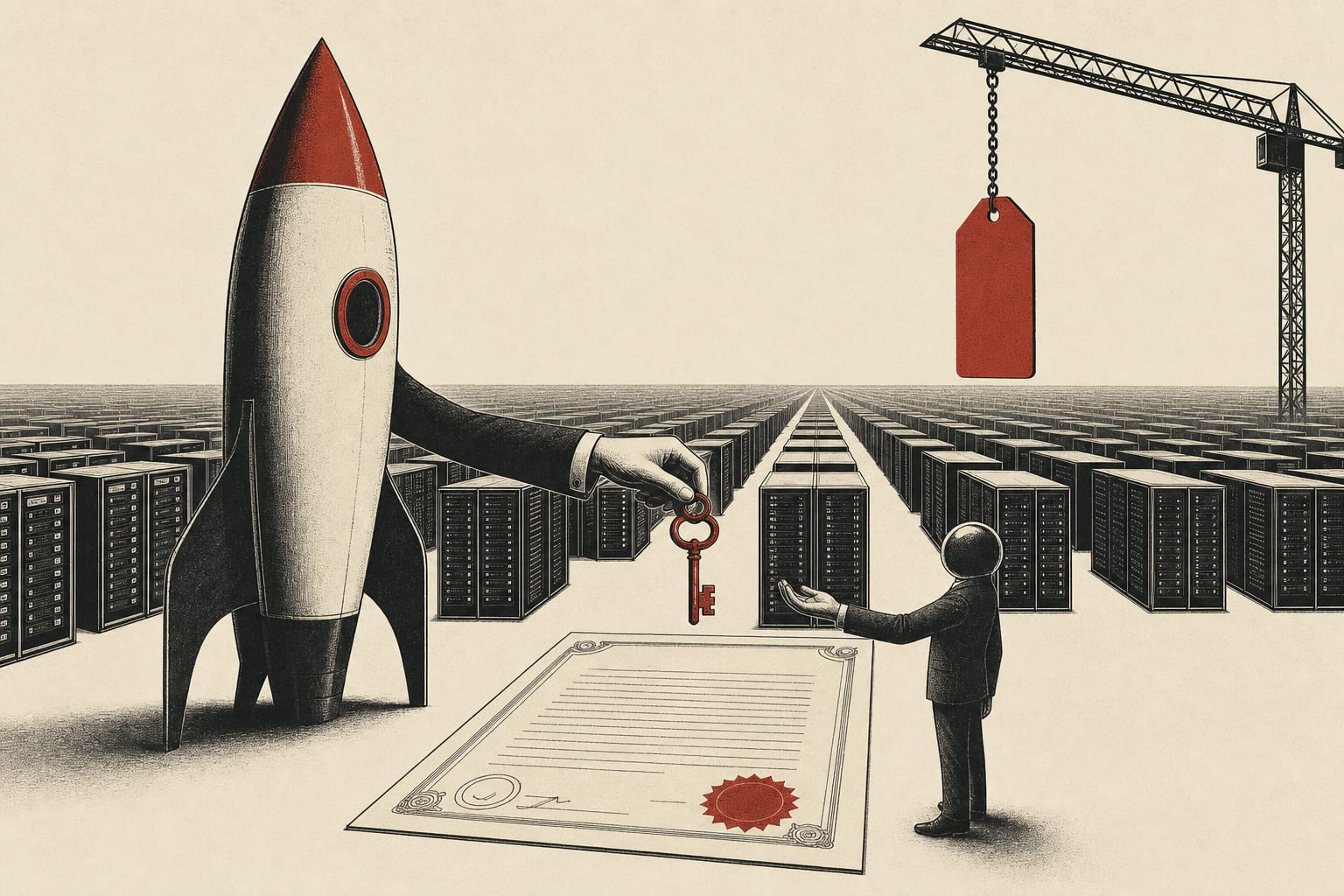
Reflection AI agreed to pay SpaceX $150 million a month for Nvidia GB300 capacity, locked in through 2029. Run the arithmetic across roughly 42 months and the open-source lab has committed as much as $6.3 billion to rent chips it will never own.
The tenant is the smaller story here. SpaceX is selling Colossus, the cluster it built for xAI, as a commercial platform, and the buyer list already reads Anthropic, Google, and Cursor. A rocket company now leases frontier training capacity the way a REIT leases floors.
GB300 allocation is the scarce thing, and whoever sits on the largest reservation sets the price for everyone downstream. SpaceX, through its xAI ties, holds one of the biggest GB300 footprints in existence and resells the slack at a markup. $150 million a month is what a frontier-scale training reservation now clears at on the open market, and that number will anchor every term sheet a lab signs for the next two years.
For anyone running training at scale, the lesson is blunt: you no longer buy GPUs, you sign multi-year leases through an intermediary who got there first. At $150 million a month, Reflection owes about $1.8 billion a year in rent alone before a single token of revenue. That math only closes if the funding spigot stays open through 2029, which means the deal is a leveraged call on Reflection's next three raises as much as on its models. If you are a smaller lab, the takeaway is darker. The good capacity is being pre-sold to the labs with balance sheets, and what reaches the spot market will be the leftovers at worse terms.
This confirms a curve we have tracked since the Anysphere acquisition in March: compute, networking, and the surfaces developers type into are consolidating under the same roof. Cursor, which SpaceX folded in this spring, shows up on that Colossus buyer list. So the landlord is now billing a tenant it already owns, and the rent flows back into the same ledger that funds the GPUs.
GB200 serving got 2.5x cheaper in 70 days with no new hardware
SemiAnalysis reports the GB200 NVL72 software stack, the same one serving Kimi and Grok-class architectures, cut serving cost 2.5x in ten weeks on optimization alone. If your inference bill is fixed against last quarter's prices, you are overpaying. Re-benchmark before you sign another capacity contract.
Electricians are starting to say no to data center jobs
WIRED finds growing local opposition and labor unease around the data center buildout. No megawatt or cost figures, but the friction is real and it lands on the slowest part of the stack: power interconnects and the trades that build them. The grid, not the GPU, is the schedule risk for 2027 capacity.
AMD pushes FSR 4.1 to RX 7000 cards in 300+ games
The INT8 upscaling model now reaches older RDNA 3 GPUs, with RDNA 3 APU support next. For anyone running local inference on consumer AMD silicon, the INT8 path signals where AMD is putting its cheap-quantization effort, not just for games.
Anthropic adds identity verification to Claude
691 points on HN, and the comment thread is the real signal: developers reading ID checks as the start of harder usage gates and KYC for high-tier access. If your product depends on Claude API keys at scale, plan for verification friction in your onboarding now.
Firecrawl tops GitHub trending again
The scrape-and-search API for feeding agents the live web is back at the top of the charts with 3,680 signals. Agent builders keep reaching for it because clean web ingestion is still the unglamorous bottleneck nobody wants to write from scratch.
NVIDIA publishes its own agent skills repo
NVIDIA shipped a public set of reusable agent skills. The move puts Nvidia one layer above the silicon, shaping how agents are built on its hardware. Worth a look if you are standardizing tool definitions across an agent fleet.
GLM 5.2 vs Opus comparison draws a crowd
384 points on a head-to-head between Z.ai's open-weights GLM 5.2 and Anthropic's Opus. The interest itself is the story: teams are seriously pricing a Chinese open model against the frontier closed one for production coding work.
Codex logging bug can write terabytes to local SSDs
An open issue on OpenAI's Codex describes runaway logging that can burn through SSD endurance. If you run Codex on developer machines or CI runners, check disk writes before this quietly chews through hardware you pay to replace.
Mitchell Hashimoto pledges another $400k to Zig
The Ghostty author is putting $400k more into the Zig foundation. Real money behind a systems language that keeps showing up in performance-critical tooling. A signal of where independent infrastructure funding is flowing while NSF programs get cut.
"Minimal downside to switching to open models" gains traction
403 points on an argument that dropping Claude for open weights costs less than teams fear. Read alongside the GLM 5.2 vs Opus thread, it is the same drumbeat: the migration off closed frontier models is moving from blog post to budget line.
Sonar acquires AI code-review startup Gitar
SonarQube folds in agentic review that finds bugs, writes patches, and commits them inside your own infrastructure. For teams already on Sonar, automated fixing is becoming a feature you own rather than a separate tool you buy.
OpenAI models now auto-write patches for critical browser bugs
Greg Brockman says OpenAI's Daybreak tooling moved from finding vulnerabilities to generating fixes for major browsers and network stacks. Defensive automation crossing from detection to remediation changes the economics of running a security team, if the patches hold up under review.
OpenAI's cyber model beats Claude on CyberGym
A new eval puts OpenAI ahead of Anthropic on offensive security testing. Benchmark wins are noisy, but for red teams picking a model, this is the kind of result that shifts a default. Pair it with the Daybreak patch-writing news and OpenAI is making a coordinated security play.
Google Search retains your uploaded images and audio for training
Media you upload during a search is now kept to train models unless you turn it off. If your team uses Circle to Search or image search on sensitive material, this is a data-leak vector hiding in a default setting. Disable it and tell your security lead.
OpenAI licenses Getty's library for ChatGPT image results
Licensed visual content lands in ChatGPT search, repeating the deal Getty cut with Perplexity. The pattern is set: answer engines are paying for image rights rather than scraping, which raises the cost floor for anyone trying to compete on visual search.
Anthropic posts a $300k SEO lead role for answer engines
The job spec treats AI Overviews and answer engines as part of search strategy, not a side function. A frontier lab paying $300k to rank inside other models' answers is a tell about where discovery is heading for everyone building consumer AI.
Governments keep publishing AI-hallucinated citations
South Africa pulled its draft AI policy 17 days after release over fabricated sources, the latest in a string of official documents citing nonexistent references. If you ship anything where citations matter, treat unverified model output as a liability, not a draft.
Chinese universities cut language majors for AI and robotics
A survey of 70 schools shows translation programs closing as embodied-intelligence degrees open. The talent pipeline is being rebuilt around robotics and AI, which feeds the same supply of engineers that keeps China's open-model labs shipping.
Google and DeepMind back A24 with $75M for film AI
Google is putting $75M into A24 with a DeepMind research partnership, starting with AI storyboarding and explicitly excluding A24's film library from training. A studio taking platform money while fencing off its own data is the template other rights holders will copy.
Meta names CRED's Kunal Shah to run WhatsApp, invests $900M
Meta tapped India's CRED founder to lead WhatsApp and put $900M into his startup. The leadership pick points WhatsApp at fintech and India, with the investment locking the relationship in. Watch for payments features shipping to WhatsApp's largest market.
Apertus ships as an open foundation model for sovereign AI
330 points on HN for a fully open model aimed at countries that want AI independent of US labs. The sovereign-AI category keeps growing, and Apertus gives governments a base they can host and audit themselves.
Moebius: a 0.2B inpainting model claiming 10B-level results
A 200M-parameter image inpainting model says it matches 10B-class output. If it holds, that is a 50x parameter cut for a common editing task, cheap enough to run on edge devices. Test before you trust the comparison.
Deno ships a desktop runtime
Deno Desktop brings the runtime to native app territory. For teams already on Deno's tooling, it is a path to desktop apps without bolting on a separate stack.
Minecraft Java Edition 26.2 is the first build on Vulkan 1.2
The flagship Java game moves to Vulkan 1.2, dropping its old rendering path. A notable signal for graphics tooling: even legacy OpenGL holdouts are migrating to modern explicit APIs.
Two numbers sit next to each other today and they point the same way. Serving GB200 clusters got 2.5x cheaper in 70 days on software alone, while Reflection just locked $150M a month into a hardware lease through 2029. Software efficiency is compounding faster than capacity contracts, which means a multi-year reservation signed at today's prices could be paying for performance you can already get for a fraction by the time it matures. Before committing to any long compute term, model the efficiency curve into your cost projection, and keep an open-weights fallback warm so you are not locked into a price that the software stack outruns.
At least one lab on SpaceX's Colossus buyer list will publicly renegotiate or restructure its compute terms within six months, citing the gap between contracted capacity prices and falling per-token serving costs.
SemiAnalysis pegged a 2.5x serving-cost drop in 70 days from software alone, while Reflection's $150M-a-month commitment runs to 2029. Those two trends diverge fast, and a lab paying fixed rent on chips whose effective cost keeps falling has every incentive to reopen the deal. The middleman model SpaceX is building assumes stable demand at fixed prices, which efficiency gains directly undercut.
No public report of a renegotiated, restructured, or canceled Colossus or comparable GB300 compute contract by a named AI lab surfaces before December 23, 2026.
Today's wire frames MediaTek's TPU v9 win as Broadcom losing Google, but the part that moved is the interim 336G SerDes and a 1-2M-unit inference SKU, not the training die where the margin lives. At $393 and down 25% since the June 3 print, the share-erosion fear is already in the tape, which is why the bear's headline is the long's entry.
Story [24] reads as a direct hit on the AVGO long the desk has carried since June 20, yet Macquarie modeled Broadcom's Google TPU share falling from ~95% in 2026 to ~65% by 2028 weeks ago, and the stock already shed close to $300B from its $495 peak on that exact fear. Broadcom reaffirmed its $100B-plus FY27 AI revenue target and keeps the high-complexity Sunfish training variant; MediaTek's exclusive Triggerfish is ~1-2M units at a 30% premium with production in 2028, not a 2026 earnings event.
Gemini's Interactions API going GA as the default orchestration layer is an enterprise lock-in event, not a feature note. Builders standardizing new agent stacks on Google's interface raise their own switching costs in the same week Google proves it can multi-source TPU silicon away from any single vendor.
Stories [0] and [1] put the stateful agent interface at GA as the standard for new Gemini builds, while [24] confirms Google now splits TPU work across MediaTek, Broadcom, Marvell, and Intel, holding architecture and the core die in-house. That combination compounds the part of Alphabet's AI value the desk has carried since June 21: distribution plus a falling internal cost-per-token that no GPU-renting lab can match. Consensus still scores Gemini on benchmark wins; the durable capture sits in being the default place agents get built.
MediaTek is the named winner of Google's TPU v9, and the stock has already more than doubled in 2026 pricing that in. The exclusive Triggerfish order is ~1-2M units in 2028 at a 30% premium, real money that still sits years from the P&L.
Story [24] hands MediaTek the 336G SerDes win after Broadcom's 448G architecture slipped on signal-integrity and thermal limits, and the bull case projects roughly 25% of AI ASIC server shipments by 2028. The re-rating from a smartphone-chip multiple to an AI-ASIC multiple has largely already run; the revenue that justifies it lands in 2028, while near-term data-center contribution stays small. Google's own analysts describe the tie-up as a calculated apprenticeship, keeping the core compute die in-house, which caps how durable the win is.