It was supposed to take six months. It took a day. A week after the US government quietly decided who could use OpenAI's strongest model, it did the same to Anthropic's Claude Mythos, and a launch gate everyone called a one-off is starting to look like a regime, even as the order behind it insists it is nothing of the kind
A day after OpenAI shipped GPT-5.6 only to a government-vetted circle, the US government cleared Anthropic to release its strongest model, Claude Mythos 5, to more than 100 "trusted" US organizations, lifting a two-week block. Both trace to the June 2 executive order "Promoting Advanced AI Innovation and Security," which directs the NSA to benchmark models by cyber capability and invites up to 30 days of pre-release access, while explicitly disclaiming any licensing or preclearance requirement. Two labs gated in one week under a "voluntary" order is the birth of a de-facto regime. Plus the open frontier closing the gap, DeepSeek's DSpark, cross-model routing, and AI in mathematics and chip design.
It was supposed to take six months. It took a day. It's Saturday, June twenty-seventh, and the US government has now decided who may use the strongest model at two different labs, in the same week.
On Friday the Commerce Department cleared Anthropic to release its strongest model, Claude Mythos, to a set of trusted US organizations, lifting a block it had imposed two weeks earlier. That's one day after OpenAI shipped GPT-5.6 to only a government-vetted circle.
The mechanics are plain. The Commerce Secretary wrote to Anthropic that appropriate safeguards were in place to permit certain trusted partners access, reaching more than a hundred institutions, after the same government had switched the model off over how good it was at finding software flaws.
Both trace to one order signed June second. It invites developers to give the government up to thirty days of access before a release, and it explicitly disclaims any licensing or preclearance requirement.
That disclaimer is the hard part. On paper this is all voluntary. In practice the two strongest models on the market reached the public only through the organizations the government approved. A voluntary process with an involuntary-looking result is still a gate.
OpenAI didn't pretend to like its own version, saying this kind of government access process shouldn't become the default because it keeps the best tools from the people who need them.
The one place the gate can't reach is open weights, now only a few months behind the closed frontier and closing. You cannot switch off a model that's already on ten thousand laptops.
Underneath the policy, builders kept routing around it. DeepSeek open-sourced a speculative-decoding trick it says makes generation up to eighty-five percent faster.
And a drop-in router made the rounds that picks the cheapest capable model per request across Claude, GPT, Gemini, and open weights. A gated frontier makes that kind of arbitrage more valuable, not less.
To the tape. We open a watch on Nvidia. A regime that clears the strongest models only for vetted institutions quietly entrenches the domestic compute they run on.
And a watch on Microsoft, the clearest listed beneficiary of a gated-but-cleared frontier, as OpenAI's cloud into the enterprise.
The tape is the desk's scorecard, not advice.
Our call: within six months, the gate reaches open weights. At least one major open-weight release above a capability line gets delayed, restricted to vetted users, or made conditional on federal review.
What proves us wrong is December with the gate still confined to closed models. Watch the release the state most fears, the one it can't recall.
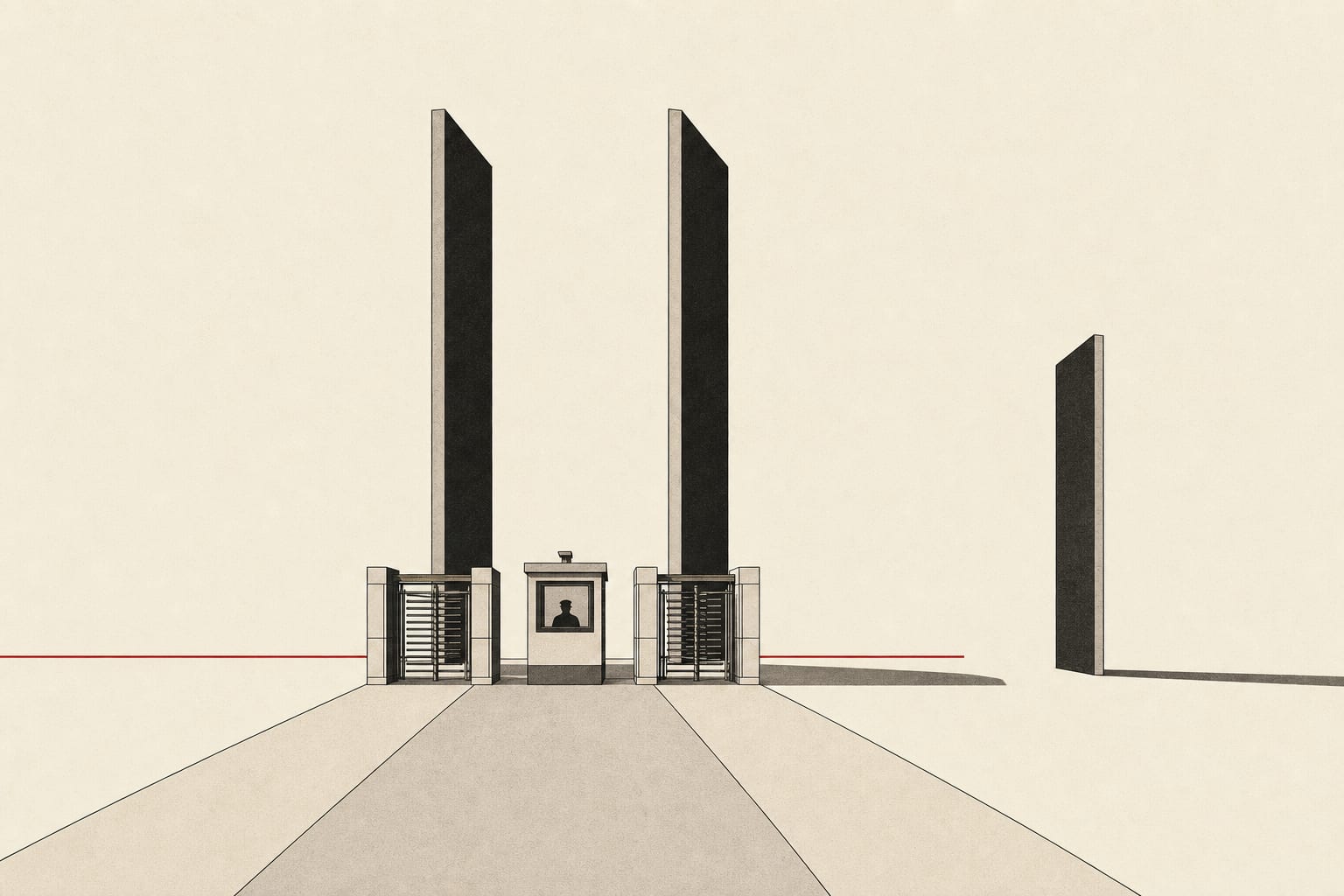
It was supposed to take six months. It took a day. A week after the US government quietly decided who could use OpenAI's strongest model, it did the same to Anthropic's Claude Mythos — and a launch gate everyone called a one-off is starting to look like a regime, even as the order behind it insists it is nothing of the kind
A day after this desk wrote that the government's new habit of deciding who may use a frontier model would spread from OpenAI to another lab, it spread. On Friday the Commerce Department cleared Anthropic to release its strongest model, Claude Mythos 5, to a set of trusted US organizations — lifting a block it had imposed on that same model roughly two weeks earlier. The gate that looked, on Thursday, like a one-off aimed at a single company now has two names behind it in a single week.
The mechanics deserve to be stated plainly. Commerce Secretary Howard Lutnick wrote to Anthropic's Tom Brown that he had "determined that appropriate safeguards are in place to permit certain trusted partners to access the Claude Mythos 5 Model." Access reportedly reaches more than a hundred US institutions — major companies and government agencies, many of them inside a program Anthropic calls Project Glasswing. Two weeks earlier the same government had switched Mythos off, along with a smaller sibling model, over warnings that it was adept at finding software flaws and had been exposed to a China-linked partner. The state turned the model off, and then turned it back on for a list it had approved.
This is the second instance in days. OpenAI shipped GPT-5.6 on Thursday to only a small, government-vetted circle, at the government's request, citing the cyber capabilities of its top trim. Both moves trace to one order signed June 2 — "Promoting Advanced Artificial Intelligence Innovation and Security" — which directs the NSA to benchmark models by cyber capability and invites developers to give the government up to thirty days of access before a public release. Two labs, one order, one week.
Here is the part that makes this a genuinely hard story instead of an easy one. That same executive order goes out of its way to say what it is not. "Nothing in this section," it reads, "shall be construed to authorize the creation of a mandatory governmental licensing, preclearance, or permitting requirement" for releasing an AI model. On paper, all of this is voluntary. In practice, the two strongest models on the market this week reached the public only through the organizations the government was comfortable with. A voluntary process that produces an involuntary-looking result is still a gate. It is simply a gate that no one has to admit they built.
For everyone downstream, the shape is the thing to hold onto. OpenAI itself pushed back — "we don't believe this kind of government access process should become the long-term default," the company said, because it keeps the best tools from the developers, enterprises, and defenders who need them. But the incentives all point toward doing it again: it costs the government almost nothing to ask, costs a lab little to comply, and hands both sides cover the next time a model looks dangerous. The one place this gate cannot easily reach is the open-weight world — a few months behind the closed frontier and closing. The distance between the models the state can wave through and the ones it cannot switch off is about to become the most important line in this industry.
OpenAI ships GPT-5.6 only to a government-vetted circle — and says out loud it shouldn't be the norm
OpenAI made GPT-5.6 available on Thursday to only a small group of partners vetted by the US government, at the government's own request, citing the cyber capabilities of its flagship "Sol" trim in finding and fixing software vulnerabilities. The company did not pretend to like it: "We don't believe this kind of government access process should become the long-term default," it said, warning that the arrangement keeps the best tools from users, developers, enterprises, cyber defenders, and global partners who need them. That a lab would ship its strongest model on the government's terms and object to the terms in the same breath is the whole tension of the week — compliance now, on the record, with a protest attached for later.
The open frontier is only months behind the closed one — and the gate can't reach it
A widely-read analysis this week put a number on the thing the gate cannot touch. Averaged across eighteen benchmarks, the best open-weight models trail the closed frontier by roughly five months; on coding specifically, the gap has collapsed from around fifteen months to one or two, and on one popular index it trends toward zero by December. The exact figure depends entirely on which benchmark you pick, so treat it as direction rather than gospel. But the direction is the point: as Washington learns to switch the closed frontier on and off for approved users, a nearly-as-capable open frontier keeps shipping to anyone who wants to download it. You cannot gate a model that is already on ten thousand laptops.
DeepSeek open-sources DSpark, a speculative-decoding trick that reports up to 85% faster generation
DeepSeek released DSpark, an MIT-licensed inference module — not a new model — that pairs confidence-scheduled speculative decoding with semi-autoregressive generation on top of its V4 family. The project reports up to roughly 85 percent faster per-user generation and, under heavy concurrency, several times the throughput, with the technique ported to Qwen3 and Gemma as well. Read the exact percentages as vendor-reported until independent benchmarks land. The significance is strategic more than numerical: while the government decides who may touch the strongest closed models, the open ecosystem keeps making the models everyone already has cheaper and faster to run — which is its own kind of frontier.
A drop-in router picks the cheapest capable model per request across Claude, GPT, Gemini, and open weights
A Show HN project, workweave's router, is a proxy that scores each request and routes it to whichever model answers it best for the price, across Claude, GPT, Gemini, and open models via OpenRouter, in under fifty milliseconds and with no code change beyond swapping an endpoint. The project claims forty to seventy percent cost savings — its own number, unbenchmarked, so weigh it accordingly. The reason it matters this week is what it assumes: that no single model is the answer, that models are increasingly interchangeable commodities to be arbitraged, and that the smart move is to stop marrying one. A gated frontier makes that assumption more valuable, not less.
The government's frontier-model gate stopped looking like a one-off this week and started looking like a habit. OpenAI shipped GPT-5.6 to a government-vetted circle on Thursday; on Friday the same government cleared Anthropic's Mythos to a list of trusted organizations after two weeks of switching it off. Both trace to a June 2 order that directs the NSA to grade models by cyber capability — and that explicitly disclaims any licensing or preclearance requirement, which is exactly why the outcome is so striking: a voluntary process produced an involuntary-looking result, twice, in a week. The one line the gate can't hold is open weights, a few months behind and closing. What the state can switch off, and what it cannot, is now the most important distinction in AI.
Within six months, the government's frontier-model gate reaches open weights: at least one major open-weight model release above a rough capability line is delayed, restricted to vetted users, or made conditional on federal review — the same treatment just handed to closed models from OpenAI and Anthropic, applied to a model anyone can otherwise download.
The gate's whole logic is cyber capability, and the open frontier is only months behind the closed one and closing. A government that will switch a closed model off over its ability to find software flaws will not indefinitely ignore an open model that can do nearly the same and cannot be recalled once released. The pressure is already visible in the "voluntary" framing; the natural next target is the release the state most fears because it is the one it cannot switch off. The non-obvious, falsifiable edge is that the reach to open weights happens inside two quarters, not eventually.
If, by December 27, 2026, no major open-weight model release has been delayed, restricted to approved users, or made conditional on federal review, and the government's gate remains confined to closed frontier models, the call is wrong.
We open a watch on Nvidia into the government-gate story. A regime that clears the strongest models only for vetted US organizations quietly entrenches the domestic, high-end compute those organizations run on — the gate is a demand tailwind for the exact silicon Nvidia sells into government and cleared-enterprise buildouts. We watch rather than take a side because the same gate also accelerates the open, run-it-yourself alternative that pressures pricing over time.
Gated frontier access pushes vetted institutions toward more of their own high-end compute, which favors the leading accelerator vendor. The offset is that the open ecosystem the gate cannot reach keeps commoditizing inference and capping pricing power.
We open a watch on Microsoft as the clearest listed beneficiary of a gated-but-cleared frontier. As OpenAI's cloud and its route into the enterprise, Microsoft is positioned to serve exactly the vetted organizations the government is willing to approve, through Azure and its government-cloud footprint. We watch rather than call it a long because the gate is a policy artifact that can shift with an administration, and because the same dynamic hands leverage to Washington that Microsoft would rather keep for itself.
A gate that concentrates frontier access in approved institutions favors the hyperscaler with the compliance footprint and the OpenAI relationship to serve them. The offset is regulatory dependence: a business advantaged by a voluntary government process is exposed the moment that process changes.