The AI shortage reaches the checkout aisle: Nvidia has finished RTX 50 Super GPUs it won't ship because 3GB GDDR7 memory costs triple the 2GB it replaces, PC building is in a "component crisis," and the fastest new memory goes to AI first, as the models themselves get cheaper and more bundled
Nvidia reportedly can't ship a finished RTX 50 Super because its GDDR7 memory now costs triple; building any PC is caught in an AI-driven "component crisis." The scarcity we've tracked at the datacenter is now a consumer tax, even as the models get cheaper and fold into flat-rate subscriptions.
There's a finished graphics card sitting in a warehouse that Nvidia can't bring itself to sell. It's Saturday, July eighteenth, and that stranded GPU is the AI boom arriving at the checkout aisle.
The RTX 50 Super refresh is reportedly built and ready, and stuck, because the memory it needs, three-gigabyte GDDR7, now costs about triple what the modules it replaces used to. Nvidia would rather not ship it than sell it at the price its own components now demand.
It's not one product. Building a PC at all has become, in the words of the hardware press, a component crisis caused by the AI boom. And the fastest new server memory this week is on display precisely because AI servers get it first. The data center runs on next year's memory; everyone else pays more for last year's.
Now hold that against the models. Anthropic is folding Fable 5, its most capable model, into flat-rate subscriptions. Kimi keeps undercutting the whole market. The intelligence is getting cheaper and more bundled by the week. The machine to run it is getting scarcer and dearer by the same week.
That divergence breaks the rule the whole industry runs on: computing is supposed to get cheaper as it improves. In AI it's split in two. The soft part, the model, obeys the rule and falls. The hard part, the memory and the boards and the power, breaks it and rises.
And a founding VC said the quiet part. Neil Rimer of Index Ventures said the historic wealth AI is generating will have to come back out, voluntarily or otherwise. Same imbalance the component aisle is straining under, said out loud from inside the money.
To the tape. We hold the Micron long, and this weekend it printed in the most vivid way yet: a finished graphics card Nvidia won't ship because the memory costs too much.
We hold the Nvidia watch, with a wrinkle. The same shortage its data centers are causing is now pinching the margins on its own consumer line.
The tape is the desk's scorecard, not advice.
Our call: the data-center memory shortage becomes a named line on a consumer price tag. By November thirtieth, at least one top-five PC or phone maker blames AI-driven memory costs, out loud, for a price hike, a delay, or a new leasing scheme.
What proves us wrong is the end of November with every big maker still eating the cost in silence. When a shortage forces the choice between absorbing a cost and passing it on, the answer is usually to pass it on and name a reason.
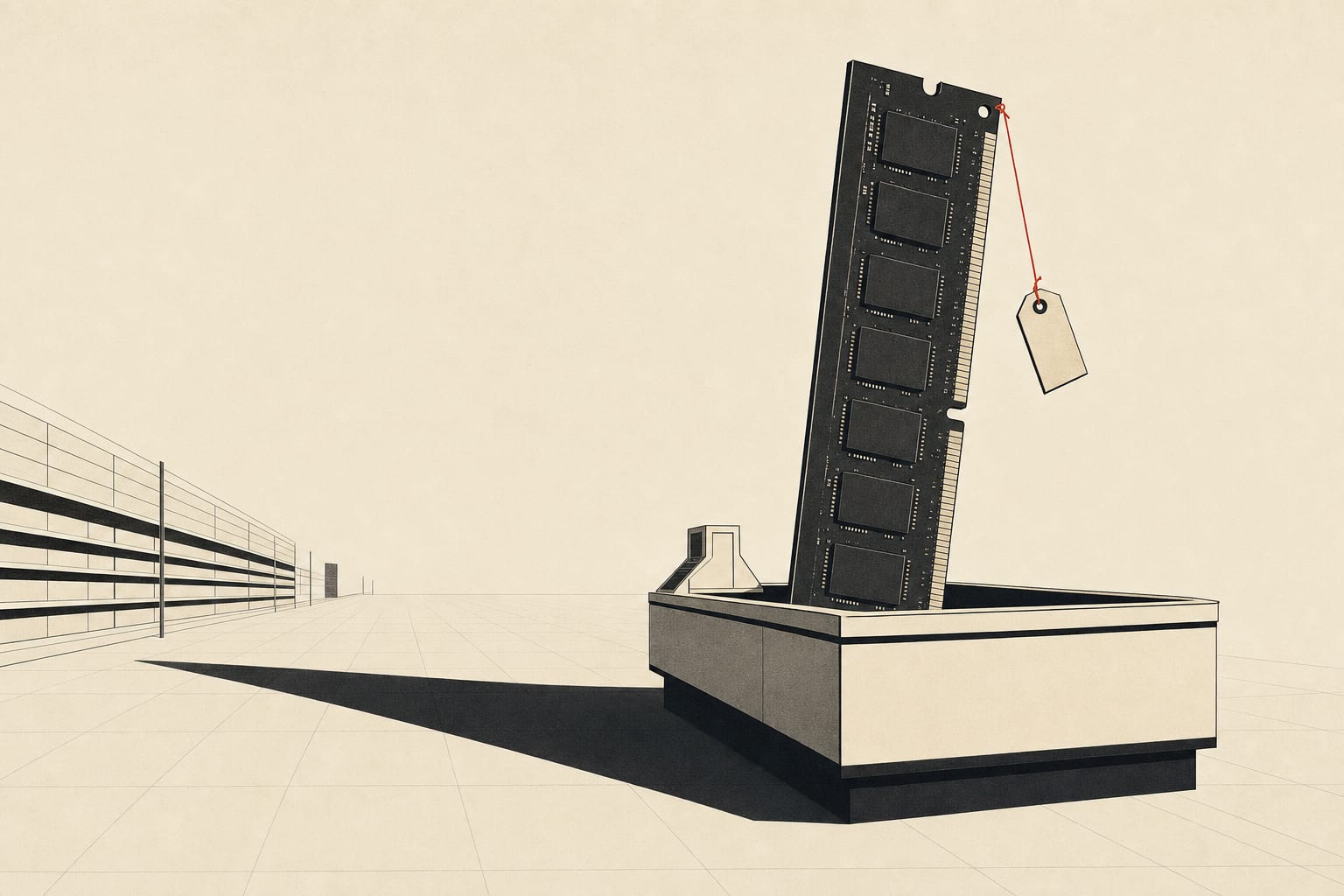
The AI shortage reaches the checkout aisle: Nvidia has finished RTX 50 Super GPUs it won't ship because 3GB GDDR7 memory costs triple the 2GB it replaces, PC building is in a "component crisis," and the fastest new memory goes to AI first — as the models themselves get cheaper and more bundled
There is a finished graphics card sitting in a warehouse that Nvidia cannot bring itself to sell. The RTX 50 Super refresh is reportedly built and ready, and it is stuck, because the 3GB GDDR7 memory modules it needs now cost about three times what the 2GB modules they replace used to. That is the AI boom arriving at the one place it was supposed to stay away from: the shelf where ordinary people buy a computer. For two years the memory shortage was a data-center story, an earnings-call abstraction. This weekend it is a gaming GPU that a company would rather not ship than sell at the price its own components now demand.
It is not one product. Building a PC at all has become, in the plain words of the hardware press, a "component crisis caused by the AI boom" — parts overpriced despite ample supply, buyers told to wait or hunt for bundles. The fastest new server memory on display this week, DDR5-8000 and second-generation MRDIMMs running at 12,800 megatransfers, is being shown off precisely because the AI servers get it first; the desktop gets last year's speed at a premium. Micron and Samsung are selling every good die they can make into the highest bidder, and the highest bidder is always the data center. Everyone else is now in line behind it.
Hold that against what happened to the models the same weekend and you get the shape of the whole year. Anthropic said it will fold Fable 5, its most capable model, into its Max and Team subscriptions from July 20 — the frontier moving from a metered luxury toward a flat-rate default. Moonshot's Kimi K3 is undercutting the American labs so aggressively that one outlet only half-joked about "full AI communism." The intelligence is getting cheaper and more bundled by the week. The machine that runs it is getting scarcer and dearer by the same week. That divergence is the single most important price signal in technology right now, and this weekend both halves of it moved at once.
The reason it matters beyond the gaming aisle is that it inverts the rule the whole industry was built on. Computing is supposed to get cheaper as it improves; that assumption underwrites every roadmap and every budget. In AI it has split in two. The soft part — the model, the tokens, the capability — obeys the old rule and falls. The hard part — the memory, the boards, the power, the physical machine — is breaking the rule and rising, because demand is inhaling supply faster than fabs can answer. A finished GPU that can't ship is what that inversion looks like when it finally reaches a store.
And underneath it a quieter question got asked out loud. Neil Rimer, who co-founded Index Ventures, said the plain thing this week: the historic wealth AI is generating will have to come back out, voluntarily or otherwise. He was talking about the money, but the mechanism is the same one straining the component aisle — an enormous amount of value pooling in a very small number of places, from the compute down to the DRAM, while the costs radiate outward to everyone buying a phone, a graphics card, or an electricity plan. The scarcity reached the checkout this week. The argument about who ultimately pays for it is just getting started.
A finished RTX 50 Super sits in limbo because its memory tripled in price
The clearest single image of the memory crunch this weekend is a graphics card Nvidia reportedly built and then declined to ship. According to board-partner sources, RTX 50 Super units are on hold because the 3GB GDDR7 modules the refresh depends on cost roughly triple the 2GB modules they replace, wrecking the margins the product was designed around. This is a company choosing not to sell finished inventory rather than eat the price its own memory suppliers now charge — because those suppliers can sell every die to a data center instead. The consumer GPU, long the way the AI hardware boom trickled down to normal buyers, has become the thing the boom is now pricing out. When the halo product can't clear its own bill of materials, the shortage has stopped being abstract.
The fastest new server memory is on display precisely because you can't have it yet
At the industry's memory trade shows this week the headline parts were DDR5-8000 registered modules and second-generation MRDIMMs clocking 12,800 megatransfers a second — and the subtext was who gets them. The answer is AI servers, first and for a premium, while desktops and mainstream servers wait a generation behind. It's the same dynamic as the stranded GPU, one rung up: the best memory the fabs can make is spoken for before it ships, absorbed by accelerators that will pay anything for bandwidth. The result is a two-tier market where the data center runs on next year's memory and everyone else pays more for last year's. That gap is the shortage expressed as a product roadmap, and it widens every quarter the AI build-out keeps buying ahead of supply.
Anthropic folds its most capable model into flat-rate subscriptions as Kimi undercuts the whole market
The other half of the divergence showed up on the model side. Anthropic said it will include Fable 5, its most capable model, in Max and Team Premium subscriptions from July 20 at half the usual limits — the frontier sliding from a metered luxury toward a flat-rate default. In the same news cycle, Moonshot's Kimi K3 kept undercutting the American labs so sharply on price that TechCrunch reached for the phrase "full AI communism" to describe the reaction. Put the two together and the direction is unmistakable: capability is getting cheaper, more abundant, and more bundled almost weekly. This is exactly the trend that makes the hardware crunch bite harder, not softer — because a world where everyone runs big models all the time is a world that needs more memory, more boards and more power than a world where models were rationed by price.
A founding VC says the quiet part: the AI wealth will have to come back out
Neil Rimer, co-founder of Index Ventures and no outsider to this boom, said the thing most of his peers won't this week: the historic wealth AI is generating will eventually have to be redistributed, voluntarily or involuntarily. It's a striking admission from inside the machine that is minting the fortunes, and it names the same imbalance the component aisle is straining under — enormous value concentrating in a handful of places, from the frontier labs down to the memory makers, while the costs fan out to everyone buying a device or paying a power bill. Rimer was talking about capital, not DRAM, but it's the same physics. When the gains pool this tightly and the costs spread this wide, the pressure to force some of it back out builds whether the winners like it or not.
Two prices moved in opposite directions this weekend, and the gap between them is the story of the year. The model got cheaper and more bundled: Anthropic is folding Fable 5 into flat-rate subscriptions, and Kimi K3 keeps undercutting the field hard enough to unsettle the American labs. The machine got scarcer and dearer: Nvidia has a finished RTX 50 Super it won't ship because its memory tripled, PC building is in an open "component crisis," and the fastest new memory is reserved for AI servers. Computing is supposed to get cheaper as it improves; in AI that rule has split in two, with the soft layer falling and the hard layer rising, and this weekend the rising half finally reached the store shelf. Neil Rimer named the endgame from inside the industry: the wealth this is generating will have to come back out. The next place to watch isn't a benchmark. It's a price tag — the first mainstream device maker to raise prices, delay a launch, or reinvent how it sells hardware and blame the memory shortage out loud.
The datacenter memory shortage becomes a named line item in consumer pricing. Within the horizon, at least one top-five PC or smartphone maker publicly attributes a price increase, a product delay, or a new leasing/financing scheme to AI-driven memory or component costs — on the record, in its own words.
The stranded RTX 50 Super and the open "component crisis" show the squeeze has already crossed from data-center contracts into finished consumer hardware; margins can absorb that quietly for only so long. When a shortage forces a company to choose between eating the cost and passing it on, the historical answer is to pass it on and name a reason — and "AI-driven memory costs" is the reason sitting right there.
If the horizon closes with no top-five PC or phone maker publicly tying a price hike, delay, or new financing scheme to AI-driven memory or component costs, the call is wrong.
We hold the Micron long, and this weekend it printed in the most vivid way yet: Nvidia has a finished graphics card it won't ship because the memory costs too much, and the fastest new server memory is reserved for AI buyers who will outbid everyone. That is the thesis made physical — memory is the scarce, repricing input, and every good die a fab makes now goes to the highest bidder, which is always the data center. Micron is the cleanest US-listed way to own that scarcity. Conviction stays measured rather than high only because the same force that mints these quarters is the one that always, eventually, over-corrects.
A stranded consumer GPU and a two-tier memory market are direct evidence that AI demand is absorbing memory supply faster than it can grow, sustaining pricing power well into the build-out. The offset is unchanged: memory is cyclical and over-corrects on a multi-year lag, and the bear case is public.
We hold the Nvidia watch, with a wrinkle from its own product line this weekend. The RTX 50 Super stuck on GDDR7 pricing is a reminder that Nvidia is not immune to the memory squeeze it helped create — its consumer margins get pinched by the same scarcity its data-center demand is causing. It's a small line against an enormous data-center business, but it's a clean illustration of why the watch is a watch: the demand is real and broad, and the cost structure underneath it is moving in ways even Nvidia can't fully control.
Insatiable accelerator demand supports the franchise, but rising memory and component costs pressure the margins on the parts of Nvidia's line that can't simply outbid everyone; the open question remains the financing quality beneath the data-center order book.