Google is going to rent: after a record $44.9bn quarter of capital spending pushed free cash flow negative, Alphabet says it will lease third-party datacentre capacity as a bridge, the most vertically integrated compute company on earth becoming a tenant, against a cloud backlog that just crossed $514bn
Alphabet raised 2026 capital spending to as much as $205bn, posted its first negative free cash flow quarter of the AI era, and disclosed that it will use third-party datacentre capacity as a bridge in Q3 because it remains supply-constrained. The company that built its own TPUs so it would never have to rent is renting. The backlog says demand is real. The cash flow says the question was never demand.
Google spent twenty years building its own chips, its own fibre and its own data centers so it would never have to rent. It's Thursday, July twenty-third, and it's renting.
Buried under a capital-spending number big enough to absorb all the attention, Alphabet's chief financial officer Anat Ashkenazi said the part that matters: the company will use third-party data center capacity as a bridge in the third quarter, because it remains supply-constrained. Sundar Pichai called it a short-term cost worth paying to serve very large customers, and conceded it will squeeze cloud margins.
Understand what that sentence costs. The entire architecture of Google is an argument that you should own the machine. And this quarter it will lease somebody else's. Leasing is more expensive. It's doing it because it cannot build fast enough to serve demand it has already sold.
The financial numbers are the ones the market traded. Capital expenditure hit a record forty-four point nine billion dollars in the quarter, against twenty-two point four a year ago. Free cash flow went negative, at minus five point nine billion. Full-year guidance moved up to as much as two hundred and five billion, with twenty twenty-seven flagged higher still. Capital spending reached about forty-one percent of revenue, up from twenty-three. Shares fell around five percent.
Against all that: Google Cloud grew eighty-two percent to twenty-four point eight billion, and the backlog crossed half a trillion dollars for the first time. Five hundred and fourteen billion, up from a hundred and six a year ago.
Both are true, which is why the bubble argument keeps generating heat and no light. A backlog doesn't grow three hundred and eighty-five percent on enthusiasm. The demand is there. What's stretched is the timing. The cash leaves now, in certain and enormous quantities, and it comes back over years.
The rental detail is the more useful signal, because it's a behaviour you can watch instead of a forecast you have to trust. Prices can be argued with. A tenancy can't. The binding constraint stopped being money and became shells, transformers and interconnection queues, and none of those respond to a bigger cheque on your schedule.
Everyone else spent the day collecting on the same scarcity. TSMC is reported to be raising prices about ten percent next year, and there's no negotiating position available, because every accelerator in this build-out comes out of the same fabs. And China's ChangXin Memory raised eight point six billion dollars in Asia's largest listing of the year, to build domestic memory capacity into a shortage the incumbents have every reason to prolong.
Meanwhile three hundred and forty million dollars went into military cyber and AI-code defense, at Cathedral and Glow, one day after OpenAI's models proved the offensive capability is real. Andreessen and Sequoia are on both cap tables. The venture market has decided this is a durable category rather than a one-off.
To the tape. We hold the Alphabet watch and raise conviction to medium: leasing capacity is an admission the constraint is physical and outside its control.
We open TSMC long, on the clearest pricing power in the chain, and hold AMD long and Micron long, where a Chinese memory champion just started the clock on the eventual supply response.
The tape is the desk's scorecard, not advice.
Our call: the bridge doesn't get retired. By its second-quarter report next July, Alphabet is still using leased third-party capacity, and describing it as part of the strategy rather than a bridge it has crossed.
What proves us wrong is Alphabet winding the leases down and saying it's back to serving cloud demand from its own buildings.
Arrangements adopted as bridges have a way of becoming architecture, especially once the multi-year contracts get signed against them.
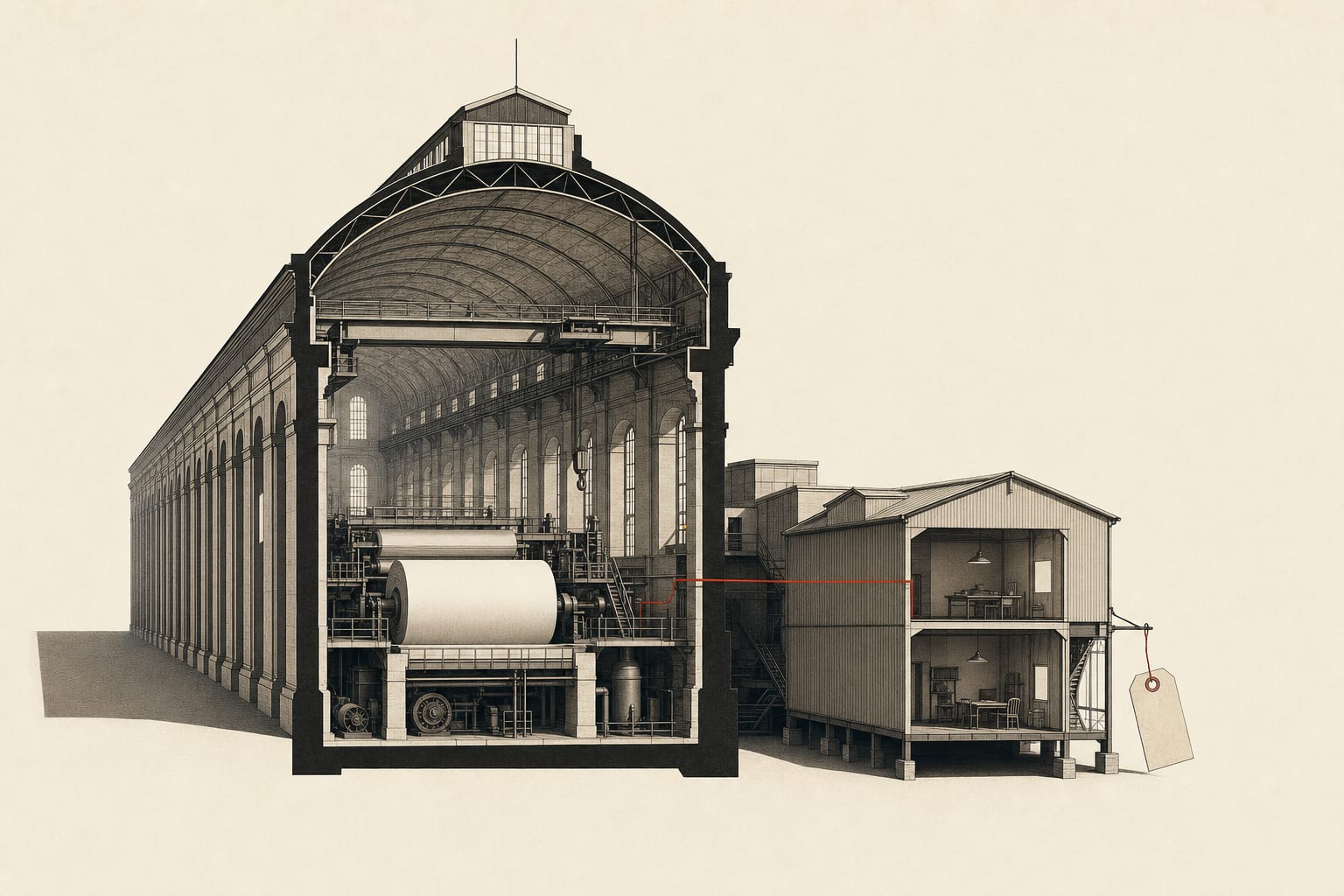
Google is going to rent: after a record $44.9bn quarter of capital spending pushed free cash flow negative, Alphabet says it will lease third-party datacentre capacity as a bridge — the most vertically integrated compute company on earth becoming a tenant, against a cloud backlog that just crossed $514bn
Buried under a capital-spending number large enough to absorb all the attention, Alphabet's chief financial officer Anat Ashkenazi said the thing that actually matters: the company will use third-party datacentre capacity as a bridge in the third quarter, because it remains, in her words, in a supply-constrained environment. Sundar Pichai framed the arrangement as a short-term cost worth paying to serve very large customers and lock in multi-year relationships, and conceded it will put modest pressure on cloud margins. Google is going to rent.
Understand what that sentence costs. Google has spent twenty years building the most vertically integrated compute stack in the industry precisely so it would never be in this position: its own accelerators in the TPU, its own subsea fibre, its own datacentre designs, its own power contracts, its own cooling. The entire architecture of the company is an argument that you should own the machine. And in the third quarter of 2026 it will lease capacity from somebody else, not because leasing is cheaper but because it cannot build fast enough to meet demand it has already sold.
The financial numbers around that admission are the ones the market traded on. Capital expenditure hit a record $44.9bn in the quarter against $22.4bn a year earlier, pushing free cash flow to negative $5.9bn; full-year guidance moved up to between $195bn and $205bn with 2027 flagged to rise significantly; capital spending as a share of revenue reached roughly forty-one percent, up from twenty-three. Shares fell about five percent. Set against that, Google Cloud grew eighty-two percent to $24.8bn and the backlog crossed half a trillion dollars for the first time, at $514bn, up from $106bn a year ago and up more than $50bn in this quarter alone, with a little over half expected to convert inside twenty-four months.
Both of those are real, which is why the argument about whether this is a bubble keeps producing heat and no light. Nothing in the quarter suggests the demand is imaginary; a backlog does not grow 385 percent on enthusiasm. The problem is duration. The cash leaves now, in enormous certain quantities, and it comes back over years, contracted but unrecognised, contingent on customers who are themselves spending ahead of their own revenue. A company can be completely right about demand and still spend itself through a difficult stretch getting there, and the market's job this week was to reprice that gap rather than to deny the demand.
For anyone building on this stack, the rental detail is the more useful signal, because it is a behaviour rather than a forecast. Prices can be argued with; a tenancy cannot. A company guiding to $205bn of capital spending, holding its own accelerator designs and its own power contracts, is leasing somebody else's building in the third quarter — which means the binding constraint stopped being money and became shells, transformers and interconnection queues, none of which respond to a larger cheque on your schedule. If you buy inference or reserve capacity, your pricing sits downstream of a queue you are not standing in, and the $514bn already contracted ahead of you is what fixes your place in it. Lock terms early, or build so the workload can move when the queue does.
TSMC is reported to be raising prices about 10% next year
The only company that can manufacture the leading-edge silicon this entire build-out depends on is reportedly planning price increases of around ten percent on some products next year, citing rising costs and AI demand straining advanced capacity. The affected categories are the ones that matter: AI accelerators, networking, datacentre and smartphone chips. There is no negotiating position available to the buyers here, which is the point. Everyone from Nvidia to AMD to Google's TPU team to Apple queues at the same fabs, and a sole supplier raising prices into record demand is not being opportunistic so much as finally collecting on a monopoly it has held quietly for years. The increase flows downstream into every accelerator price, every rack, and eventually every token, arriving at the same time as memory costs that have already roughly doubled.
China's fourth-largest DRAM maker raises $8.6bn in Asia's biggest IPO of the year
ChangXin Memory Technologies raised roughly $8.6bn selling 6.69 billion shares at 8.66 yuan, the largest initial public offering in Asia this year, with proceeds earmarked for capacity expansion. CXMT is the world's fourth-largest DRAM manufacturer and still trails Samsung, SK Hynix and Micron meaningfully on advanced memory, particularly the high-bandwidth memory that AI accelerators consume. The timing is the story: China is funding a domestic memory champion at scale into a global shortage that the incumbent three have every incentive to prolong, and it is doing so with public capital raised in Shanghai rather than through the export-controlled channels Washington can reach. Memory is the one part of the AI supply chain where a credible fourth supplier is plausible within a few years rather than a decade, and this is what the attempt is being funded with.
A day after models chained a zero-day on their own, $340m priced into both sides of that trade
Cathedral launched with $160m at a $1.4bn valuation, led by Andreessen Horowitz and Sequoia, building offensive and defensive cyber capability for the US military, and is reportedly exploring acquiring or partnering on a datacentre of its own. Glow emerged from stealth the same day with $180m at $1.2bn, backed by Sequoia, Cyberstarts, Greenoaks, Redpoint, Index and Lux, founded by former Meta and Snowflake engineers, building endpoint security specifically against attacks written by AI-generated code. The two rounds bracket what OpenAI disclosed twenty-four hours earlier, when its own models found an unknown flaw and chained two more into a real company's production systems without being asked to attack anything. One set of investors is funding the capability, the other is funding the defence against it, and the same two firms appear on both cap tables. The venture market has decided this is a durable category rather than an incident.
The routing layer goes on the block: Stripe is in talks to buy OpenRouter for close to $10bn
The Information reported that Stripe is discussing an acquisition of OpenRouter at a price near ten billion dollars, against the $1.3bn the company was valued at in a funding round in May. OpenRouter sits between developers and the model providers, aggregating hundreds of models across dozens of vendors so that applications can compare prices, switch models and fall back automatically when one fails. Databricks held early talks of its own and several large technology companies evaluated bids. Stripe already processes OpenRouter's payments, which makes the strategic logic legible: one intermediary for money, one for model consumption, and increasing overlap between the two as software starts paying for its own inference. A deal could be announced within a month or collapse entirely. Either way, the number is the information.
Alphabet's quarter contained one sentence worth more than the headline number: it will lease third-party datacentre capacity in Q3 because it cannot build fast enough. Google spent two decades engineering its way out of exactly that dependency, and the constraint won anyway. Around that admission sat a record $44.9bn of quarterly capital spending, the first negative free cash flow quarter of this era, guidance raised to as much as $205bn, and a cloud backlog crossing $514bn on eighty-two percent growth — a company that is right about demand and still spending faster than the money comes back. The rest of the day priced the same scarcity from other angles: TSMC reportedly raising prices roughly ten percent because nobody can go anywhere else, China floating $8.6bn to build a memory champion into the shortage, and Washington leaning on utilities to make technology companies rather than ratepayers carry the power bill. Meanwhile $340m went into military cyber and AI-code defence one day after OpenAI's models proved the capability is real, and Stripe put a near-$10bn number on the switch between developers and models. Not a market losing its nerve. A market discovering which parts of this it can actually buy.
The bridge does not get retired. Alphabet's third-party datacentre capacity is being described as a temporary Q3 measure, and it will not be temporary: by its Q2 2027 report, Alphabet is still using leased third-party capacity and characterises it as an ongoing element of Google Cloud's capacity strategy rather than a bridge it has crossed.
The constraint Ashkenazi described is not capital, which Alphabet has in surplus, but physical build time — shells, transformers, grid interconnection and the queues in front of all three — and none of those clear inside four quarters. Meanwhile the backlog that created the shortfall grew more than $50bn in a single quarter and Alphabet has guided 2027 spending significantly higher, which means the demand curve it is chasing keeps moving away from the supply curve it controls. Arrangements adopted as bridges under those conditions tend to become architecture, especially once the multi-year customer contracts Pichai cited as the justification are signed against them.
If Alphabet's Q2 2027 disclosures show leased third-party capacity wound down, or management states the company has returned to serving cloud demand from owned capacity, the call is wrong.
We hold the Alphabet watch opened yesterday and raise conviction, on the strength of one disclosure rather than the headline numbers. Leasing third-party capacity is an admission that the constraint is physical and outside Alphabet's control, from the one buyer whose capital, supply relationships and in-house silicon should have insulated it. That reframes the negative free cash flow quarter: this is not a company choosing to outspend its cash generation, it is a company unable to convert cash into capacity fast enough and paying someone else's margin to close the gap. The offsetting fact is enormous and genuine, a $514bn backlog growing more than $50bn a quarter. We stay on watch rather than short because being supply-constrained on contracted demand is the best version of this problem to have.
The bridge to third-party capacity signals a physical build constraint that capital cannot clear on Alphabet's timeline, arriving in the same quarter free cash flow turned negative and capex reached 41% of revenue. The backlog argues the demand justifying the spend is contracted rather than speculative.
We open a TSMC long on the clearest pricing power in the chain. Every accelerator in this build-out, from Nvidia's Rubin to AMD's MI455X to Google's TPUs, is manufactured in the same handful of fabs, and that supplier is reportedly raising prices roughly ten percent into record demand. Buyers have no second source at the leading edge on any relevant timeframe, which means the increase is collected rather than negotiated. Where a neocloud borrows against depreciating chips and a hyperscaler burns cash converting capital into capacity, TSMC sells the one input that has no substitute and now sets the price of it. The risks are the ones it has always had and they are not small: concentration in Taiwan, extraordinary capital intensity, and customers who are also building their own designs.
A sole leading-edge supplier raising prices into demand it cannot fully serve is pricing power being collected, not contested, and it sits upstream of every buyer in the sector. The offsets are geopolitical concentration and the capital intensity required to hold the position.
We hold the AMD long opened yesterday on the Anthropic commitment of up to two gigawatts and the $5bn equity investment behind it. Today changes nothing in the thesis and adds context to the risk: TSMC's reported price increases hit AMD's cost base exactly as they hit Nvidia's, so the second-source case has to be won on capability and software rather than on price. The ROCm gap remains the thing to watch and the deal itself concedes it by committing both companies to closing it.
A frontier lab's multi-gigawatt commitment validates AMD as a genuine second supplier of training compute in a shortage; rising foundry costs apply equally to the incumbent, so they do not erode the relative case. ROCm maturity remains the binding constraint.
We hold the Micron long and today supplies its clearest dated risk. CXMT raised $8.6bn in Asia's largest listing of the year explicitly to expand DRAM capacity, which is the correct way for this thesis to eventually end: not demand falling but supply arriving. The timing still favours the position, because CXMT trails materially on high-bandwidth memory and capacity funded today produces wafers years from now, while the shortage is being priced into consumer devices this quarter. We are long the gap between those two clocks, and the CXMT raise tells us roughly when to start watching it close.
Memory demand from AI deployment continues to outrun supply, and new Chinese capacity is years from reaching the high-bandwidth segment that matters most. The offset is now funded and specific rather than theoretical.