
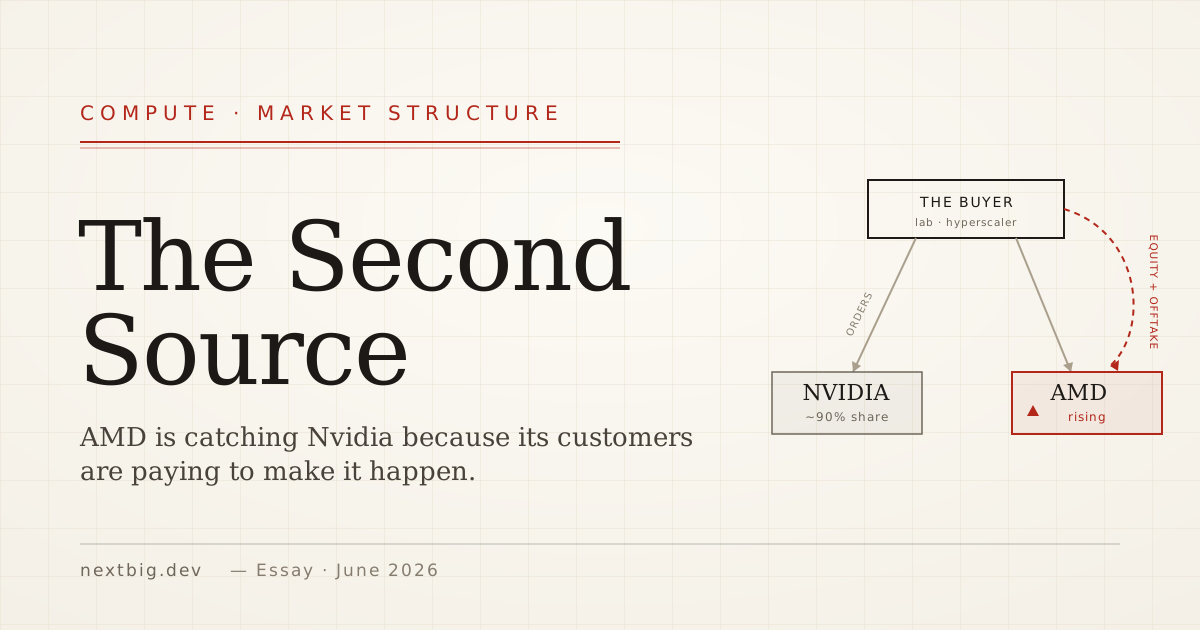
For a decade, "is AMD catching up to Nvidia?" had the same answer every year: not really. AMD shipped capable GPUs, won the odd benchmark, and watched Nvidia keep roughly nine of every ten dollars spent on AI accelerators. In 2026 the answer changed. AMD's data-center business booked $5.8 billion in a single quarter, up 57% on the year. OpenAI signed for six gigawatts of AMD chips and took a stake in the company to seal it. The catch-up is real, and the part worth your attention is who is paying for it.
Is AMD actually catching up to Nvidia?
On the metrics that pay rent, yes. AMD's first quarter brought in $10.3 billion in total revenue, up 38% year over year, with the data-center segment alone at $5.8 billion. Management guided the next quarter to $11.2 billion and called the moment "a clear inflection in our growth trajectory and a structural shift in our business." That is not the language of a company nibbling at the edges.
The technical gap closed too. AMD's current flagship, the MI355X, reached the latest round of MLPerf training benchmarks within range of Nvidia's Blackwell and scaled across multiple servers for the first time. On paper it carries more memory per GPU than the chip it competes with. Where AMD still trails, it trails on the parts that take longest to fix. Here is the round-by-round.
| Round | Where it stands in 2026 |
|---|---|
| Raw compute | Even The MI355X trades blows with Nvidia's B200 on dense throughput. The era of AMD being a generation behind on the chip is over. |
| Memory | AMD ahead 288GB of HBM3E per GPU against the B200's 192GB. More of a large model fits on one card, which matters most for serving. |
| Inference cost | AMD's claim AMD reports up to 40% more tokens per dollar on some Llama and DeepSeek runs. A vendor benchmark. Worth testing on your own workload before you trust it. |
| Rack-scale | Closing AMD's Helios rack answers Nvidia's NVL72: dozens of GPUs wired to run as one. New, unproven at fleet scale, but real. |
| Networking | Nvidia ahead NVLink and Spectrum-X are a full-stack interconnect lead AMD is still assembling. |
| Software | Nvidia ahead ROCm 7 is finally day-zero on PyTorch and vLLM. CUDA still owns the twenty-year long tail of kernels and libraries. |
| Market share | Nvidia leads Roughly 90% to single digits. The gap is wide. For the first time, it is genuinely moving. |
Read the card and a pattern shows up. AMD has pulled even on silicon and is closing on systems. It still trails on software and the network fabric, the two things you cannot rebuild in a quarter. That is a company that has become genuinely competitive without yet being a peer.
The chip is not why this is happening
Here is the catch. AMD had competitive silicon in 2023. The MI300X was a good chip, and it barely changed AMD's share. Capable hardware was necessary and nowhere near sufficient, because buyers do not switch a $100 billion compute pipeline for a 10% spec advantage. The reason 2026 looks different is not sitting in the chip.
What changed is the demand side. The handful of companies that buy almost all of the world's AI accelerators decided that a one-vendor market had become a risk they could no longer carry. So they stopped waiting for a competitor to arrive and started building one.
AMD did not win the second-source slot on merit alone. Its biggest customers funded one into existence.
The OpenAI warrant gives it away
In October 2025, OpenAI agreed to deploy six gigawatts of AMD Instinct GPUs across several years, the first gigawatt of MI450 chips landing in the back half of 2026. The headline was the scale. The story was the structure.
To lock the deal, AMD handed OpenAI a warrant for up to 160 million of its own shares at a penny each, vesting in tranches as OpenAI actually buys the chips. Exercised in full, OpenAI would own close to a tenth of AMD. Read that backwards. The customer now holds equity that only pays off if its supplier wins. A buyer does not negotiate for a slice of its vendor unless it has decided it cannot afford for that vendor to fail.
OpenAI is not alone. Oracle committed to a cluster of 50,000 MI450 GPUs starting in the third quarter of 2026, a build worth somewhere north of $3.5 billion. Meta signed a multi-year Instinct deal. These are the same names that absorb most of Nvidia's output. Together they form a monopsony, a market with a few enormous buyers, and a monopsony's deepest fear is a supplier it cannot replace.
Why a second source beats a discount
Nvidia's gross margin runs north of 70%. Spread across order books measured in the hundreds of billions, that margin is the single largest cost the buyers can actually do something about. No amount of polite negotiation moves it. Only a credible alternative does.
A real second source buys three things at once. It caps the price of the first source. It guarantees you can get chips when supply is tight. And it ends the risk of tying your whole roadmap to one company's silicon. A GPU that is 90% as fast delivers all three the day it becomes credible, which is why the buyers are not waiting for AMD to surpass Nvidia. They need it to be good enough to be real, and then they can sit across a table.
Warrants, multi-year offtake, and named clusters are how you take a vendor from "good enough" to "real" in eighteen months instead of five years. This is catch-up pulled forward by demand. The market grew the competitor it needed, then watered it.
AMD still had to be worth funding
None of this works if AMD has nothing to sell. You cannot sponsor a vendor into relevance on a roadmap of promises, and for three years AMD did the unglamorous work of making itself fundable.
The MI355X gave it a chip buyers could deploy without apology: a serious memory advantage and competitive benchmarks. ROCm 7, AMD's answer to CUDA, finally arrived as something teams could adopt on day one for the most common stack, PyTorch and vLLM. That closed the gap on the path most workloads actually take, even if it left the long tail untouched.
The swing is the MI400 series. The MI450 in the OpenAI and Oracle deals is among the first data-center GPUs built on TSMC's 2nm process, putting AMD ahead of Nvidia on manufacturing for the first time in memory. Its Helios system ties 72 of those GPUs into a single rack with 31 terabytes of fast memory, a direct answer to the rack-scale machines that are Nvidia's real product now. Merit got AMD to credible. Demand is carrying it to share. The order matters, and it runs in that direction.
Catching up is not caught up
Three gaps keep this honest. The first is software. CUDA is twenty years deep and the default assumption in every framework, paper, and tutorial written in the last decade. ROCm is good on the common path now and thin on everything else, and that switching cost is a tax AMD has lowered but not removed.
The second is systems. Nvidia no longer sells chips so much as racks and the network that binds them, and its interconnect remains a full-stack advantage AMD is only beginning to match with Helios. The third is timing. AMD's MI450 arrives in the second half of 2026 directly into the path of Nvidia's next platform, Vera Rubin, shipping the same half with its own memory and bandwidth leap. AMD is catching last year's Nvidia while Nvidia ships next year's. Every challenger in this market runs that treadmill, and Nvidia sets the speed.
What changes if you ship on GPUs
You do not need to buy a single AMD card to benefit from this. A credible number two lowers what everyone pays the number one, and that discount reaches your invoice whether or not you ever switch. For most teams, that is the whole story, and it is a good one.
If your serving stack is standard PyTorch with vLLM or SGLang, AMD is now a real option to price, especially for memory-bound inference where the larger card earns its keep. Run tokens per dollar on your own traffic, not the vendor's slide. If instead you live in the CUDA long tail of custom kernels and niche libraries, you are still locked in, and pretending otherwise buys you a migration you never budgeted for.
The deeper shift is optionality. For the first time in years, the compute market has two sellers worth taking seriously, and that fact rewrites every negotiation downstream of it.
Our Call
AMD exits 2026 with double-digit data-center GPU share for the first time, carried by the OpenAI and Oracle MI450 ramps. Then the climb slows. We expect AMD's share to plateau in the low-to-mid teens through 2027, because the binding constraint was never the silicon. It is CUDA and the systems stack, and those move in years, not quarters.
The test is the second half of 2026: MI450 against Vera Rubin, head to head, with ROCm asked to carry real training runs and not just inference. Falsifier: AMD clears 20% of data-center GPU revenue by the end of 2027, which would mean the catch-up became a pass. Or it slides back under 8%, which would mean the sponsorship never converted. Horizon: through 2027.
Frequently asked questions
Is AMD catching up to Nvidia in 2026?
Yes, on the numbers that matter most. AMD's data-center revenue hit $5.8 billion in Q1 2026, up 57% year over year, and buyers including OpenAI, Oracle, and Meta have signed multi-year deals for its Instinct GPUs. AMD is still behind on software (CUDA versus ROCm) and on rack-scale networking, so it is narrowing the gap rather than erasing it. The unusual part is what is driving it: Nvidia's own largest customers are funding AMD as a second source to break the single-vendor market.
How does AMD's MI355X compare to Nvidia's Blackwell B200?
The MI355X (CDNA 4) carries 288GB of HBM3E memory at 8TB/s against the B200's 192GB, so a single AMD GPU can hold more of a large model. On dense compute the two trade blows, and at MLPerf the MI355X now approaches Blackwell and scales across servers. AMD also claims as much as 40% more tokens per dollar on certain inference workloads, though that is a vendor benchmark you should verify on your own load.
Why did OpenAI invest in AMD?
OpenAI's October 2025 agreement commits it to 6 gigawatts of AMD Instinct GPUs over several years, beginning with the MI450 in late 2026. To secure it, AMD gave OpenAI the right to buy up to 160 million AMD shares for a penny apiece, vesting as the chips are delivered. Exercised in full, that is roughly 10% of the company. The structure ties the customer to the supplier's success and is the clearest sign buyers want a credible alternative to Nvidia.
Can AMD's ROCm replace Nvidia's CUDA?
For the common path, increasingly yes. ROCm 7 supports PyTorch and vLLM on day one, which covers most inference and a lot of training. For the long tail of custom CUDA kernels and niche libraries built over two decades, the honest answer is still no. If your stack is standard PyTorch plus vLLM or SGLang, AMD is a real option; if you depend on hand-written CUDA, switching still costs a migration.
Will AMD take market share from Nvidia?
Almost certainly some. AMD held single-digit data-center GPU share entering 2026 and is targeting double digits, and the OpenAI and Oracle ramps should get it there by the end of the year. The harder question is the ceiling. Our call is that share plateaus in the low-to-mid teens through 2027, because the real constraints, software depth and full-stack systems, take years to overcome.
Sources
- AMD, First Quarter 2026 Financial Results (data-center revenue, guidance).
- OpenAI, OpenAI and AMD announce strategic partnership to deploy 6 gigawatts of AMD GPUs; CNBC on the warrant and ~10% stake.
- Oracle, Oracle and AMD expand partnership (50,000 MI450 GPUs).
- Igor's Lab, MI355X at MLPerf Training 6.0 (benchmarks, multi-server scaling).
- The Register, AMD's Helios rack-scale system (MI400 series, rack architecture).
- Computer Weekly, ROCm versus CUDA (software ecosystem).
- Silicon Analysts, AMD vs Nvidia AI GPU market share 2026.