
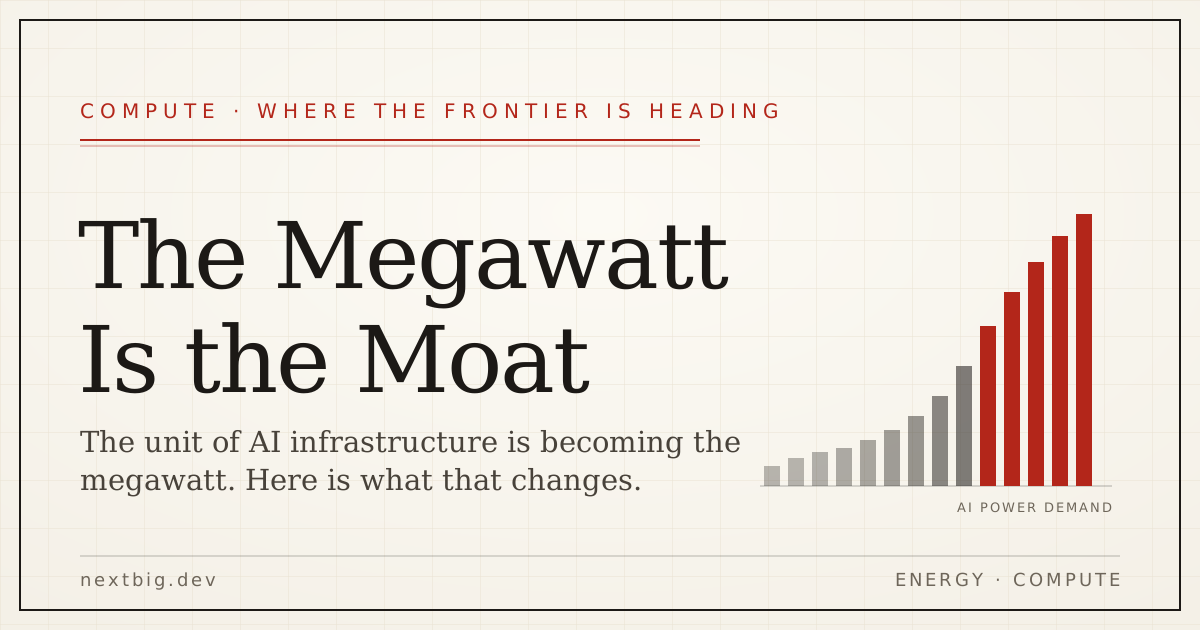
For three years, the AI build-out has read as a chip story. Whoever holds the most accelerators wins; whoever is short of them waits. That framing is now wrong at the load-bearing joint. Chips you can buy. A substation you cannot order off a shelf, and the wait for a fresh grid connection in the United States runs past four years. The scarce input stopped being the processor. It became the power to run it, and the wire that carries that power to the door.
This is the quiet turn underneath every loud datacenter headline. The binding constraint in AI has moved from silicon to electricity, and that moves the whole industry onto new ground. The companies that see it are reorganizing themselves around power. The ones that do not are counting GPUs and wondering why the GPUs are sitting in a warehouse, waiting on a transformer that is three years out.
You can buy a chip. You cannot buy a grid.
Start with the thing every shortage has in common: it ends. The AI chip crunch was real, and it was also temporary, the way chip crunches always are. Fabs add capacity. Packaging catches up. A second supplier appears. Eighteen months of scarcity turns into a glut and the price falls. That cycle has run in semiconductors for fifty years, and it is running again now.
Power does not behave like that. Electricity is not a thing you stockpile; it is a service delivered the instant you use it, over physical wire that takes years to permit and build. The bottleneck in front of every large AI datacenter today sits one layer below the rack, at the interconnect: the substation, the transmission upgrade, and the queue you stand in to get them.
That queue is now the defining number in AI infrastructure. At the end of 2025, more than 2,000 gigawatts of generation and storage sat in United States interconnection queues, waiting for permission to plug in. That is close to twice the entire installed capacity of the country's power fleet, lined up and idling. The median project now waits more than four years from request to switch-on, over double the wait a decade ago. You can stand up a building full of accelerators in a year. The wire to feed it takes longer than the hardware inside will stay current.
2,000+ GW
capacity waiting in US interconnection queues, end of 2025
4+ yrs
median wait from request to grid connection
9x
PJM capacity-price jump in one auction, 2025 to 2026
The price signal is already screaming. In the PJM grid that covers the mid-Atlantic and the densest concentration of datacenters on Earth, the 2025 to 2026 capacity auction cleared at $269.92 per megawatt-day, up from $28.92 the year before. That is a ninefold jump in the cost of merely promising power will be available, in a single auction, and the grid operator named datacenter load as the driver. In the Dominion zone around Northern Virginia, where the servers are thickest, the price hit its ceiling. Power used to be the line item you assumed. Now it is the line item that decides whether the project happens at all.
The chip was a shortage. The megawatt is a constraint. Shortages clear in a cycle. Constraints reprice everything built on top of them.
The unit of account flips to the megawatt
Once power is the binding input, the whole stack reprices around it, starting with how you count. For a decade the question was how many GPUs you had, then how many exaflops, then how many tokens per second. Those were the right units when silicon was the scarce thing. They are the wrong units now. The number that decides who builds what is contracted power, measured in megawatts and gigawatts, and the order of operations has inverted to match.
The old way: design the cluster, buy the chips, then go find somewhere to plug it in. The new way: lock the power first, then size the cluster to fit what you locked. Power moves to the front of the line. It is the first box now, and everything downstream is built to fit it.
Training era · silicon was scarce
Count the chips
- Unit: GPUs, exaflops, tokens per second
- Power is a utility bill you assume
- Order: site the cluster, then find a plug
- Edge: whoever holds the most accelerators
Power era · electricity is scarce
Count the megawatts
- Unit: contracted power, firm and behind-the-meter
- Power is the asset you secure first
- Order: win the energy, then size the cluster
- Edge: whoever controls the most firm, flexible load
You can watch the inversion happen in the most aggressive builds. When xAI stood up its Colossus cluster in Memphis in 2024, the local utility could offer it roughly 8 megawatts on day one. The datacenter needed something closer to 150. So the company did the thing that tells you exactly where the industry is going: it did not wait for the grid. It rolled in its own gas turbines and generated the power on site, ahead of the permits, and absorbed the lawsuits as a cost of speed.
A 150-megawatt computer running on an 8-megawatt connection is the entire thesis in a single site. When the grid cannot feed the frontier, the frontier brings its own power plant.
Compute gets an address again
For thirty years the whole promise of the cloud was that compute had no location. You did not know or care which building ran your workload. Capacity was abstract, fungible, everywhere. "Region" was a dropdown menu. The entire industry organized itself around the idea that where the computer physically sat was somebody else's problem.
Power dissolves that abstraction. A megawatt is intensely local. It exists at a specific substation, on a specific grid, under a specific regulator, near specific generation. When power is the binding input, the compute has to travel to where the power is, and the where turns concrete: a real place with a real address, a basin of cheap, firm electricity that a transmission line can actually reach.
So the map is being redrawn around energy. The build-out is migrating to places with spare generation and water and permitting will: stretches of Texas, the Ohio and Pennsylvania gas belt, the Upper Midwest, the desert Southwest, the Nordics. It is draining out of places where the grid is already full, no matter how badly the customers there want to buy. Northern Virginia still has all the demand in the world. What it has run out of is room on the wire.
Which is why the companies with the most at stake have stopped acting like software firms and started acting like industrial energy buyers. Microsoft signed a twenty-year agreement to restart a reactor at Three Mile Island, 835 megawatts contracted to a single customer to feed AI. Amazon bought a datacenter campus wired straight into a nuclear plant. Google and Amazon are funding small modular reactors. Meta put out a request for up to four gigawatts of new nuclear.
None of these are green press-release gestures. They are supply contracts, signed because the open market for firm power is now too tight and too slow to lean on.
When a software company signs a twenty-year nuclear contract, it has told you with its balance sheet what it now believes the scarce asset is. The model is the thing you can copy. The energy is the thing you cannot.
Compute is congealed electricity
This has all happened before, to a different product. For most of the twentieth century the most power-hungry thing humans made at scale was aluminum. Smelting it is essentially the act of forcing enormous current through molten ore; people sometimes call the metal congealed electricity, because that is most of what it costs to make.
And so the aluminum industry never sited itself near its customers or its ore. It sited itself near power. The smelters went to the cheap hydro: the Pacific Northwest behind the Bonneville dams, the fjords of Norway, Quebec, Iceland. The power did not move to the smelter. The smelter moved to the power.
AI compute is becoming the same kind of load. A frontier training run is, in plain physical terms, a months-long process for turning a few hundred megawatts of electricity into a model. That makes a datacenter far more like a smelter than like an office. And the smelter's logic, sixty years proven, is now the datacenter's logic: go to the power, sign for it long, and treat the energy contract as the core of the business instead of an overhead.
There is a second half of the aluminum story that matters even more, because it points straight at where this goes next. Smelters did not only chase cheap power. They sold their flexibility back to the grid. Many ran on interruptible tariffs: they took a lower price in exchange for a promise to power down within minutes whenever the grid got tight. A smelter is a giant schedulable load, and a schedulable load is worth more to a grid operator than a rigid one. That arrangement, the interruptible industrial customer, is about to become the most important idea in AI infrastructure.
The frontier becomes a load the grid can dispatch
Here is the part the current build-out has not priced yet. Everyone is racing to add firm, always-on power for datacenters, as though AI compute has to run flat out every second or the business breaks. For inference, the live serving of models to users, that is roughly true. For training, it is not.
A training run can pause. It can checkpoint, idle for an hour while a heat wave stresses the grid, and resume, with no user ever noticing the gap. Training is the most interruptible large industrial load ever invented, and almost nobody is using that fact yet.
Firm compute
Always on
What inference needs. Runs every second, pays a premium for the privilege, and competes head-on for scarce firm power.
Interruptible compute
Yields on command
What training can be. Checkpoints and pauses when the grid is tight, takes a lower price for the flexibility, and unlocks capacity that firm load can never reach.
The moment AI operators use it, the supply problem changes shape.
A 2025 study from Duke's Nicholas Institute ran the numbers. The existing United States grid, with no new power plants at all, could take on 76 to 100 gigawatts of fresh load, as long as that load agreed to throttle back for under 1 percent of the year. In PJM alone, about 18 gigawatts of headroom opens up at half a percent of annual curtailment. The grid has far more room than the queue suggests. What it is full of is demand that refuses to flex. The instant a large slice of AI compute agrees to bend, a continent's worth of stranded capacity appears, without pouring a single new foundation.
We know it works because another power-hungry compute industry already proved it. Bitcoin miners spent the last decade learning to be the grid's shock absorber. They put their machines where power was stranded and cheap, and they wrote their contracts to curtail on command. In Texas, miners routinely power down during peak demand and get paid for it; one large operator reported roughly $31 million in power and demand-response credits in a single hot month, earned mostly by switching off.
Then those miners found the real asset was the layer beneath the machines: the interconnects, the substations, the signed power. Core Scientific, a Bitcoin miner fresh out of bankruptcy, converted exactly that into a twelve-year deal to host AI compute for CoreWeave worth billions of dollars. The mining rigs were incidental. The megawatts were the company.
Put those together and you can see the next layer of AI infrastructure forming. Compute splits into two products with two prices. Firm compute, always on, is what inference buys at a premium. Interruptible compute, cheaper, is training capacity that agrees to yield when the grid is stressed. The two get priced apart, the way firm and interruptible power have been priced for a century, on a curve that moves by the hour and by the region.
AI capacity starts to behave like an energy market: a spot price, a forward curve, hedges, brokers. A training run gets scheduled against the price of electricity, the way an aluminum line always was.
That is where this is heading, and it is closer than the current conversation admits. The pieces are already on the table. Curtailable load is proven. The grid headroom is measured. The crypto industry built the demand-response playbook and signed the contracts to test it. What is missing is the last cultural step. AI operators have to accept that the most capable thing they run does not need to run every single second. Agreeing to flex is how they get power years sooner than the queue ever would.
The next moat in AI infrastructure is a book of power: how many megawatts you hold, how firm they are, and how cheaply you can flex the rest.
What to do while the megawatt is still mispriced
The repricing is early, which is exactly where the edge is. See it before it becomes consensus. Concretely:
- Read interconnects, not chip launches. The announcement that matters is not a new accelerator. It is a signed power purchase agreement, a substation upgrade, a slot in a grid queue. If you want to know who will actually have frontier-scale capacity in 2027, do not count their GPUs. Count their contracted megawatts, and check where they sit.
- Price inference against a power curve, not a flat rate. The cost of a token is becoming a function of when and where it is served. Build the assumption that compute has a peak and an off-peak price into your unit economics now, while your competitors still model it as a single fixed number.
- Make training interruptible before anyone asks you to. The teams that can checkpoint cleanly and yield compute on short notice will get power, and get it cheaper, years ahead of the teams that demand firm capacity. Treat clean preemption as an infrastructure feature worth engineering, the way you already treat fault tolerance.
- If you are buying compute, ask where the electrons come from. A provider sitting on owned, firm, behind-the-meter power is a different risk than one reselling grid capacity it does not control. The first can hold a price through a tight year. The second is exposed to the same auction that just cleared ninefold higher in PJM.
- If you invest in this, underwrite the energy book. The durable question about any AI infrastructure company has changed. It is how many megawatts it controls, on what terms, for how long, and how much of that load it can flex. That is the balance sheet that will still matter in 2030.
Software got to ignore physics. That holiday is ending.
For seventy years, computing got to pretend physics did not bind it. Every constraint that mattered, transistors and memory and bandwidth, kept getting exponentially cheaper, so the industry built a culture that treats resources as effectively free and location as irrelevant. The cloud was the purest expression of that culture: infinite compute, anywhere, on demand, billed by the second.
AI is the workload that finally hit the wall behind the abstraction. The wall is built out of megawatts, transmission lines, cooling water, and the slow physics of constructing any of them. None of that moves on a software timeline. So the industry is being pulled back into the physical economy it believed it had escaped, into the world of energy contracts and industrial siting and grid operators, the heavy slow world that aluminum and steel were never allowed to leave.
The teams that understand this are quietly rebuilding themselves around power. They are signing for electricity the way a smelter would, and engineering their workloads to bend so the grid will have them. The rest are counting chips. The chips, increasingly, are the easy part.
Our Call
By December 31, 2027, AI compute becomes a measurable participant in grid demand response, and the industry starts pricing it that way. Two observable things happen. First, at least one frontier-scale training operation runs publicly as a flexible grid load: it signs an interruptible or demand-response arrangement, curtails compute in response to grid conditions, and presents that as a design choice rather than an embarrassment. Second, at least one major cloud or neocloud ships a distinct interruptible or preemptible training tier whose price is explicitly tied to power or grid conditions, sold apart from firm, always-on capacity.
The case: every input already exists. The grid headroom for flexible load is measured and large. The contracts and the demand-response plumbing were built and proven by the crypto industry and are sitting right there. The economic pressure is extreme, with interconnect queues past four years and capacity prices up ninefold where the datacenters cluster. The only missing piece is the decision to treat training as interruptible, and the first operator to make it gets power years before the queue would deliver it. That is too large an edge to leave unclaimed through 2027.
What proves us wrong: the industry solves power by brute supply alone, pouring enough new gas and nuclear and firm capacity that nobody has to flex; training stays must-run by cultural default; and no major provider ships an interruptible compute tier priced against the grid. Power gets built, the megawatt stays a cost rather than a market, and AI compute never learns to bend.
Settles: December 31, 2027.
References and research base
- International Energy Agency, "Energy and AI" (2025). Used for the scale of the problem: datacenter electricity demand near 485 TWh in 2025 rising toward roughly 950 TWh by 2030, with demand from AI-optimized datacenters more than quadrupling over the period. Source.
- Lawrence Berkeley National Laboratory, "Queued Up" (2025 edition). Used for the interconnection-queue figure of more than 2,000 GW awaiting connection and the median request-to-operation wait now exceeding four years. Source.
- Utility Dive and PJM Interconnection, on the 2025 to 2026 Base Residual Auction clearing at $269.92/MW-day versus $28.92 the prior year, with the Dominion zone at its cap and datacenter load named as the driver. Source.
- Constellation Energy, "Constellation to Launch Crane Clean Energy Center," September 2024. Used for the twenty-year Microsoft power purchase agreement and the 835 MW Three Mile Island Unit 1 restart targeted for 2028. Source.
- DataCenterDynamics and the Southern Environmental Law Center, on xAI's Colossus datacenter in Memphis running on on-site gas turbines ahead of permits, a roughly 150 MW load brought up on an 8 MW grid connection. DCD, SELC.
- Nicholas Institute for Energy, Environment and Sustainability, Duke University, "Rethinking Load Growth" (2025). Used for the curtailment-enabled headroom modeling: 76 to roughly 100 GW of new flexible load integrable with under 1 percent annual curtailment, and about 18 GW of headroom in PJM at 0.5 percent. Source.
- Core Scientific, Form 8-K (SEC, 2024), on the twelve-year, roughly 200 MW agreement to host high-performance AI compute for CoreWeave, the clearest case of stranded mining power converting into AI capacity. Demand-response curtailment economics (including the Riot figure) reflect ERCOT programs and company-reported monthly updates. Source.
Source-quality note
The power figures here are drawn from primary and official sources and re-verified on June 20, 2026: the IEA's Energy and AI report for global datacenter demand; Lawrence Berkeley National Laboratory's Queued Up 2025 edition for interconnection-queue size and wait times; PJM and Utility Dive for the 2025 to 2026 capacity-auction prices; Constellation Energy's own announcement for the Three Mile Island restart; DataCenterDynamics and the Southern Environmental Law Center for the xAI Memphis power setup; Duke's Nicholas Institute for the curtailment-headroom modeling; and Core Scientific's SEC filing for the miner-to-AI conversion. The Riot demand-response figure is company-reported. The forward-looking claims (the megawatt as the unit of account, compute re-anchoring to power, the split into firm and interruptible compute, and Our Call) are this publication's thesis, not reported fact, and should be read as such.