
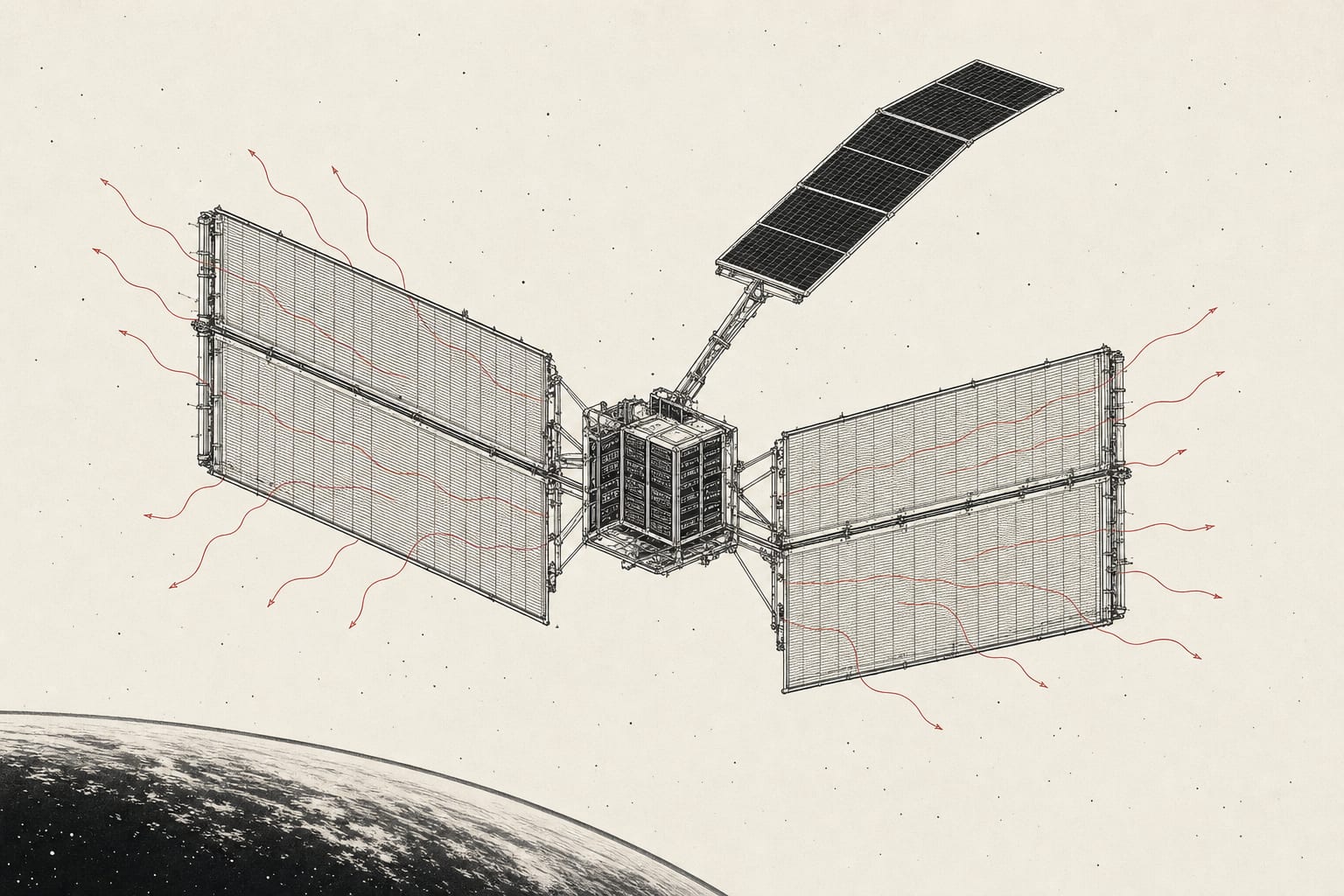
On June 8, SpaceX rolled out a satellite with a 70-meter wingspan, wider than a 747, and called it a data center. AI1 carries about 120 kilowatts of compute, roughly one rack of Nvidia's newest chips, and it is built to run that rack in orbit, off sunlight, for years. A week before that, Anthropic had told the market it wants gigawatts of the same thing. Seven months before that, a startup ran an H100 around the Earth and asked it questions. The idea that AI compute is moving off the planet stopped being a pitch deck this spring. It is hardware now.
So the live question is no longer whether you can put a computer in orbit. You can. One is up there. The question is whether the arithmetic ever closes. Everyone is talking about power. The thing that actually decides it is heat.
A data center with a wingspan
Strip AI1 to what matters. Seventy meters of solar wing and radiator, twenty meters tall, about 120 kilowatts of sustained compute at 600 kilometers up. Musk's own comparison was a single Nvidia GB300 rack. One rack, in orbit, is the whole machine. SpaceX says it is simpler than a Starlink broadband satellite, because it does not need the big phased-array antennas; it is mostly solar, radiator, and a box of chips.
AI1 is not alone, and that is the part worth sitting with. Starcloud put the first H100 in orbit last November and ran a Google open model on it, the first time a data-center-grade GPU did real work off the planet; its next launch, due in October, carries Blackwell silicon and a cloud platform customers can rent. Google's Project Suncatcher is designing clusters of TPUs flying in tight formation, linked by laser, with two demonstrator satellites booked for early 2027. Nvidia has stood up a space-computing line and is funding the startups. And in January, SpaceX filed with the FCC for up to a million satellites to serve as orbital data centers. A year ago this was a slide. Now it is a manifest.
The pull is coming from the labs. On May 6, Anthropic agreed to take all the capacity of a SpaceX terrestrial data center, more than 300 megawatts across some 220,000 GPUs, and in the same announcement said it wants to develop multiple gigawatts of orbital compute with SpaceX over time. Dario Amodei's stated reason was plain: for the first time, the company is growing faster than the exponential it had been planning around. When demand runs ahead of every forecast, people start looking at the sky.
Earth ran out of room, not ideas
To see why anyone would do this, look at what an AI data center fights for on the ground. Power, first and hardest: grid interconnects now come with multi-year queues, and the biggest buildouts stall waiting on substations and turbines, not chips. Then water, for cooling, in places that increasingly have none to spare. Then land, then permits, then the neighbors. The constraint on AI is no longer how many GPUs you can buy. It is where you can plug them in. On the ground, that scarcity is the whole game; we made that case in The Megawatt Is the Moat. Orbit is what you reach for when you stop competing for the plug and go to the source.
And the source is the sun. In the right orbit a satellite sits in near-constant sunlight, no night, no clouds, no atmosphere skimming the top off, which yields roughly a third more energy per panel than the best desert site and almost no batteries to buy. No grid queue. No water. No county to ask. The power that takes three years to connect on Earth is simply there, all the time, for the price of the panel.
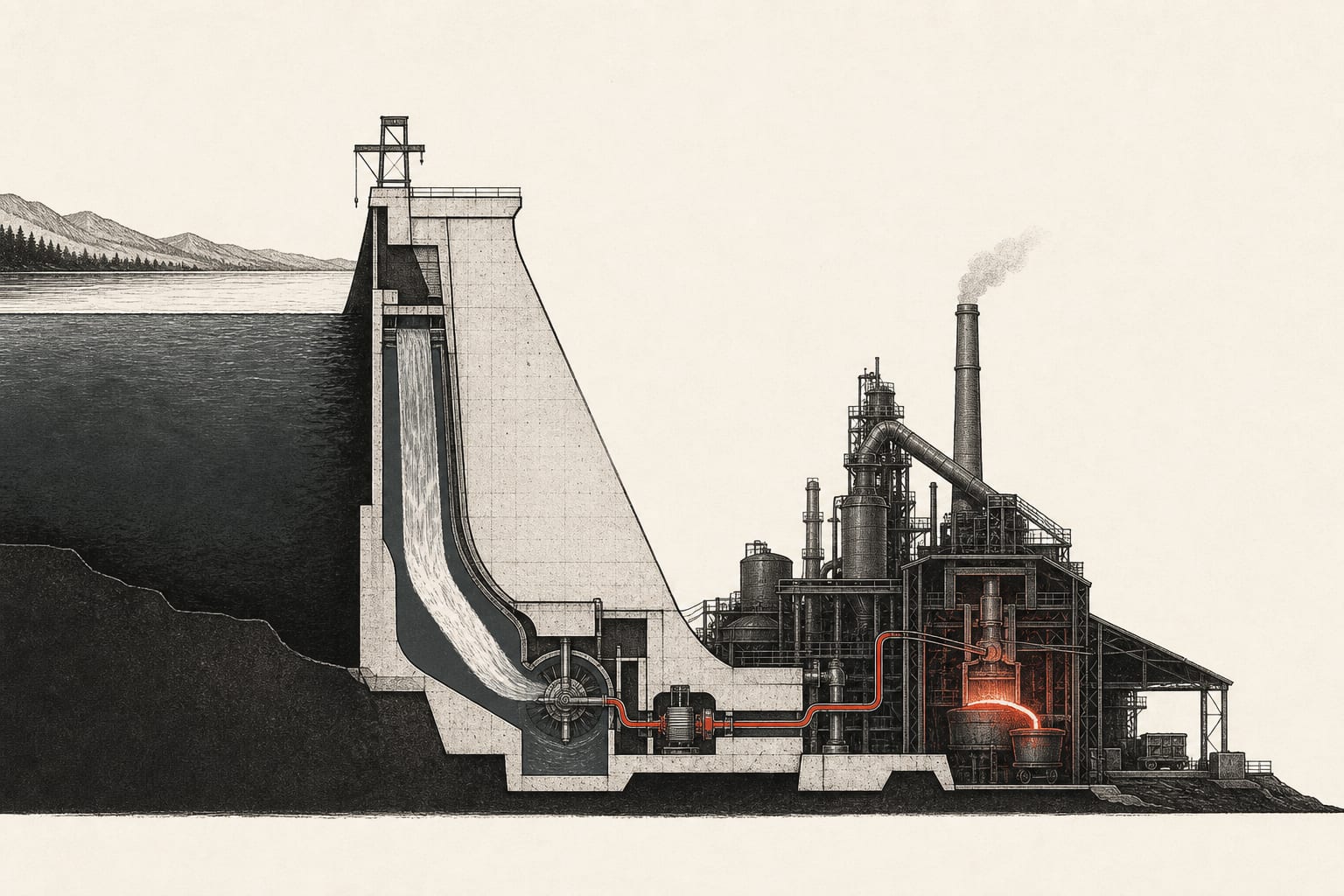
This is an old move in a new coat. Aluminum is sometimes called congealed electricity, because smelting it is mostly an electricity bill with a metal attached. So for a century we did not ship the power to the smelter; we built the smelter at the power. Alcoa sat its potlines at the foot of hydro dams. Iceland smelts other countries' bauxite because its geothermal power is too cheap to export any other way. AI compute is the new aluminum, congealed electricity in a different shape, and orbit asks the same question the dam once answered: if the cheapest power in the solar system is in space, does the smelter move there too.
You cannot open a window in a vacuum
Here is what the sunlight pitch leaves out. Every watt you compute is a watt you then have to throw away as heat. On Earth that is the easy half: blow air over it, or run water through it, and the atmosphere or a river carries it off. In a vacuum there is no air and no river. The only exit is radiation, the hardware glowing its heat away as infrared into the dark. And radiation is slow.
The physics is not kind. A radiator panel held near room temperature sheds only about 630 watts per square meter. Water-cooling the same chips on the ground moves heat more than a thousand times faster. So cooling stops being a detail and becomes the machine. A one-megawatt data center in orbit needs on the order of 1,600 square meters of radiator, about the footprint of a hockey rink, hung off a one-megawatt box of chips. Build the cooling the way the Space Station does and the radiators alone weigh ten times what the computers weigh. AI1 tells on itself here: 110 square meters of liquid radiator to shed the heat of a single rack.
630 W/m²
What a room-temperature radiator sheds in vacuum. Water-cooling on Earth moves heat about 1,000× faster.
~1,600 m²
Radiator area to cool one megawatt in orbit. Roughly the size of a hockey rink.
10 : 1
At Space-Station-grade cooling, radiator mass versus compute mass. The cooling outweighs the computer.
In orbit, the radiator is the computer. The chips are just the part that makes the heat you spend the entire design getting rid of.
This is the move most coverage misses. Orbit does not delete the constraint. It swaps which constraint binds. On the ground, power is scarce and cooling is cheap, so power sets the size of your data center. In space, power is free and cooling is brutal, so heat sets the size instead. You do not escape thermodynamics by leaving the planet. You change which side of the ledger the bill arrives on.
It comes down to dollars per kilogram
If heat sets the size, mass sets the price, because all of it, the chips, the radiators, the structure, the shielding, has to be launched. So the whole case for orbital compute rides on one number that has been falling for a decade: the cost to put a kilogram in orbit.
On a Falcon 9 that number is around 1,500 dollars a kilogram. Starship is built to drag it toward 100, and the people doing the sums are clear about the threshold. Google's Suncatcher paper argues that once launch costs fall under roughly 200 dollars a kilogram, which it expects by the mid-2030s, the lifetime cost of a data center in space lands in the same range as one on the ground. Below that line, the sun's free power outruns the cost of hauling the radiators up to use it. Above it, you should have built in Texas.
That is why SpaceX, not a chip company, is the name to watch. The case does not rest on a cleverer satellite. It rests on owning the whole chain: the rocket that sets the dollars-per-kilo, the satellite bus borrowed from Starlink, an 11-million-square-foot factory in Texas to stamp out solar wings and radiators, the laser mesh to move the data, the ground stations to catch it. No one else holds all of it. The orbital data center is less a new product than the thing that falls out of Starship working.
Built on the ground
Power-bound
- The wall: grid queues, substations, cooling water
- Energy: expensive, contested, years to connect
- Heat: cheap to dump into air or a river
- Repair: a technician swaps a dead GPU in minutes
Built in orbit
Heat-bound
- The wall: radiator area, launch mass, radiation
- Energy: free, constant, no storage, no permits
- Heat: leaves only by radiating, slowly, into the dark
- Repair: none. A dead cluster is relaunched, not fixed
Iridium worked. It still went bankrupt.
There is a ghost at this party, and its name is Iridium. In 1998 Motorola finished one of the engineering feats of the age: 66 satellites, more than five billion dollars, a phone that worked anywhere on Earth. It was magnificent, and it was bankrupt inside nine months. The handsets were bricks, the calls were dear, and by the time it flew, ordinary cell towers had eaten its market from below. The satellites worked perfectly. The spreadsheet did not.
That is the real warning for orbital compute, and it is not the one the skeptics usually reach for. The physics will probably work; Starcloud already ran the chip. The danger is the arithmetic, and the costs that never make the reveal-day slide.
Three of them. You cannot service the thing: when a GPU dies in a ground rack a technician replaces it in minutes, and AI silicon goes obsolete in two or three years regardless, so an orbital data center is not maintained, it is relaunched, the old one left to burn up on reentry. Radiation degrades the chips, though here the news is genuinely good: Google ran its TPUs through a particle beam and they took nearly three times a five-year dose before the memory complained. And debris: low orbit already holds tens of thousands of tracked objects and sees a reentry most days. A million-satellite plan is a great many new things to track, and a great deal of aluminum coming back through the upper atmosphere when they die.
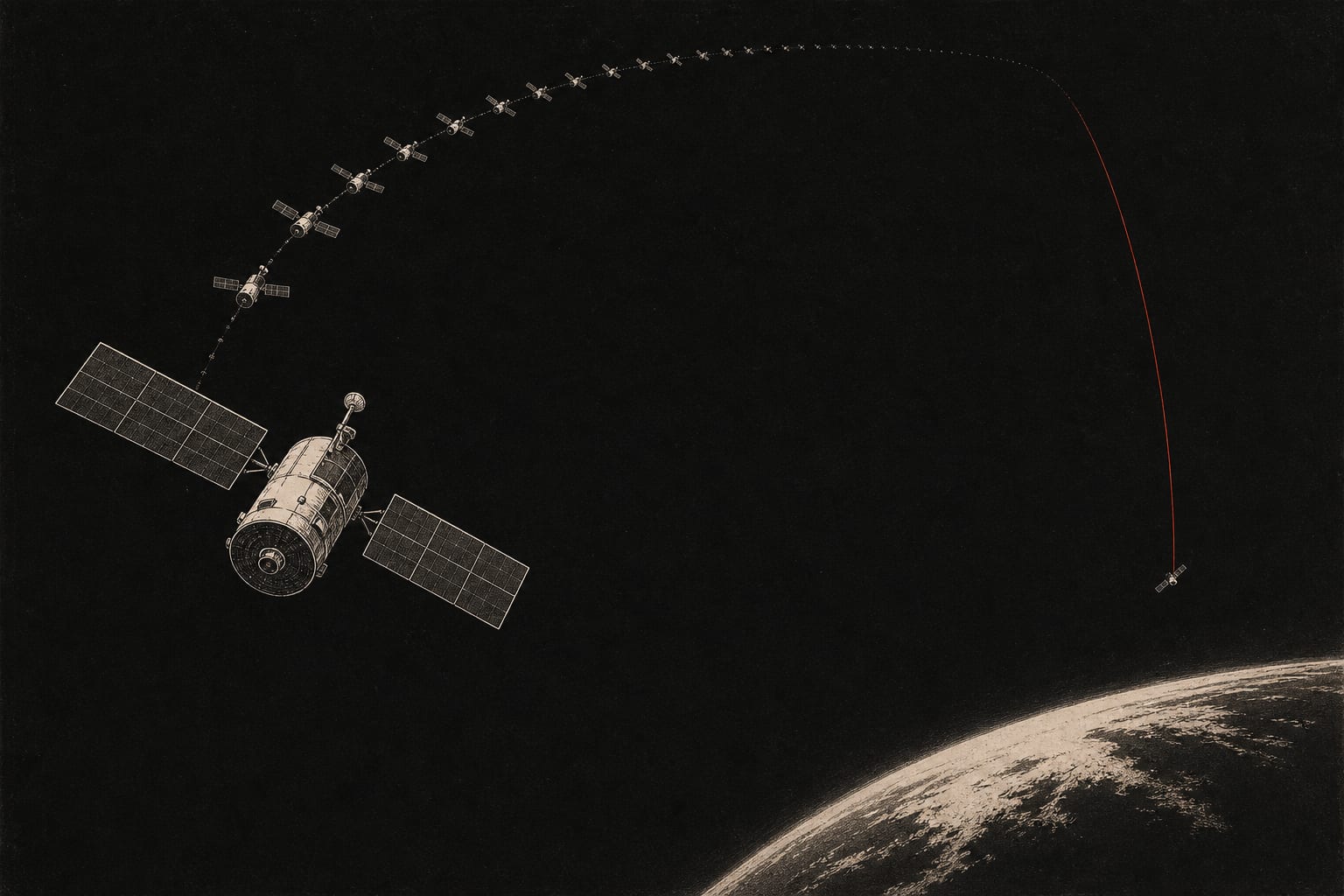
Iridium has a coda worth keeping, though. Investors bought the bankrupt constellation for about 25 million dollars, a cent on every dollar Motorola spent, and it flies today, profitably, doing jobs the ground cannot. The technology outlived the balance sheet that paid for it. That is most likely the honest shape of orbital compute too: the first movers eat the learning curve, and someone else runs the business that survives.
Real, small, and inference first
Strip off the hype and the dismissal, and here is what stands. Orbital compute is real: there is a working GPU overhead right now. It will stay small for a long time, measured in megawatts while the announcements say gigawatts, because heat and mass hold the size down hard. And it will begin with the workloads that can live inside those limits.
That means inference, not training. Training a frontier model wants thousands of chips lashed together with enormous bandwidth, run flat out for months, dead nodes swapped on the fly. Orbit is poor at all of it. Inference forgives what training will not: it tolerates being spread thin, it shrugs off a node dropping offline, and some of it already wants to be up there, close to other satellites, or somewhere no single government can switch it off. Defense and sovereign compute will pay a premium that orbit can meet. The frontier keeps training on the ground, where you can still dump heat into a river and replace a chip with a screwdriver.
There is a clean tell to watch for. Today the announcements lead with the glamorous numbers: gigawatts, satellite counts, acres of solar. The day the spec sheets lead with heat rejection instead, square meters of radiator, watts shed per kilogram, is the day the industry has quietly conceded what really sets the size of the machine. Watch for the boring number to climb to the top of the page.
Our Call
By June 2028, orbital compute is real but small: deployed capacity is counted in megawatts, not the gigawatts now being promised, and it earns its keep on inference and specialized work (defense, sovereign, satellite-adjacent), not on frontier training. The frontier still trains on the ground.
The case: heat, not power, sets the size, and shedding it costs radiator mass that scales with the compute. You cannot repair or upgrade hardware in orbit, so every cluster is a two-year disposable. And parity economics need launch under roughly 200 dollars a kilogram, which even Starship's own boosters put in the back half of the decade. Training has no reason to accept those terms while terrestrial power, however constrained, is still available. Inference does.
What proves us wrong: before June 2028, someone runs a genuine frontier-scale training run, on the order of 100 megawatts of coordinated compute or more, primarily in orbit; or deployed, revenue-earning orbital capacity crosses a gigawatt. Either would mean the mass-and-heat arithmetic closed years sooner than the physics says it should, and that Starship bent the cost curve harder than even Musk is promising.
Settles: June 20, 2028.
Frequently asked questions
Why would anyone put an AI data center in space?
Because the hard limit on building AI compute on Earth is no longer chips, it is power, water, and grid connections, which now come with multi-year queues. In the right orbit a satellite sits in near-constant sunlight with no night, clouds, or atmosphere, so energy is roughly a third more abundant than the best desert site and needs almost no storage. The catch is that getting rid of waste heat in a vacuum is very hard, and that is what limits how large an orbital data center can be.
What is SpaceX's AI1 orbital data center?
AI1 is the first orbital data center satellite SpaceX has shown publicly, unveiled in June 2026. It has a roughly 70-meter wingspan, carries about 120 kilowatts of compute (Musk compared it to a single Nvidia GB300 rack), and runs on solar power with large liquid radiators to shed heat. SpaceX says it is simpler than a Starlink broadband satellite because it skips the big phased-array antennas. It is part of a filing for up to a million such satellites.
Why is cooling the hard part of a data center in space?
On Earth you remove a chip's heat with air or water. In the vacuum of space there is neither, so heat can only leave by radiating away as infrared, which is more than a thousand times slower. A one-megawatt orbital data center needs on the order of 1,600 square meters of radiator, about the size of a hockey rink, and at large scale the radiators can weigh many times more than the computers. Cooling, not power, sets the practical size of an orbital data center.
Will AI training move to space?
Not the frontier, and not soon. Training the largest models needs thousands of chips tightly linked with huge bandwidth, run for months, with failed parts swapped quickly, and orbit is poor at all of that. The workloads that fit space first are inference and specialized jobs (defense, sovereign, and satellite-adjacent compute) that tolerate being spread out and are hard to run on the ground. Frontier training is likely to stay terrestrial well past 2028.
References and research base
- SpaceX, AI1 orbital data center reveal (June 8, 2026): the 70-meter wingspan, ~120 kW compute, the single-GB300-rack comparison, the 110 m² liquid radiators, and the "simpler than a Starlink satellite" framing, reported via TechSpot and Yahoo Finance.
- Anthropic, "Higher usage limits for Claude and a compute deal with SpaceX" (May 6, 2026): the Colossus 1 capacity purchase (300+ MW, 220,000+ GPUs) and the stated interest in multiple gigawatts of orbital compute. Anthropic; context via SpaceNews and CNBC.
- Starcloud: first Nvidia H100 in orbit and an open model run in space, the $1.1B valuation, and the October 2026 Blackwell-plus-Crusoe follow-on. CNBC, Data Center Dynamics, GeekWire.
- Google Research, Project Suncatcher: TPU clusters, free-space optical links, the radiation test (Trillium TPUs to ~3× a five-year dose), the early-2027 Planet demonstrators, and the sub-$200/kg parity argument. Google Research, Data Center Dynamics.
- The cooling physics: ~630 W/m² radiative heat rejection, ~1,600 m² of radiator per megawatt, and radiators outweighing compute roughly 10:1 at Space-Station scale. SatNews, "The Physics Wall"; World Economic Forum; EE Times.
- SpaceX's FCC filing for up to one million orbital data center satellites, and Musk's "always sunny" / cheapest-compute-in-space framing. Space.com.
- Iridium: the 66-satellite Motorola constellation, its 1999 bankruptcy nine months after service, and the ~$25M acquisition out of bankruptcy. General history; see contemporaneous reporting and Iridium Communications' own corporate record.
Source-quality note
The hardware, deals, and physics figures here are reported fact, drawn from the companies' own announcements (SpaceX AI1, the Anthropic-SpaceX deal, Starcloud, Google Suncatcher) and from independent engineering analysis of radiative cooling, all dated June 2026 and linked above. The framing that orbit swaps a power constraint for a heat constraint, the Iridium parallel, and Our Call are this publication's thesis, not reported fact, and should be read as argument.