Memory just repriced the AI build-out. A Lexar-brand maker guided to a 60,000 percent profit jump, and Microsoft now pins $25 billion of its record capex to the cost of memory alone
The value in AI kept sliding outward from the model to the GPU to the systems around them, and this week it reached the memory, the one ring that only gets more expensive. Longsys, which owns the Lexar brand, guided to a profit jump north of 60,000 percent on pure AI-memory demand; Microsoft pinned $25 billion of its record $190 billion capital budget to memory and component costs; DRAM prices rose about 95 percent in a quarter with no relief before 2028. Plus South Korea's $880 billion plan hitting power and water limits, the UK letting data centers override local planning, and Anthropic's Claude Cowork reaching mobile and web.
Memory just repriced the entire AI build-out. It's Tuesday, July seventh, and the clearest proof is a company most people in AI have never heard of.
Longsys, the Shenzhen maker that owns the Lexar brand, guided to roughly one and a half billion dollars in profit for the first half of this year, against two million in the same stretch last year. That's a jump north of sixty thousand percent, and no new product explains it.
One force is bending every line in the memory business the same way. AI data centers are buying memory faster than the world can make it, and the price of anything that stores a bit has gone vertical. DRAM contract prices climbed about ninety-five percent in a single quarter.
Read it from the other end, in a budget too big to hide. When Microsoft set capital spending near a hundred and ninety billion dollars, it named memory as the reason twenty-five billion of that was new.
For anyone building, the volatile number in a capacity plan used to be whether you could get GPUs. Now it's the memory bill, climbing faster than the compute line and in one direction. The model you run has fallen close to free; the cost of the year is on the components list underneath it.
The same wall shows up in the ground. South Korea's eight-hundred-and-eighty-billion-dollar chip and AI plan is colliding with physics: a single planned megacluster would draw about a quarter of Seoul's entire power demand, sited faster than the grid and water can follow.
And Britain is now letting qualifying data centers claim national-importance status to override local planning, cutting a year and more than a billion dollars off the fight. The binding constraint in developed economies has become the permission to build.
To the tape. We hold Micron long, and this week the thesis printed in daylight, as the memory shortage started arriving on income statements.
We add SK Hynix as a watch while Wall Street packages the memory boom for retail, and we hold the Nvidia watch, where a rising memory bill is the tell. Late retail access is usually a caution rather than a green light.
The tape is the desk's scorecard, not advice.
Our call: within nine months, a frontier lab or hyperscaler publicly blames memory, supply or price rather than GPUs or power, for a delayed or re-architected build.
What proves us wrong is April with the constraint story still told entirely through GPUs and power.
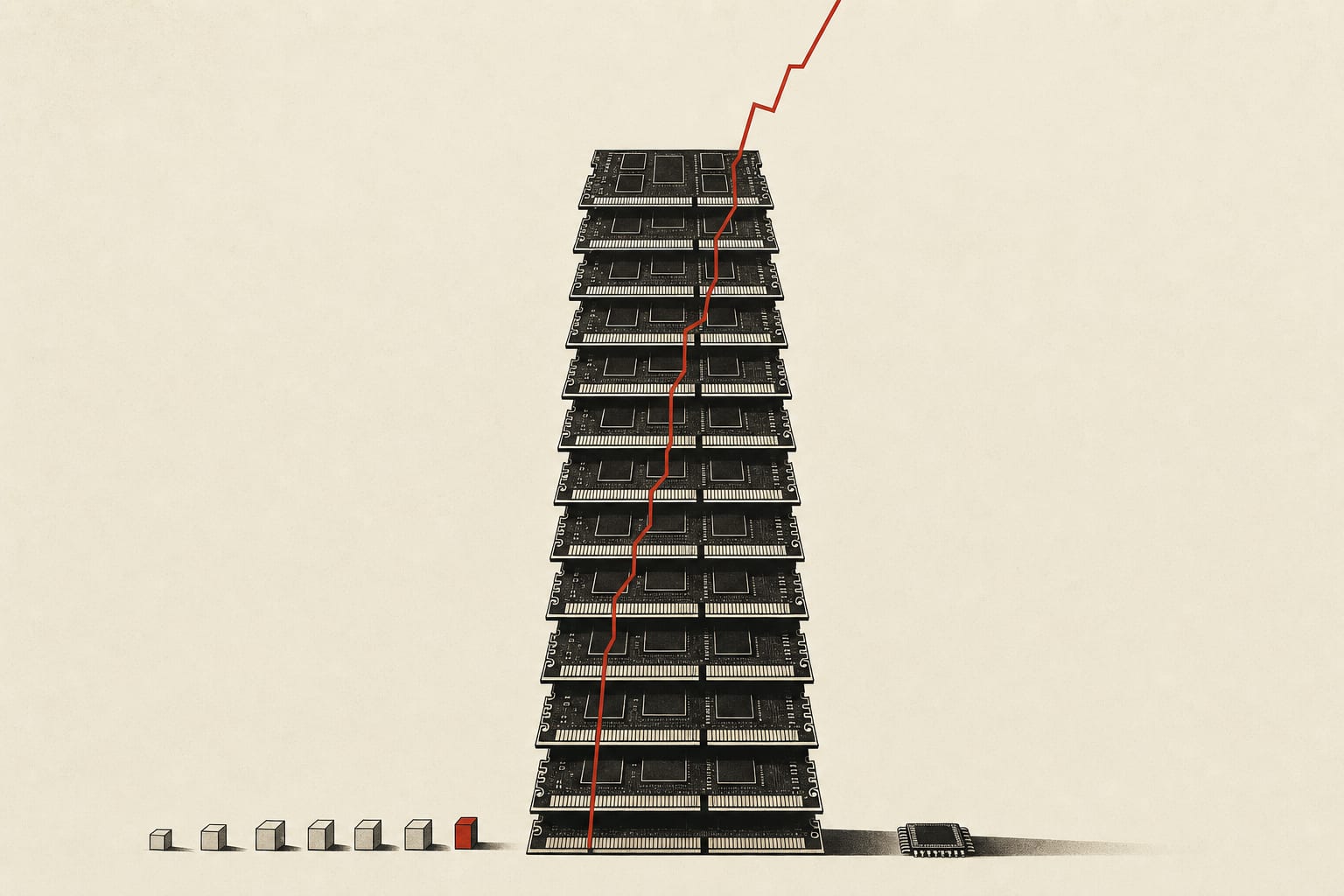
A memory-chip maker most people in AI have never heard of just told investors to brace for a number that reads like a typo. Longsys, the Shenzhen company that owns the Lexar brand, guided to roughly $1.5 billion in profit for the first half of this year, against $2.1 million in the same stretch of 2025. That is a jump north of 60,000 percent, and no clever new product explains it. One force is now bending every line in this business the same way: AI data centers are buying memory faster than the world can make it, and the price of anything that stores a bit has gone vertical.
The scale of that repricing is easiest to read in the budget of a company too big to bury it. When Microsoft set its capital plan for the year at about $190 billion, it named memory as the reason $25 billion of that was new spending. The added cost was the DRAM, flash, wafers, and substrates inside the machines, which had simply gotten more expensive. Contract prices for DRAM climbed roughly 95 percent in a single quarter to open the year. The three makers who supply almost all of it, Samsung, SK Hynix, and Micron, keep steering wafers toward the high-bandwidth memory stacked beside an AI accelerator, which starves everything else.
This is where the last two weeks of this briefing have been pointing. The argument has been that the model slid toward a commodity, and that the hard engineering and the margin moved outward, into the systems around the chip. Meta rebuilt its storage plane to stop its GPUs idling; OpenAI now sells the orchestration layer as Sol Ultra. Memory is the next ring out, and it behaves in reverse: a model gets cheaper every time someone ships a better one, while a gigabyte of HBM only climbs. Demand barely flexes on price, new supply takes years to pour, and the makers guide to no real relief until 2028.
Our own market notes have carried a memory position for two weeks, on the plain reasoning that the build-out's scarce, repricing input is now the memory around the accelerator itself. This week the trade got more crowded in daylight. US investors are about to get easier access to SK Hynix, the second of the big three, as Wall Street packages the memory boom for retail the way it once packaged the GPU. Late money usually arrives as a caution rather than a green light. The squeeze underneath it is real and measurable, and memory is the rare layer of this stack where the pricing power sits with the seller, not the buyer.
For anyone building on this hardware, the lesson is a budgeting one. A year ago the volatile number in a capacity plan was whether you could get GPUs. Now it is the memory bill, and it is climbing faster than the compute line and in one direction only. The teams that locked multi-year memory contracts last autumn are still paying last autumn's prices; the ones buying on the spot market this quarter are the ones financing Longsys's 60,000 percent. The model you run has fallen close to free. The real cost of this year is sitting on the components list underneath it, and it is the one number in the plan you cannot ship your way out of.
Lexar's owner guides to a 60,000 percent profit jump, all of it AI memory demand
Longsys, the Shenzhen company that owns the Lexar brand, guided to roughly $1.5 billion in profit for the first half of 2026, against $2.1 million a year earlier. That is a jump north of 60,000 percent, and none of it traces to a new product. AI data centers are consuming the world's memory capacity, and Samsung, SK Hynix, and Micron, who make over 95 percent of DRAM, are diverting wafers to the high-bandwidth memory beside an accelerator. That leaves everything else scarce and climbing. DRAM contract prices rose about 95 percent in a single quarter, with no relief expected before 2028. A profit alert this extreme is the memory shortage arriving on an income statement.
Wall Street is about to sell the memory boom to retail, via SK Hynix
US investors will soon get easier access to SK Hynix, the second-largest memory maker, as banks package the AI memory cycle for retail the way they once packaged the GPU trade. The demand behind it is real. Memory has gone from a part that gets procured to a ceiling that reshapes plans, and Microsoft pinning $25 billion of its $190 billion budget to memory and component costs put a number on it. The caution is timing. Broad retail access to a theme usually arrives late in its repricing, so the move validates the thesis and crowds the entry at once. Watch the squeeze, and treat the packaging of it as a late-cycle tell.
South Korea's $880 billion chip and AI plan runs into power and water it does not have
South Korea's $880 billion push to lead in chips and AI is colliding with physics. A single planned megacluster would draw about a quarter of Seoul's entire power demand, and the fabs and data centers are being sited faster than the grid and water supply can follow. It is the same lesson landing everywhere the build-out touches ground: the scarce input is rarely the silicon. It is the megawatts and the cooling water to keep the silicon running, and those take a decade of planning that no capital budget can compress. A national plan can fund the fabs in a year; it cannot conjure the power lines and reservoirs on the same timeline.
The UK hands data centers a way to bypass the neighbors: 'national importance' status
Britain will let qualifying data centers apply for a 'national importance' designation that overrides local planning rules and lifts decisions above local councils. It can cut a project's timeline by a year and save more than a billion dollars in the objection fights that usually stall them. The move is an admission dressed as policy. The binding constraint on AI infrastructure in developed economies has become the permission to build, more than capital or chips, and governments are now routing around their own approval processes to get the megawatts sited. Expect other countries whose AI ambitions are stalling in planning queues to copy it.
Two weeks of this briefing tracked the value moving off the model and the GPU into the systems around them. Today it reached the memory, and that ring reprices differently from the rest. A model gets cheaper with every release, while a gigabyte of HBM has roughly doubled in a quarter and, by the makers' guidance, stays scarce until 2028. Longsys guiding to a 60,000 percent profit jump and Microsoft pinning $25 billion of its capex to memory are one event seen from opposite ends. The planning question for the year is simple and new: what did you lock your memory price at? That is the line in the model that only moves up.
Within the next nine months, at least one frontier lab or major hyperscaler will publicly attribute a delayed, downsized, or re-architected training run or data-center build specifically to memory supply or memory pricing, rather than to GPU availability or power.
The constraint the industry names out loud is still compute, and lately power; memory is treated as a part that gets ordered, not a ceiling that rewrites the schedule. The figures argue the other way. DRAM contract prices rose about 95 percent in a single quarter, Microsoft tied $25 billion of its capital budget to memory and component cost, and the makers guide to no real relief before 2028. When an input roughly doubles in price and stays scarce for years, it stops being a line item and starts setting the timeline. Someone building at the frontier hits that wall in public inside a year.
If, by April 7, 2027, no frontier lab or major hyperscaler has publicly tied a specific delay, downsizing, or redesign to memory supply or pricing, and the industry still tells its constraint story entirely through GPUs and power, the call is wrong.
We hold the Micron long from July 5, and this week the thesis printed. Longsys guided to a 60,000 percent profit jump, Microsoft pinned $25 billion of its capex to memory and component cost, and DRAM ran up about 95 percent in a quarter. Memory is the scarce, repricing input in the AI build-out, and Micron is the cleanest US-listed way to hold that. We keep conviction at medium rather than raising it, because the second derivative is the honest flag: Q3 contract increases are decelerating to the low-to-mid teens from 60-percent-plus jumps, so the easy part of the move is behind us.
HBM and high-end DRAM are sold on AI capacity, not the PC cycle, so the pricing power sits with the makers and flows straight to ASPs and margins, with the makers guiding to no real relief before 2028. The offset is unchanged: the consumer side is at an affordability ceiling, so a demand air-pocket would dent volumes even with AI holding the price floor.
New to the book as a watch, on the same memory thread. SK Hynix is the second of the three makers riding the AI memory cycle, and US investors are about to get easier access to it as banks package the theme for retail. We watch rather than hold, because broad retail access usually shows up late in a repricing, not early, and the cleaner US-listed expression of the same thesis is already the Micron long.
If the memory squeeze runs into 2028 as the makers guide, the pure-play leaders capture the most operating leverage, and SK Hynix is a direct way to hold it once access opens. The offset is that it is a foreign listing arriving to US retail after a large move, and much of the easy repricing has happened.
We hold the watch. Nothing today moves the core trade, but the memory repricing is the tell we keep tracking: a rising memory bill is a cost pressure on every buyer of Nvidia systems, and value keeps migrating into the components and plumbing around the accelerator rather than the accelerator itself. Bullish for near-term demand, a slow question over the pricing power the whole trade leans on.
The bull case is that agentic workloads, Sol Ultra and Claude Cowork among them, lift accelerator demand regardless of who captures the margin. The offset is that when memory and power are the scarce, repricing inputs, the dollar of AI spend increasingly lands on suppliers Nvidia does not own.