The biggest foreign listing in the history of the US stock market this week was not a chip designer or an AI lab. It was the Korean company that makes the memory those chips can't run without, SK Hynix raised $26.5 billion on Nasdaq, and the market priced the scarcest input in AI
SK Hynix raised $26.5 billion on Nasdaq, the largest foreign IPO in US history, topping Alibaba's 2014 record, priced at $149 a share and more than seven times oversubscribed, and was immediately pressed by Commerce Secretary Howard Lutnick to build US fabs. It is the clearest market sign yet of the week's thesis: value has slid off the commoditized model into the scarce inputs beside it, and memory (SK Hynix supplies ~58% of the HBM feeding Nvidia's GPUs) is the scarcest. Plus Anthropic's "global workspace" interpretability research, Beijing forcing Meta to unwind its Manus deal, a memristor in-memory chip, and Sequoia's $3 trillion question.
The biggest foreign listing in the history of the US stock market this week went to a company that makes memory. It's Friday, July tenth, and that single fact is the whole week.
SK Hynix raised twenty-six and a half billion dollars on Nasdaq, priced at a hundred and forty-nine a share, more than seven times oversubscribed. The record it broke had stood since Alibaba in 2014.
The company that broke it makes the high-bandwidth memory that sits next to Nvidia's chips and feeds them, roughly fifty-eight percent of the world's supply. Starve a GPU of it and the GPU idles.
Capable models turned cheap this fortnight, and the value they shed drained into the scarcest thing beside them. The public market just paid a record to own it.
If you're building, watch where the money pools. The model is a dollar a million tokens, the memory to serve it just got crowned, and the power to run it is four years deep in a queue.
Washington read it the same way. The Commerce Secretary is pressing SK Hynix and Samsung to build fabs on US soil, and the proceeds are already earmarked for capacity in Korea. Micron has floated a quarter of a trillion dollars in planned US manufacturing.
The same week, SK Hynix and a startup called TetraMem showed a research chip that does the math inside the memory itself, a hedge toward a world where the memory is the computer.
On the model side, Anthropic published a working sketch of Claude's internal reasoning, a global workspace it can read and even edit, changing an answer by swapping one internal concept.
It's careful about the limits, less than a tenth of what's happening inside, and not a claim about consciousness. It's the kind of instrument auditing agents will need.
To the tape. We hold Micron long. The SK Hynix listing is the loudest confirmation yet that memory is the scarce, repricing input, and Micron is the cleanest US-listed way to own it.
We add SK Hynix as a watch now that it has a US ticker, and we hold the Nvidia watch, where the best-priced part of an Nvidia system is increasingly the memory Nvidia has to buy.
The tape is the desk's scorecard, not advice.
Our call: within six months, a hyperscaler or a frontier lab names memory, not GPUs and not power, as the specific bottleneck that slipped a buildout, on the record.
What proves us wrong is two quarters with memory still an unnamed input. Watch the earnings calls.
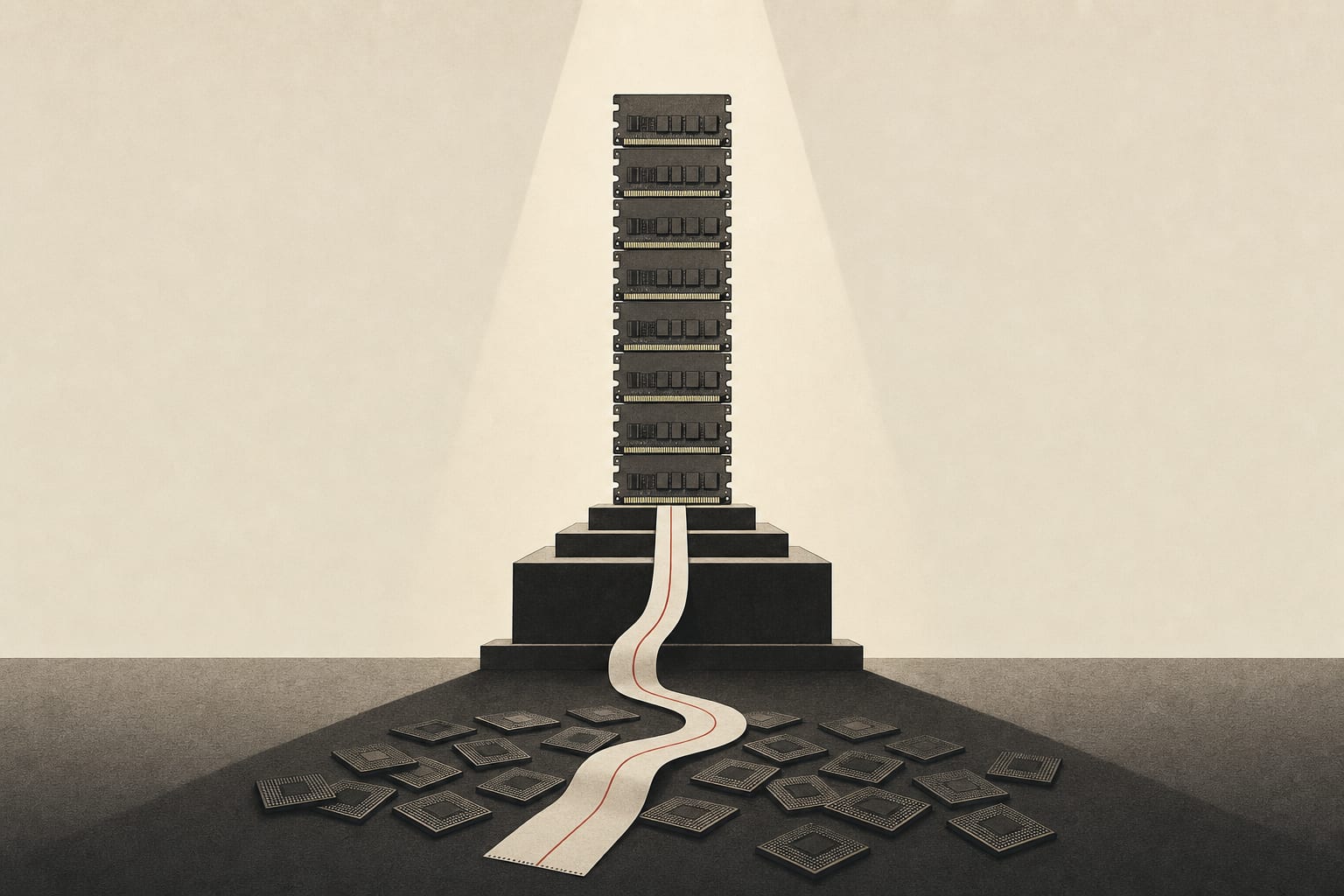
The biggest foreign listing in the history of the US stock market this week was not a chip designer or an AI lab. It was the Korean company that makes the memory those chips can't run without — SK Hynix raised $26.5 billion on Nasdaq, and the market priced the scarcest input in AI
The largest foreign listing in the history of the US stock market did not go to a model lab or a chip designer. On Friday, SK Hynix sold twenty-six and a half billion dollars of stock on Nasdaq, priced its shares at a hundred and forty-nine dollars, and closed its first session up around thirteen percent on a book more than seven times oversubscribed. The record it broke had stood since 2014, and it belonged to Alibaba. The company that broke it makes memory.
That single listing is the whole week compressed. Capable models turned cheap and tiered over the past fortnight, and the value they shed did not evaporate — it drained into the parts of the stack that stay scarce. Memory is the scarcest of them. High-bandwidth memory is the stack of chips that sits shoulder to shoulder with an Nvidia accelerator and feeds it; starve a GPU of it and the GPU idles. SK Hynix supplies most of the world's HBM — roughly fifty-eight percent of the revenue in the first quarter, by Counterpoint's count — and the public market just paid a record to own that seat.
Washington read the tape the same way the buyers did. Commerce Secretary Howard Lutnick is pressing SK Hynix and Samsung to put memory fabs on American soil, and the proceeds are already spoken for: new fabrication in Yongin, advanced packaging in Cheongju, the extreme-ultraviolet tools that make both possible. Micron has attached a figure to the American version of the same instinct — on the order of a quarter of a trillion dollars in planned US manufacturing. A country that learned it could not make its own leading-edge logic without a single company in Taiwan is now trying not to learn the lesson twice with memory.
There is a bill behind the celebration, and it is not small. Sequoia's David Cahn spent the week writing the round number on the board: roughly a trillion and a half dollars of AI infrastructure spending this year, which on his arithmetic needs something like three trillion in revenue to earn its keep. Memory is a cyclical business that has ruined its own participants more than once, and the demand that made SK Hynix a record IPO is the same demand that has to keep arriving, quarter after quarter, for years. Friday bought the boom. Nobody has been handed the invoice yet.
For anyone building, the useful signal is simply where the money is pooling. The model is a commodity you can hold for a dollar a million tokens; the memory to serve it is a scarce input the public market just crowned at a record; the power to run it is still four years deep in an interconnection queue. The companies worth watching over the next year are not the ones with the sharpest model. They are the ones who locked up the inputs the sharpest model cannot run without.
SK Hynix is pressed to build on US soil the moment its record IPO closes
The same week SK Hynix raised $26.5 billion in the largest-ever US debut by a non-American company, Commerce Secretary Howard Lutnick began pressing it and Samsung to build memory fabs inside the United States. The proceeds already have destinations — new fabrication capacity in Yongin, advanced HBM packaging in Cheongju, and the EUV tools both require — and regular Nasdaq trading opens Monday under the ticker SKHY. The subtext is an onshoring campaign that started with logic and is now reaching the memory beside it: Micron has floated roughly a quarter of a trillion dollars in planned US manufacturing. Leading-edge memory is being treated as the strategic asset it quietly became.
SK Hynix and TetraMem show a memristor chip that does the math inside the memory
SK Hynix, the startup TetraMem, and researchers at USC published a proof-of-concept system-on-chip that performs neural-network inference inside a memristor array — computing where the data already sits, instead of shuttling it back and forth to a processor. The demonstrated part peaks near 2.54 TOPS, roughly sixteen times below Microsoft's Copilot+ bar, so this is a research artifact, not a product. It matters as direction, not spec: the entire industry is trying to move work closer to memory precisely because memory bandwidth, not raw compute, is the wall. The same company that just IPO'd on selling HBM is hedging toward a world where the memory is the computer.
Anthropic says it can read a working sketch of Claude's thoughts — and is careful about how much that means
Anthropic published research describing a "global workspace" inside Claude: using a technique it calls the Jacobian Lens, it isolates a small set of word-like internal representations, a "J-space," that the model can report on and even deliberately activate, and that when swapped changes the model's reasoning. Change the internal token for "spider" to "ant" and the model answers six legs instead of eight. The lab is deliberately modest about it — J-space is less than a tenth of what is happening inside, the lens "only approximately" captures the real workspace, and none of this is a claim about consciousness. It is a first, honest instrument for seeing why a model said what it said, which is exactly what auditing agents will need.
Beijing forces Meta to unwind its Manus deal, and Tencent moves to buy the agent startup back
Meta paid more than two billion dollars in December for Manus, the originally-Chinese startup that marketed the first general AI agent and had relocated to Singapore. Chinese regulators opened a review in April and pushed to unwind the sale, and Tencent — an early backer — is now leading a consortium, reportedly with ZhenFund and HongShan, to buy it back at no less than the price Meta paid. Former US investors are unlikely to join. The episode is a small map of where agents now sit in the geopolitics: a capability valuable enough that one government will reverse a closed acquisition to keep it home, and a reminder that "who owns the agent" is becoming a state question, not only a cap-table one.
The week that made capable models cheap ended by paying a record for the memory beside them. SK Hynix's $26.5 billion listing is the largest foreign IPO in US history, and it went to the company that supplies most of the HBM feeding Nvidia's chips — the clearest sign yet that the scarce, repricing input in AI is not the model and not even the GPU, but the memory and the power around them. Washington is already pressing that supply onshore. The open question is the invoice: a trillion and a half dollars of build-out this year still has to earn something like three trillion back, and memory has bankrupted its own believers before.
Within the next six months, at least one hyperscaler or frontier lab names memory supply — HBM or DRAM specifically, not GPUs and not power — as the concrete bottleneck that slipped a buildout, capacity target, or product timeline, on the record in an earnings call or filing. Memory stops being the quiet input and becomes the stated constraint.
The scarcity narrative has a default villain, and it is the GPU, with power as the runner-up; memory is treated as a component that simply arrives. SK Hynix's record IPO, the onshoring pressure, and a supply the makers guide as tight into 2028 all point the other way. When the binding constraint is the HBM stack and buyers are competing for allocation a year out, the miss eventually gets attributed out loud rather than absorbed quietly — a CFO explains a slipped target by naming the part that was short. The falsifiable edge is that the naming happens inside two quarters.
If, by January 10, 2027, no hyperscaler or major AI lab has attributed a specific buildout, capacity, or timeline miss to HBM or DRAM supply on the record, and memory remains an unnamed input in their disclosures, the call is wrong.
We hold the Micron long, carried since July 5, and today it got the loudest confirmation yet from the other side of the Pacific: SK Hynix priced the largest foreign IPO in US history on the strength of exactly the thesis we are trading — that HBM and high-end DRAM are the scarce, repricing input in the AI build-out. Micron remains the cleanest US-listed way to own that. We keep conviction at medium, not high, on the flag we have carried all week: contract-price increases are decelerating from the sixty-percent-plus jumps that opened the year, so the easy part of the move is behind us.
HBM and leading-edge DRAM are sold on AI capacity, not the PC cycle, so pricing power sits with a short list of makers who guide supply tight into 2028. The offset is the consumer side at an affordability ceiling, where a demand air-pocket can dent volumes even while AI holds the floor.
We move SK Hynix from a watch-only note to a named watch now that it has a US ticker. It is the purest expression of the memory thesis — the dominant HBM supplier to Nvidia, roughly fifty-eight percent of first-quarter HBM revenue — and it just raised twenty-six and a half billion dollars to build more of it. We watch rather than hold because a name that opened up around thirteen percent on its first session, more than seven times oversubscribed, carries IPO-pop volatility and a lockup calendar that Micron does not. The thesis is the same; the entry is not.
SK Hynix is the closest thing to a pure-play on AI memory demand, with onshoring pressure now adding a US-policy tailwind. The offset is a freshly-floated stock priced for the boom, exposed to the same cyclical reversal that has punished memory before.
We hold the Nvidia watch, unchanged. Nothing today moves the core trade, but the SK Hynix listing sharpens the picture the watch is built on: the scarcest, best-priced part of an Nvidia system is increasingly the memory Nvidia buys rather than the accelerator it sells. Demand for the accelerator is intact — the week's cheaper models are more inference, not less — and the pressure remains on pricing power, not volume, as every hyperscaler ships a good-enough custom part.
Agentic and multimodal workloads keep accelerator demand rising regardless of who captures the margin. The offset is that when memory and power are the binding inputs and custom silicon caps prices, the marginal AI dollar lands on suppliers Nvidia does not own.