The frontier model finished turning into a commodity this week, three dozen GPT-5.6 variants, a single consumer slider, a proof written before the referees could check it, so the fight moved off the model. On Friday Apple sued OpenAI, and the suit is about hardware, talent, and the people who build both
Apple sued OpenAI on Friday in the Northern District of California, accusing it and its hardware unit io Products of trade-secret theft through ex-Apple hires, naming Tang Tan, Apple's former iPhone/Watch design VP and now OpenAI's chief hardware officer, and engineer Chang Liu. The suit is the clearest sign of the week's shift: with GPT-5.6 now a commodity (roughly 36 API variants, a single consumer slider, and a contested Sol Ultra math proof), the competition moved off the model and onto hardware, distribution, and talent. Plus Washington weighing limits on open-weight models, Hugging Face's Delangue on open source, Meta pulling an Instagram AI feature, and SpaceX's 100,000-satellite filing.
The clearest sign a technology has stopped being scarce is where the lawsuits land. It's Saturday, July eleventh, and on Friday, Apple sued OpenAI. Not over a model. Over hardware.
The model finished commoditizing this week. OpenAI now ships something like three dozen API variants of GPT-5.6, ordinary users get a single slider, and a trim of it produced a claimed proof of a fifty-year-old math problem.
So the fight moved off the model. Apple's suit, filed in Northern California, accuses OpenAI and its hardware unit of taking trade secrets through the people it hired, naming Tang Tan, Apple's former iPhone design chief, now OpenAI's head of hardware.
OpenAI paid about six and a half billion dollars for Jony Ive's startup to build a device, and the fastest way to build hardware is to hire the people who already build the best of it. More than four hundred former Apple employees now work there.
The read for a builder: the weights are rented and the benchmark lead lasts a quarter. The defensible assets left are the device, the distribution, and the people who make either.
On the proof, OpenAI credits a fifty-year-old conjecture to GPT-5.6 running sixty-four sub-agents for under an hour. Read it with the mathematicians. One called it a very nice proof, then noted no one has finished checking it and it may recombine known work.
It's a real event, not a settled result. Treat it as a capability signal to watch, not a thing to cite.
Meta pulled an Instagram tool that let anyone generate images from strangers' public photos, after the obvious backlash.
And SpaceX filed to launch up to a hundred thousand next-generation Starlink satellites, each claiming more than ten times the bandwidth. The connectivity, the silicon, and the device are all being staked out. The model is the one piece nobody is fencing.
To the tape. We hold Micron long on the memory thesis, unchanged.
We open a watch on Apple. No frontier model of its own, but it owns the device and the distribution, the two layers that don't commoditize, and the suit is a tell it feels OpenAI's device as a real threat. We hold the Nvidia watch.
The tape is the desk's scorecard, not advice.
Our call: within nine months, the talent-and-IP war goes further into the courts. At least one more trade-secret or non-compete suit between a big incumbent and a lab over AI-hardware hiring, following Apple and OpenAI rather than settling around it.
What proves us wrong is April with Apple's suit standing alone. The scarce asset is people. Watch who sues to keep them.
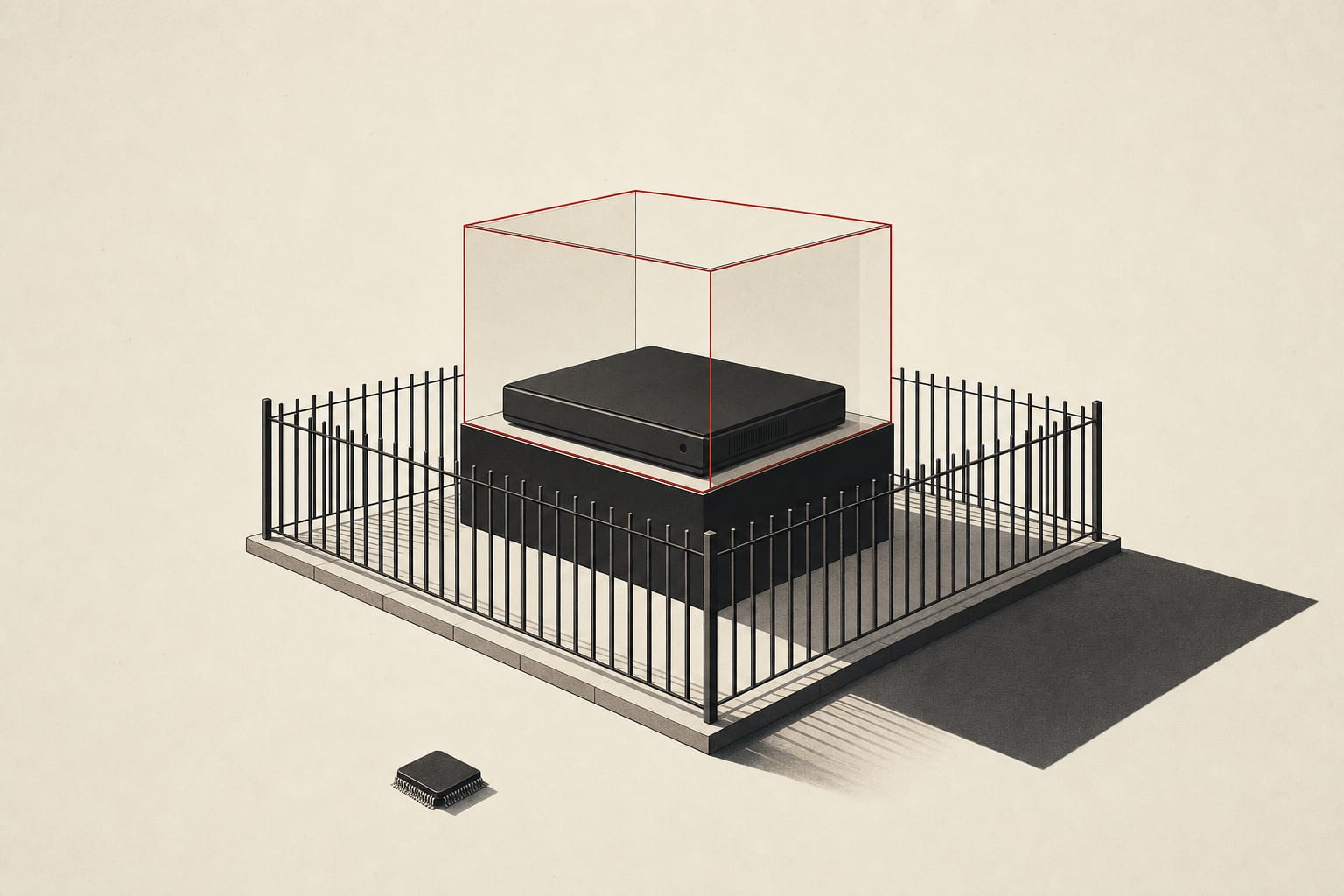
The frontier model finished turning into a commodity this week — three dozen GPT-5.6 variants, a single consumer slider, a proof written before the referees could check it — so the fight moved off the model. On Friday Apple sued OpenAI, and the suit is about hardware, talent, and the people who build both
The clearest sign that a technology has stopped being scarce is where the lawsuits start to land. This week the model itself finished sliding into a commodity: OpenAI now fields something like three dozen API variants of GPT-5.6, ordinary users get a single slider, and a trim called Sol Ultra spent the week producing a claimed proof of a fifty-year-old math conjecture. And on Friday, Apple sued OpenAI. Not over a model. Over hardware.
The complaint, filed in the Northern District of California, accuses OpenAI and its hardware unit, io Products, of taking Apple's trade secrets through the people it hired. It names Tang Tan — a twenty-four-year Apple veteran who ran product design for the iPhone and the Watch and is now OpenAI's chief hardware officer — and Chang Liu, a former Apple systems engineer. Apple says the effort was directed from the top: that Tan used Apple's confidential codenames while recruiting, told candidates to bring actual parts and design files into interviews, and that Liu downloaded confidential engineering material on his way out the door. More than four hundred former Apple employees now work at OpenAI.
This is what a commoditized model does to competition — it shoves the contest down into the layers that do not copy for a dollar a million tokens. OpenAI paid roughly six and a half billion dollars last year for Jony Ive's io to build its first hardware device, and the fastest way to build hardware is to hire the people who already built the best hardware on the planet. Apple's suit is an attempt to wall off the one thing it still plainly leads, industrial design and the supply chain under it, at the exact moment the model inside the device became something anyone can rent by the token.
None of this means the model stopped getting better. The same week, OpenAI released a proof of the Cycle Double Cover Conjecture — open since the 1970s — that it credits entirely to GPT-5.6 Sol Ultra running sixty-four sub-agents for under an hour. Read it with the mathematicians rather than the press release: Thomas Bloom called it a very nice proof, then noted the community has not finished checking it and that it may recombine known results rather than break genuinely new ground. The honest version is the more interesting one — a serious machine-made proof being read in public before anyone has verified it. Capability is still climbing. It has simply stopped being the thing a company can defend.
So the map of moats is being redrawn in the open. The weights are rented, the benchmark lead lasts a quarter, and now the proof arrives faster than the referees can check it. What does not commoditize is the device a person will actually hold, the distribution to put it in their hands, and the small number of humans who know how to make either. Apple is going to court to protect the last of those. That it has come to litigation is the sharpest read available on where the value in this industry has quietly moved.
OpenAI kills the consumer model picker and ships roughly three dozen API variants of GPT-5.6
Two weeks after GPT-5.6 went to a single slider for consumers — the model picker retired, routing handled by the acquisition of Statsig — developers find themselves staring at the opposite: by one widely-shared count, something like thirty-six selectable variants of GPT-5.6 in the API, spread across trims and effort levels. Most builders can get by with three rough clusters, and a small industry of guides has already appeared to explain the rest. The split is the whole commoditization story in one product decision: hide the complexity from the many, expose every knob to the few, and let the model become a catalog. A thing you pick from a menu is not a thing anyone still has to be impressed by.
A GPT-5.6 trim claims a proof of a 50-year-old conjecture, and the mathematicians start reading
OpenAI published a proof of the Cycle Double Cover Conjecture — open since the 1970s — credited entirely to GPT-5.6 Sol Ultra, reportedly produced by sixty-four sub-agents in under an hour, with both the proof and the prompt released. The correct posture is neither hype nor dismissal. Mathematician Thomas Bloom called it a very nice proof and then said the plain truth: the community has not finished checking it, and it may recombine existing theory rather than open new ground, with at least one older result apparently uncited. It is a real event regardless of the verdict — a machine-generated proof serious enough to be read in public before it has been verified. Treat it as a capability signal to watch, not a settled result to cite.
Meta pulls an Instagram AI tool after it let anyone conjure images from strangers' photos
Meta removed a feature that let users generate images by @-mentioning public Instagram accounts, drawing on those accounts' photos without notifying the people in them — a design that talent agencies and users flagged as ripe for misuse. "We've heard the feedback that this feature missed the mark, so it's no longer available," the company said. It is a small but telling entry in the week's pattern: the AI capability is trivial to ship and the consent model around it is an afterthought, right up until the backlash forces a retraction. The friction is never the model anymore. It is everything the model touches.
SpaceX asks the FCC to bless 100,000 next-generation Starlink satellites
SpaceX filed for authorization to launch as many as a hundred thousand third-generation Starlink satellites, each claimed to carry more than ten times the bandwidth of the current design, pitched as backhaul for consumers, enterprise, and increasingly for connected AI devices. The aggregate is the eye-catching part — an order-of-magnitude jump in orbital capacity from one company — and it lands in the same week Apple and OpenAI are fighting over the device layer. The connectivity, the silicon, and the hardware are all being staked out at once; the model is the one piece nobody is bothering to fence.
The model finished becoming a commodity this week, and the industry's response was to start fighting everywhere else. OpenAI now ships GPT-5.6 as a catalog of three dozen variants; a trim of it wrote a fifty-year-old proof that mathematicians are still checking; and none of that is defensible for more than a quarter. So the contest moved to the layers that are: the hardware device, the distribution, and the people who know how to build them. Apple sued OpenAI over exactly that, naming its own former designers now running OpenAI's hardware. When the model is rented and the benchmark lead is gone by the next release, the scarce asset left is talent — and this week a company started defending it in federal court.
Within the next nine months, the AI industry's fight over talent and IP goes further into the courts: at least one more trade-secret, non-compete, or IP suit lands between a large hardware or platform incumbent and a frontier lab, or between two labs, over AI-hardware or model-team hiring — following Apple v. OpenAI rather than settling quietly around it.
The model is now the cheap, copyable layer, and the defensible assets are the device, the distribution, and the engineers who build both. When the scarce thing is a few hundred people who can ship hardware or train a frontier model, the incentive to move fast by hiring rivals' teams collides with the incentive to wall those teams off — and that collision is what litigation is for. Apple v. OpenAI is the first big instance, not a one-off; the pressure that produced it is pointed at every lab racing into hardware.
If, by April 11, 2027, no additional trade-secret, non-compete, or comparable IP action over AI-hardware or model-team hiring is filed between major players, and Apple v. OpenAI stands alone, the call is wrong.
We hold the Micron long, carried since July 5 and reinforced yesterday by SK Hynix's record listing. Nothing in today's talent-and-IP story moves the memory trade directly, but it fits the same frame: as the model commoditizes, the durable value keeps settling into the physical inputs — memory, hardware, the people who make them. Micron remains the cleanest US-listed way to own the memory leg. Conviction stays at medium on the flag we have carried all week: contract-price increases are decelerating from the jumps that opened the year.
HBM and leading-edge DRAM are sold on AI capacity, not the PC cycle, and the makers guide supply tight into 2028. The offset is the consumer side at an affordability ceiling, where a demand air-pocket can dent volumes even while AI holds the floor.
We hold the Nvidia watch, unchanged. Today's story is orthogonal to the accelerator trade, but the through-line holds: value is leaving the layers that copy easily. Demand for Nvidia's parts is intact, the pressure remains on pricing power rather than volume, and every hyperscaler shipping a good-enough custom chip keeps that pressure on.
Agentic and multimodal workloads keep accelerator demand rising regardless of who captures the margin. The offset is that memory and power are the binding inputs, and custom silicon caps the price Nvidia can hold.
New to the book as a watch, on the hardware-moat thread the hero sits on. Apple has no frontier model of its own and has been the slowest of the giants on generative AI — but it owns the device and the distribution, the two layers this week showed do not commoditize. The lawsuit cuts both ways: it is a defense of a real moat, and it is a tell that Apple feels OpenAI's io device as a genuine threat to the one franchise it cannot afford to lose. We watch rather than take a side because the thesis is a multi-year platform question, not a catalyst.
If the AI contest is decided at the hardware-and-distribution layer, Apple starts from the strongest position in the industry. The offset is that a company with no competitive frontier model, reduced to suing to protect its designers, may be defending the last war rather than winning the next one.