Altman and Musk spent the weekend accusing each other of misleading public-market investors, and the closer you look at how the AI build-out is financed, the clearer it gets why. The chip maker funds the clouds that buy its chips, the memory that just IPO'd is one cycle from a glut, and the spending still needs $3 trillion it can't yet point to
After a week that made capable models cheap and crowned memory with SK Hynix's record IPO, the mood turned to the money: Altman and Musk publicly accused each other of misleading public-market investors, and a resurfaced Beth Kindig analysis laid out the circular financing under the GPU boom, Nvidia is supplier, investor ($2B each into CoreWeave and Nebius), and demand backstop (~$6B guarantee) for the clouds that buy its chips, which borrow against depreciating GPUs to buy more. The Register warns the memory boom is "stacked for a reversal," and Sequoia's $3 trillion question hangs over it all. Plus Terence Tao on coding agents, AI flattening scientific discovery, and Ireland's data centers at 23% of national power.
The two most powerful people in AI spent the weekend accusing each other of lying to their investors. It's Sunday, July twelfth, and the reason that insult landed is that the money in this build-out has started moving in a circle.
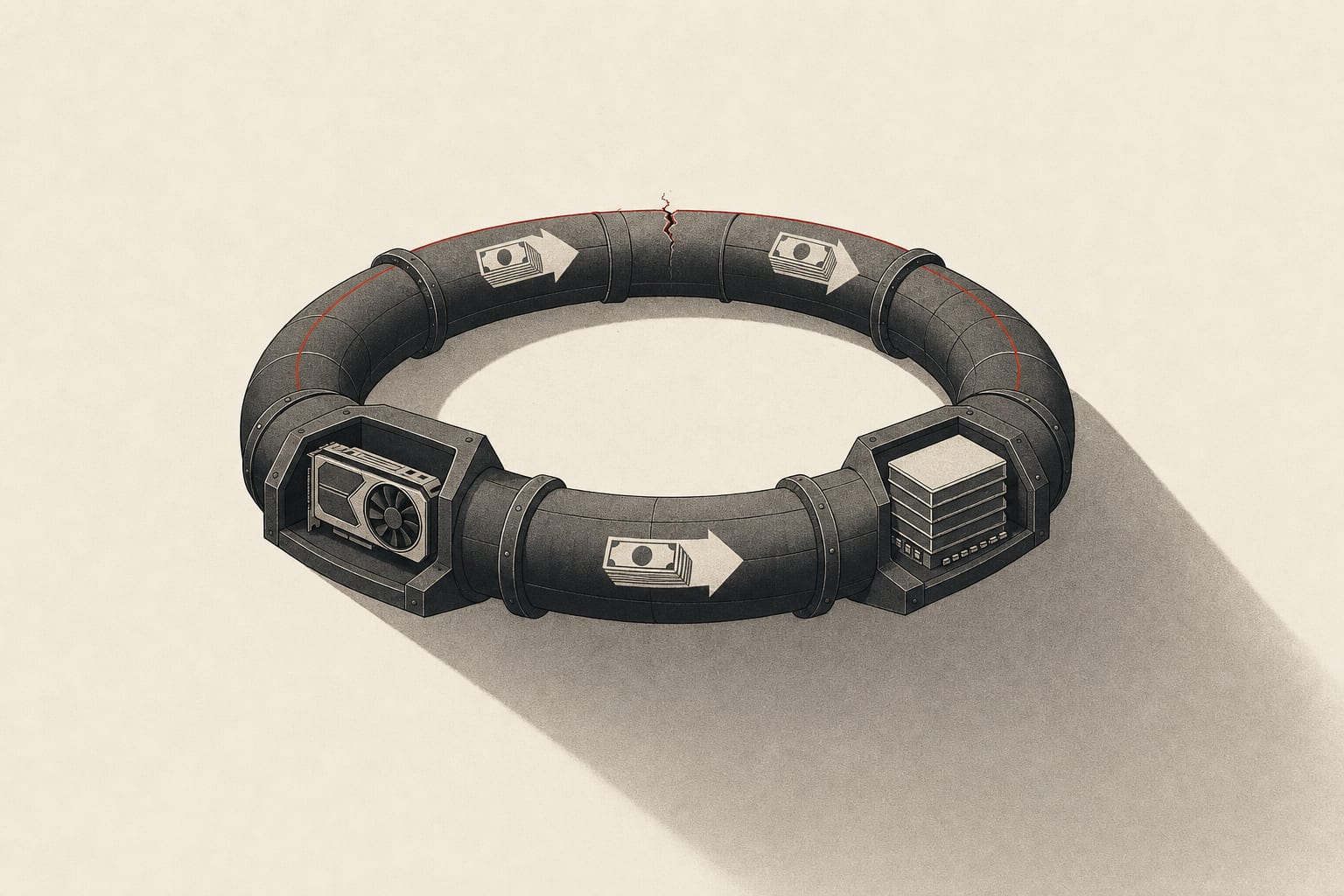
Start with the loop. Nvidia is now three things at once to the clouds that buy its chips: their supplier, their investor, and their backstop. It has put around two billion dollars into CoreWeave, two billion into Nebius, and guaranteed to buy CoreWeave's unsold capacity through 2032.
Those clouds then borrow against the chips to buy more chips. CoreWeave grew revenue a hundred and twelve percent last quarter, and burned nearly five billion dollars in cash, against almost twenty-five billion in debt, spending a quarter of every revenue dollar on interest.
The supplier is helping fund the customer. That is the structure two of the loudest founders in the industry just called out in each other.
For a builder, the signal is the demand behind your vendors. How much of it is real end use, and how much is financed in a circle that only holds while the chips hold their value.
The other end of the trade turned cautious the same day. The Register laid out the memory boom for what history says it is. SK Hynix and Micron roughly tripled revenue in a year, Samsung nearly doubled, and the deck is now stacked for a reversal, with no real supply relief expected before twenty twenty-eight.
It's the honest counterweight to Friday's record memory IPO. The same scarcity minting record quarters is the scarcity that always, eventually, over-corrects.
Away from the money, Terence Tao filed the most useful data point of the weekend. He used a coding agent to port two dozen of his own 1999-era Java applets to working JavaScript in hours, and called the risk acceptable precisely because they're throwaway visuals.
That is where agents pay off right now. Bounded, verifiable, unglamorous work.
To the tape. We hold Micron long, but today the bear case got its clearest airing, and that memory boom-bust warning is almost word for word our own falsifier, so conviction stays measured, not high.
We open a watch on CoreWeave as the canary for the whole financing loop, and we hold the Nvidia watch, where the question is no longer how much demand there is, but how much of it is vendor-financed.
The tape is the desk's scorecard, not advice.
Our call: within nine months, the vendor-financed cloud loop shows its first concrete strain. A major GPU neocloud restructures debt, cuts a build target, or draws on a backstop.
What proves us wrong is nine months, to April, with none of that on the record. Watch the cash flows, not the narrative.
Altman and Musk spent the weekend accusing each other of misleading public-market investors — and the closer you look at how the AI build-out is financed, the clearer it gets why. The chip maker funds the clouds that buy its chips, the memory that just IPO'd is one cycle from a glut, and the spending still needs $3 trillion it can't yet point to
The mood at the top of the industry turned this weekend, and it turned personal. Elon Musk said Sam Altman "takes scamming to a whole new level." Altman fired back that Musk is the one "selling public market investors on short-term space data centers." Clear away the venom and the same accusation is left standing on both sides: that the other is misleading the public markets. It is worth asking why, of all the insults available to two of the most powerful people in AI, that is the one they both reached for.
Because the money in this build-out increasingly moves in a circle, and a piece by Beth Kindig that spent the weekend making the rounds lays out the loop. Nvidia is at once the supplier, an investor, and the demand backstop for the clouds that buy its chips: roughly two billion dollars of equity into CoreWeave, two billion into Nebius, and a guarantee — initially valued around six billion — to purchase CoreWeave's unsold capacity through 2032. The neoclouds then borrow against those GPUs to buy more GPUs. CoreWeave booked about two billion in first-quarter revenue and burned nearly five billion in free cash flow, carries almost twenty-five billion in debt, and spends roughly a quarter of every revenue dollar on interest. The vendor is helping fund the customer that buys from the vendor.
The other end of the same trade turned cautious on the very same day. The Register laid out the memory boom for what history says it is: SK Hynix and Micron roughly tripled their revenue in a year, Samsung nearly doubled its own, and the deck is now stacked for a reversal, because new fabs take at least three years to build and the analysts see no real relief before 2028. This is the honest counterweight to Friday's record IPO. The demand that crowned SK Hynix is the demand that has to keep arriving on schedule, and memory is the business that has bankrupted its own believers on exactly this kind of high.
Underneath both sits a single number. Sequoia's David Cahn has been circulating the arithmetic all week: something like a trillion and a half dollars of AI infrastructure spending in 2026, which by his math needs on the order of three trillion dollars of revenue to justify. Set that against roughly twenty billion in annualized revenue at OpenAI late last year, plus generous estimates for everyone else, and the distance between the two is the entire argument. Apollo's Torsten Slok has taken it a step further, warning that if the hyperscalers miss their late-decade cash-flow targets, the shortfall is large enough to pull the broader market down with it.
None of this proves a bust. Circular financing has funded plenty of real build-outs, and the demand for inference is not imaginary. But it does explain the weekend's insult of choice. When the chip supplier helps fund its own customers, the memory that just went public at a record is one cycle away from a glut, and the spending needs three trillion dollars it cannot yet point to, the honest position is neither bull nor bear. It is that the loop has grown circular enough that the people standing inside it have started saying so about each other, out loud and in public.
Nvidia is supplier, investor, and backstop to the clouds that buy its chips
The clearest map of the loop is Beth Kindig's: Nvidia has put roughly two billion dollars of equity into CoreWeave and two billion into Nebius, and guaranteed — at an initial value near six billion — to buy CoreWeave's unsold capacity through 2032. The neoclouds borrow against their GPUs to buy more GPUs from Nvidia. The strain shows in the cash flows: CoreWeave's first-quarter revenue rose 112 percent to about two billion dollars, but it burned nearly five billion in free cash flow, carries almost twenty-five billion in debt, and spends better than a quarter of its revenue servicing it, with only about half of its contracted power live. Nebius grew revenue nearly 700 percent off a small base. Vendor financing is a normal tool; a loop this tight, funded by debt against depreciating chips, is the thing to watch.
The memory boom is "stacked for a reversal," which is the honest bear case on Friday's record IPO
The Register put the counterweight to SK Hynix's $26.5 billion listing on the board the same weekend: memory is a boom-and-bust business, and this is the wildest ride yet. SK Hynix and Micron roughly tripled revenue in a year and Samsung nearly doubled its own, but new fabs take at least three years to stand up, and analysts see no meaningful supply relief before 2028 — so either AI demand keeps climbing to meet the coming capacity, or the industry walks into "the bust cycle to end all bust cycles." It is the falsifier on the whole memory trade, named out loud: the same scarcity that is minting record quarters is the scarcity that always, eventually, over-corrects.
Terence Tao ports two dozen 1999-era Java applets to JavaScript with a coding agent, "within hours"
Away from the financing drama, one of the world's foremost mathematicians filed a quiet, useful data point. Terence Tao described using a modern coding agent to port about two dozen visualization applets he wrote in 1999, in Java 1.0, over to working JavaScript — a job he put at hours, not the weeks it would have taken by hand. He is careful about scope: he names no products and calls the downside risk acceptable specifically because these are secondary visuals, not load-bearing code. That is the honest shape of where agents actually pay off right now — bounded, verifiable, unglamorous migration work — and it is worth more than any benchmark for judging what to hand one this week.
AI lifts individual research careers but flattens what science explores
A study of 41.3 million papers, written up by IEEE Spectrum, finds a sharp double edge to AI in science: researchers who adopt AI tools produce roughly three times the papers and earn about five times the citations, and reach leadership a year or two earlier. The catch is at the level of the field, not the individual — the same tools nudge everyone toward the same well-trodden topics, homogenizing what gets studied even as it accelerates who studies it. It is the scientific mirror of the week's larger theme: the tool makes the individual player far more productive while quietly narrowing the collective bet. Faster careers, flatter frontier.
The week that made capable models cheap ended by asking who is actually paying for all of it. The answer, increasingly, is the same small circle: the chip maker funds the clouds that buy its chips, those clouds borrow against depreciating GPUs to buy more, the memory that just IPO'd at a record is one cycle from a glut, and the whole structure needs three trillion dollars in revenue it cannot yet point to. That is why Altman and Musk spent the weekend accusing each other of lying to investors — it is the fear each recognizes in the other. None of it proves a bust; the demand for inference is real. But the honest read on the week is that the financing has grown circular enough that the people inside it have started saying so, in public.
Within the next nine months, the vendor-financed GPU-cloud loop shows its first concrete strain: at least one major GPU neocloud — CoreWeave, Nebius, Crusoe, Lambda, or a close peer — publicly restructures or refinances GPU-backed debt, cuts a stated capacity or build target, or discloses drawing on a vendor backstop. The circular financing stops being an analyst's critique and becomes a reported event.
The loop only holds while GPUs hold their value and demand arrives on schedule to service the debt. CoreWeave alone is burning nearly five billion dollars a year against almost twenty-five billion in debt with half its power still unbuilt, on hardware that depreciates and against rates that have crept up. A structure that leveraged does not need a demand collapse to crack — a single slipped quarter, a delayed build, or one drawn backstop is enough to surface. The falsifiable edge is that the first visible strain shows up on the record inside three quarters, not that the whole thing fails.
If, by April 12, 2027, no major GPU neocloud has restructured or refinanced GPU-backed debt, cut a stated capacity or build target, or disclosed drawing on a vendor backstop, and the loop keeps funding itself without a reported strain, the call is wrong.
We hold the Micron long, carried since July 5 — but today is the day the bear case got its clearest airing, and we are not going to pretend otherwise. The Register's boom-bust piece is, almost line for line, our own falsifier: memory is cyclical, this is the wildest up-cycle yet, and no supply relief is expected before 2028. We stay long because the demand is real and the supply is genuinely tight into 2027, and the cleanest US-listed way to own that is still Micron. We keep conviction at medium precisely because the reversal risk is now named and dated, not hypothetical.
HBM and leading-edge DRAM are sold on AI capacity and the makers guide supply tight into 2028, which supports pricing through at least next year. The offset, sharpened today, is that memory always over-corrects: three-year fab lead times mean whatever capacity is coming arrives all at once, and if AI demand so much as pauses, the glut follows.
New to the book as a watch — the canary for the whole circular-financing thesis, and we are watching it, not shorting it. CoreWeave grew first-quarter revenue 112 percent to about two billion dollars, and in the same period burned nearly five billion in free cash flow, sits on almost twenty-five billion in debt, spends better than a quarter of revenue on interest, and has only about half its contracted power live. It is the cleanest public read on whether the vendor-financed GPU loop holds. We watch rather than take a side because the same numbers read as either a hyper-growth build-out or a leveraged bet on GPUs holding their value — and which one it is resolves in the cash flows, not the narrative.
If AI demand keeps arriving on schedule, CoreWeave's leverage converts into a dominant capacity position. The offset is that the structure is debt against depreciating chips with rates creeping up and half its power unbuilt, which does not need a demand collapse to strain — only a slipped quarter.
We hold the Nvidia watch, and today's story sharpens what we are watching. The circular-financing map raises the one question the bull case has to answer: how much of Nvidia's demand is genuine end-use and how much is vendor-financed neoclouds buying with money Nvidia helped provide? We do not move to a short — the underlying inference demand is real and Nvidia still sells the best part — but the quality of the demand, not just its quantity, is now the thing to track.
Agentic and multimodal workloads keep true accelerator demand rising. The offset, clearer today, is that a meaningful slice of near-term demand runs through leveraged neoclouds Nvidia is helping fund, which flatters the demand signal until the financing is tested.